

Archive position — measured, not model output
0 likes on Devpost
2,263 of the 7,850 archived projects have more likes, and 5,587 share exactly 0 — so this project's #2,604 place in the like-ranked listing is a tie-break inside that group, not a ranking.
Projects (log scale)
Likes on Devpost. ▲ marks this project's group.
Show the figures
| Likes | Projects | Share of archive |
|---|---|---|
| 0 | 5,587 | 71.2% |
| 1 | 1,758 | 22.4% |
| 2 | 284 | 3.6% |
| 3–4 | 132 | 1.7% |
| 5–9 | 75 | 1.0% |
| 10+ | 14 | 0.2% |
 User Stories BotA demo video on every pull request
Get a demo video on every new feature
GitHub App that watches your pull requests and records a narrated, captioned demo.
Save time on demo prep and make informed decisions faster with a video walkthrough of every new feature.
Executive Summary
What the company appears to be
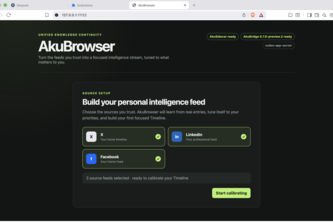
AkuBrowser is a self-reported browser plugin (currently Chrome extension) that uses AI (specifically Codex) to filter and prioritize social media content from X, Facebook, and LinkedIn. It aims to give users control over their attention by allowing them to define preferences, surface relevant content, and reduce the burden of passive consumption.
What changed
The project evolved significantly during OpenAI Build Week, where it was extended with Codex integration across multiple components (AkuSidecar, AkuBridge, AkuSupervisor). It transitioned from a Node.js-based prototype to a Go-based local application, and added features like AI detection, cross-source semantic reasoning, preference-aware filtering, and structured session capture.
Single most important open question
Is there any evidence of user adoption or feedback beyond the author’s own claims? The description states no revenue, customers, or traction data are available — only self-reported development progress and conceptual intent.
What The Product Actually Is
The description states that AkuBrowser is:
- A Chrome extension (plugin) currently
- A local application built in Go (AkuSidecar)
- An AI-powered content filter using Codex for reasoning, semantic resolution, and AI detection
- A system that captures bounded sets of posts from X, Facebook, and LinkedIn
- Designed to collapse repeated content, preserve sources, and provide a finite timeline
It is not evidenced whether it has been released beyond the prototype stage or used by anyone outside the author.
Positioning & Claim Evolution
The author states:
- AkuBrowser aims to "bring back the power of the algorithm to the hands of the user"
- It seeks to give control back to the user over their attention and information consumption
- It is positioned as a browser plugin, not a replacement for social platforms
- The product is described as working with existing feeds, rather than replacing them
The positioning evolved from an idea to a working prototype during OpenAI Build Week. However, there is no evidence of prior market traction or user feedback beyond the author’s own claims.
Target Customer & ICP
The description states:
- The target audience is users who are overwhelmed by social media feeds
- Users who want to regain control over their attention and information consumption
- People who are interested in AI-driven filtering and personalized timelines
It does not state whether the product targets specific demographics, industries, or use cases beyond general social media users.
Business Model & Pricing Evidence
Not evidenced. The description makes no claims about pricing, monetization, or business model. It is unclear if AkuBrowser intends to be free, paid, ad-supported, or otherwise monetized.
Technical & Delivery Signals
The author states:
- Built with Chrome, Codex, Golang, HTML5, JavaScript, Node.js, Plugin, Rust, Web
- Components include: AkuBridge (Chrome extension), AkuSidecar (Go app), AkuBrowser (main repo), AkuSupervisor (Rust tool)
- Uses Codex for Acquisition Planning, Candidate Evaluation, Semantic Event Resolution, and AI Detection
- Supports bounded capture, source fidelity, deterministic selection, and preference-based filtering
- Implements cross-source semantic reasoning to collapse repeated content
- Includes AI Fast/Deep Detection with user-configurable modes
There is no evidence of production deployment or scalability beyond the prototype stage.
Traction & Maturity Signals
Not evidenced. The description states:
- AkuBrowser was built during OpenAI Build Week
- It includes a working prototype
- It supports Windows x64 and macOS portable bundles
- It has no revenue, customer, or traction data
No evidence of user adoption, usage metrics, or market validation.
Competitive Context
Not evidenced. The description does not mention any competitors or how AkuBrowser compares to existing tools for content filtering or attention management on social media.
Open Questions & Risks
- Self-reported only: All information is unverified and self-reported
- No traction or revenue: No evidence of users, customers, or monetization
- Prototype stage: Product is described as a working prototype, not a commercial offering
- Limited scope: Currently supports only X, Facebook, and LinkedIn
- AI dependency: Heavy reliance on Codex for reasoning raises questions about scalability, cost, and control
- Technical complexity: Managing source fidelity, AI token usage, and multi-platform packaging is complex — no evidence of successful resolution at scale
Questions the description leaves open
- What is the current user feedback or testing data (if any)?
- How does AkuBrowser plan to expand beyond X, Facebook, and LinkedIn?
- Is there a long-term roadmap for monetization or business model?
- How does the product handle privacy and security concerns with local AI processing?
- What are the technical limitations of using Codex at scale, especially in terms of token usage and cost?
- Are there any plans to release on other platforms (e.g., Linux)?
- How is the preference learning mechanism implemented beyond explicit feedback?
Overall Assessment
Not evidenced. The description does not provide any data on:
- Revenue or ARR
- Customer base or adoption
- Funding rounds or valuation
- Team size or structure beyond one person
The project is described as a self-developed prototype with no commercial traction, and no evidence of market validation or scalability.
This is a conceptual product in early development, not a commercial entity. Any investment or partnership would be based on the potential of the idea rather than demonstrated performance or market readiness.
User Stories BotA demo video on every pull request
Get a demo video on every new feature
GitHub App that watches your pull requests and records a narrated, captioned demo.
Save time on demo prep and make informed decisions faster with a video walkthrough of every new feature.
Source
Submitted to the OpenAI 2026 hackathon on Devpost. Project home on Devpost. Back to the full gallery on Devpost.
This competitive analysis was produced by top-founders.com (opens in a new tab)
Generated by a language model from this project's public Devpost page — its tagline, the author's own write-up and any built-with tags listed there — as captured in August 2026. Short quotations are the author's words. It is an opinion on the idea as a business, not on the people behind it, and it reflects the description as published then. If the project has moved on, request a correction below. The analysis is not independent research and contains no verified traction, revenue or customer data.
An independent guide by KFG International LLC — not affiliated with, endorsed by, or connected to Devpost or OpenAI.