

Archive position — measured, not model output
0 likes on Devpost
2,263 of the 7,850 archived projects have more likes, and 5,587 share exactly 0 — so this project's #2,606 place in the like-ranked listing is a tie-break inside that group, not a ranking.
Projects (log scale)
Likes on Devpost. ▲ marks this project's group.
Show the figures
| Likes | Projects | Share of archive |
|---|---|---|
| 0 | 5,587 | 71.2% |
| 1 | 1,758 | 22.4% |
| 2 | 284 | 3.6% |
| 3–4 | 132 | 1.7% |
| 5–9 | 75 | 1.0% |
| 10+ | 14 | 0.2% |
 User Stories BotA demo video on every pull request
Get a demo video on every new feature
GitHub App that watches your pull requests and records a narrated, captioned demo.
Save time on demo prep and make informed decisions faster with a video walkthrough of every new feature.
Executive Summary
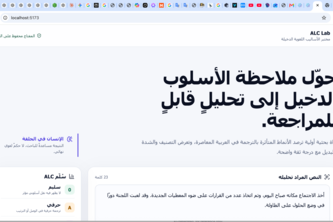
ALC Lab is an AI-assisted research tool for analyzing contemporary Arabic text at the sentence level to detect translation-influenced patterns. The author states it classifies sentences into five categories (0–D) based on linguistic influence from other languages, and provides explanations, alternatives, and export options. It uses OpenAI's GPT-5.6 with structured JSON output and includes a rule-based demo mode.
The project is self-reported as a prototype built for the OpenAI 2026 hackathon. No revenue, customers, or traction data are provided. The tool is described as designed for researchers, editors, translators, and teachers who need to distinguish between standard Arabic and translation-influenced expressions.
The single most important open question
What is the actual utility of this classification system in real-world linguistic research or editorial workflows? The description does not indicate whether any such users exist or have engaged with the tool.
What The Product Actually Is
The description states that ALC Lab:
- Analyzes contemporary Arabic text at the sentence level
- Classifies sentences into five categories (0–D) based on translation influence:
- 0 — Standard: no influential transferred pattern detected
- A — Literal: literal transfer in word order or connection
- B — Lexical: translation-influenced collocation or word choice
- C — Structural: transferred syntactic construction
- D — Formulaic: translated institutional or fixed template
- Presents for each suspected pattern:
- The sentence and expression
- Category and severity
- Confidence level
- Linguistic explanation
- Possible source-language pattern
- Clearer Arabic alternative
- Methodological limitations
- Can export results as JSON or CSV
- Uses React, Vite, Node.js, TypeScript for frontend/backend
- Integrates OpenAI’s GPT-5.6 API with JSON schema validation
- Includes a rule-based demo mode that does not require an API key
This is a sentence-level linguistic analysis tool aimed at identifying and explaining translation-influenced expressions in modern Arabic.
Positioning & Claim Evolution
The author states:
- ALC Lab was created to turn "this difficult judgment into a transparent, sentence-by-sentence research workflow."
- It aims to help researchers, editors, translators, and teachers distinguish between grammatically correct but translation-influenced text and standard Arabic.
- The tool avoids presenting final linguistic judgments, instead exposing evidence, confidence, limitations, and alternatives.
The positioning is that of a research assistant for Arabic linguists, not a general-purpose language tool. It is described as a transparent, expert-review-oriented system rather than an automated correction engine.
No claims are made about commercial viability, scalability, or mass adoption. The project is framed as a prototype submitted to a hackathon.
Target Customer & ICP
The description states that ALC Lab is intended for:
- Arabic researchers
- Editors
- Translators
- Teachers
These are the intended users based on the author’s own account. No evidence of actual customer engagement or user feedback is provided.
There is no indication of a defined Ideal Customer Profile (ICP) beyond these roles. The tool is described as being built for expert review, not mass consumption.
Business Model & Pricing Evidence
Not evidenced.
The description does not state anything about pricing, monetization, or business model. It is unclear whether the tool will be offered free, paid, or as part of a larger service.
Technical & Delivery Signals
The author states:
- Built with React, Vite, Node.js, TypeScript
- Uses OpenAI’s GPT-5.6 API with JSON schema validation
- Default model is GPT-5.6 Terra; Luna and Sol are available for different needs
- API key remains on the server and is not exposed to the browser
- Includes a rule-based demo mode that does not require an API key
The tool is described as having:
- A sentence-level analysis workflow
- Structured output (JSON/CSV)
- Transparent interface with explanations and alternatives
No evidence of scalability, performance metrics, or deployment infrastructure is provided.
Traction & Maturity Signals
Not evidenced.
There is no mention of:
- Revenue
- Customers
- Usage statistics
- Product adoption
- Market feedback
- Iteration history beyond the hackathon prototype
The project is described as a hackathon submission, and no traction or maturity indicators are present in the description.
Competitive Context
Not evidenced.
No information is provided about:
- Competing tools
- Market landscape
- Prior art
- Competitive advantages or disadvantages
The author does not reference any existing solutions in this space.
Open Questions & Risks
Inferences based on the self-reported description:
- Unclear commercial viability: The tool is described as a hackathon prototype with no evidence of market traction, revenue, or customer engagement.
- Limited scope and audience: It targets a niche group (Arabic linguists, editors, teachers) with unclear demand or adoption.
- Dependency on OpenAI API: Reliance on GPT-5.6 may create cost, availability, or scalability risks.
- Lack of validation data: No mention of benchmark datasets, expert annotation workflows, or accuracy metrics.
- No monetization strategy: The tool is not described as part of a commercial offering.
Questions the description leaves open
- What specific linguistic research or editorial workflows does ALC Lab aim to support?
- Have you tested the tool with actual users (researchers, editors, teachers)?
- How do you plan to validate the accuracy and usefulness of the classification system?
- Is there a roadmap for expanding beyond the current prototype?
- What is the intended pricing model or monetization strategy?
- Are there any existing partnerships or collaborations in Arabic linguistics or education?
Overall Assessment
Not evidenced.
There is no indication of:
- Funding status
- Investor interest
- Partnership opportunities
- Commercial potential beyond the prototype
The project is described as a hackathon submission with no evidence of traction, revenue, or market validation. The author’s own account does not suggest any commercial intent or strategic positioning beyond the tool’s utility for personal or academic use.
User Stories BotA demo video on every pull request
Get a demo video on every new feature
GitHub App that watches your pull requests and records a narrated, captioned demo.
Save time on demo prep and make informed decisions faster with a video walkthrough of every new feature.
Source
Submitted to the OpenAI 2026 hackathon on Devpost. Project home on Devpost. Back to the full gallery on Devpost.
This competitive analysis was produced by top-founders.com (opens in a new tab)
Generated by a language model from this project's public Devpost page — its tagline, the author's own write-up and any built-with tags listed there — as captured in August 2026. Short quotations are the author's words. It is an opinion on the idea as a business, not on the people behind it, and it reflects the description as published then. If the project has moved on, request a correction below. The analysis is not independent research and contains no verified traction, revenue or customer data.
An independent guide by KFG International LLC — not affiliated with, endorsed by, or connected to Devpost or OpenAI.