

Archive position — measured, not model output
0 likes on Devpost
2,263 of the 7,850 archived projects have more likes, and 5,587 share exactly 0 — so this project's #2,579 place in the like-ranked listing is a tie-break inside that group, not a ranking.
Projects (log scale)
Likes on Devpost. ▲ marks this project's group.
Show the figures
| Likes | Projects | Share of archive |
|---|---|---|
| 0 | 5,587 | 71.2% |
| 1 | 1,758 | 22.4% |
| 2 | 284 | 3.6% |
| 3–4 | 132 | 1.7% |
| 5–9 | 75 | 1.0% |
| 10+ | 14 | 0.2% |
 User Stories BotA demo video on every pull request
Get a demo video on every new feature
GitHub App that watches your pull requests and records a narrated, captioned demo.
Save time on demo prep and make informed decisions faster with a video walkthrough of every new feature.
Executive Summary
What the company appears to be
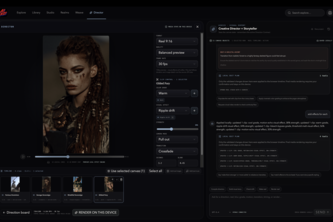
AIKIZI Director is a browser-based creative direction and video editing tool that allows users to search through a personal library of 15,000+ decoded visual references, compile them into a "Direction Contract", animate the story using dropdowns or natural language, and render cinematic reels entirely on their device using WebAssembly and FFmpeg. The platform claims to eliminate cloud usage, external credits, and third-party rendering.
What changed
The author states they built this tool after being frustrated with the cost and complexity of generating AI videos using external models. They describe a shift from relying on outsourced generation to leveraging local hardware for rendering, with an emphasis on privacy, control, and zero-cost per clip.
Single most important open question
Is there any evidence of actual user adoption or commercial traction beyond the single developer's personal use case?
What The Product Actually Is
The description states that AIKIZI Director is a creative-direction and pre-production studio available at aikizi.com/director. It enables users to:
- Search through more than 15,000 decoded visual references (emotion, material, framing, palette, lighting).
- Place these references on a canvas.
- Choose specific elements from each reference to build a Direction Contract.
- Expand the contract into a multi-beat visual story with continuity checking.
- Animate using dropdown controls or natural-language chat.
- Add effects like color grades, camera movements, transitions, captions, and structural visual effects (e.g., pixel sorting, glitch bursts).
- Render H.264 MP4s entirely on the user's device via WebAssembly and FFmpeg.
The tool is built with React, TypeScript, Vite, Cloudflare, and uses GPT-5.6 for development assistance. It compiles FFmpeg to WebAssembly for rendering without uploading media.
Inference This appears to be a personal project focused on empowering creators to produce video content using their own hardware, with no external cloud dependencies or billing systems.
Positioning & Claim Evolution
The author positions AIKIZI Director as a tool that treats the browser as a render engine and the user’s own image library as the creative brain. It emphasizes:
- Zero credits per clip.
- No data leaves the device.
- No reliance on Adobe or cloud services.
- Use of local hardware for rendering.
It also claims to support “familiar motion” rather than synthesized motion, aiming to reduce costs and increase control over video creation.
Inference The positioning reflects a niche focus on privacy-conscious creators who want to avoid external services and leverage their own computing power. The evolution seems to be from a personal solution to a platform that could potentially allow others to contribute effects or collaborate.
Target Customer & ICP
The description does not name specific customer segments or personas. However, it implies:
- Creators who generate content regularly (e.g., reels).
- Users with powerful local hardware.
- Individuals who value privacy and control over their media.
- Developers or advanced users interested in building effects within the browser.
Inference The target audience likely includes independent creators, small studios, or tech-savvy individuals who are comfortable working in a browser-based environment and prioritize data sovereignty.
Business Model & Pricing Evidence
There is no evidence of pricing, subscriptions, or monetization strategies. The author states:
- "Zero credits per clip."
- "Nothing gets billed."
- "A 5 or 10 second clip costs you exactly zero credits."
Inference The business model appears to be non-commercial at this stage, possibly a personal project or prototype with no revenue streams yet.
Technical & Delivery Signals
The platform is built using:
- Cloudflare Workers
- Codex
- FFmpeg compiled to WebAssembly
- GPT-5.6 (for development)
- React, TypeScript, Vite
- HTML5, x264
It supports real-time rendering of structural effects inside the browser and uses typed arrays for pixel-level manipulation.
Inference The technical stack suggests a strong focus on performance and local execution. The use of WebAssembly indicates an attempt to bring high-performance video processing into the browser.
Traction & Maturity Signals
There is no evidence of users, customers, or adoption beyond the author's personal experience. The project was submitted to a hackathon, and there are no mentions of:
- Revenue
- Customers
- User base
- Market traction
- Product usage metrics
Inference This appears to be an early-stage prototype or proof-of-concept with no demonstrated market traction.
Competitive Context
The description does not mention competitors. However, based on the stated functionality — visual reference search, creative direction, local rendering, and browser-based editing — it may compete with:
- Adobe Premiere Rush
- CapCut
- Runway ML
- Local video editors that support WebAssembly or browser-based workflows
Inference The competitive landscape is unclear due to lack of data. The unique selling point appears to be local rendering and privacy, which could differentiate it from cloud-based tools.
Open Questions & Risks
- No commercial traction: No evidence of users, customers, or revenue.
- Single developer team: Only one member listed (Sai Sharan Ramakrishna).
- Unverified claims: All features and performance are self-reported without external validation.
- Limited scalability: The tool is designed for local hardware; may not scale well for larger teams or enterprise use cases.
- No monetization strategy: No indication of how the product will be monetized in the future.
Inference The project lacks commercial viability indicators and appears to be a personal endeavor rather than a scalable business.
Questions the description leaves open
- What is your plan for monetizing this tool?
- Have you tested it with other users beyond yourself?
- How do you intend to grow the visual reference corpus beyond 15,000 images?
- Are there any plans for collaboration or API access for third-party developers?
- What are the limitations of the current WebAssembly implementation in terms of performance and compatibility?
Overall Assessment
Not evidenced.
There is no evidence of commercial traction, revenue, customer base, or clear path to monetization. The project appears to be a personal prototype built during a hackathon with no demonstrated market readiness or business model.
Confidence level Low — based solely on self-reported information and lack of external validation.
User Stories BotA demo video on every pull request
Get a demo video on every new feature
GitHub App that watches your pull requests and records a narrated, captioned demo.
Save time on demo prep and make informed decisions faster with a video walkthrough of every new feature.
Source
Submitted to the OpenAI 2026 hackathon on Devpost. Project home on Devpost. Back to the full gallery on Devpost.
This competitive analysis was produced by top-founders.com (opens in a new tab)
Generated by a language model from this project's public Devpost page — its tagline, the author's own write-up and any built-with tags listed there — as captured in August 2026. Short quotations are the author's words. It is an opinion on the idea as a business, not on the people behind it, and it reflects the description as published then. If the project has moved on, request a correction below. The analysis is not independent research and contains no verified traction, revenue or customer data.
An independent guide by KFG International LLC — not affiliated with, endorsed by, or connected to Devpost or OpenAI.