

Archive position — measured, not model output
1 like on Devpost
505 of the 7,850 archived projects have more likes, and 1,758 share exactly 1 — so this project's #555 place in the like-ranked listing is a tie-break inside that group, not a ranking.
Projects (log scale)
Likes on Devpost. ▲ marks this project's group.
Show the figures
| Likes | Projects | Share of archive |
|---|---|---|
| 0 | 5,587 | 71.2% |
| 1 | 1,758 | 22.4% |
| 2 | 284 | 3.6% |
| 3–4 | 132 | 1.7% |
| 5–9 | 75 | 1.0% |
| 10+ | 14 | 0.2% |
 User Stories BotA demo video on every pull request
Get a demo video on every new feature
GitHub App that watches your pull requests and records a narrated, captioned demo.
Save time on demo prep and make informed decisions faster with a video walkthrough of every new feature.
Executive Summary
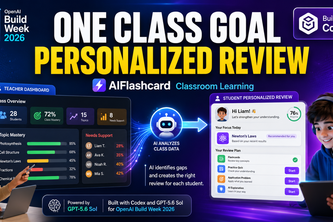
The company appears to be a single-person project (team size: 1) building an educational tool for classroom learning using WeChat Mini Programs and AI technologies. The author states that the product evolved from a personal flashcard app into a system enabling teachers to assign shared class goals while preserving individual student privacy and progress tracking.
Key changes include
- Expansion of existing AIFlashCard functionality to support classroom workflows
- Implementation of independent student review groups within shared class projects
- Addition of teacher insights, targeted interventions, and versioned learning content
The single most important open question is
What is the actual market demand for this specific solution, and how does it differ from existing classroom management tools?
This analysis is based entirely on self-reported evidence. No revenue, customer data, traction metrics or third-party validation are available.
What The Product Actually Is
The description states that AIFlashCard Classroom Learning is a WeChat Mini Program built with Tencent Cloud services, designed to enable teachers to organize learners around a common learning objective while preserving each student's independent progress and review history.
Key functional elements include:
- Class creation and management
- Shared learning projects published to students
- Separate personal review groups for each student
- Classroom-level insights and targeted interventions
- Versioned content snapshots that do not change after publication
The system is described as using Codex powered by GPT-5.6 Sol for development assistance, with a modular architecture consisting of:
miniprogram/pkg_classroomsubpackage- Three domain services:
ClassroomActionCenter,ClassroomQueryCenter,ClassroomReadModel - A consolidated cloud-function boundary:
cloudfunctions/classroomGateway
The product is said to integrate with the existing AIFlashCard Review workflow rather than duplicating it.
Not evidenced Specific features beyond what's described, actual user adoption, or technical performance data.
Positioning & Claim Evolution
The author claims that AIFlashCard began as a personal study tool focused on content creation but evolved during OpenAI Build Week to address a deeper classroom learning need: "How can one shared classroom goal produce private, personalized learning paths for every student?"
The resulting positioning emphasizes:
- Private student progress within shared class objectives
- Targeted teacher support
- Separation of personal and class learning states
This evolution suggests a shift from a generic flashcard tool to a more structured classroom learning platform.
Not evidenced Market positioning, competitive differentiation, or prior user feedback on the original product.
Target Customer & ICP
The description indicates that the primary users are:
- Teachers who want to assign shared class goals while maintaining individual student privacy
- Students in a classroom setting using WeChat Mini Programs in mainland China
The system supports:
- Class enrollment via invitation or code
- Teacher-defined learning projects
- Personalized review workflows for each student
It is designed specifically for use within the WeChat ecosystem, targeting users in mainland China.
Not evidenced Specific customer segments beyond teachers and students, user personas, or market size estimates.
Business Model & Pricing Evidence
The description does not provide any information about:
- Revenue streams
- Pricing models
- Monetization strategy
- Customer acquisition costs
- Unit economics
It only describes the functionality of the product and its technical implementation.
Not evidenced Any commercial details or business model elements.
Technical & Delivery Signals
Technical aspects described include:
- Implementation as a WeChat Mini Program
- Use of Tencent Cloud services
- Modular architecture with independent
pkg_classroomsubpackage - Server-side authorization and idempotent writes
- Immutable project versions using content digests
- Integration with existing Review workflow
- Use of Codex powered by GPT-5.6 Sol for development
The author notes challenges such as:
- Avoiding duplication of learning workflows
- Protecting personal learning context from class membership
- Handling network retries safely through idempotent operations
- Ensuring privacy via server-side authorization
Not evidenced Performance benchmarks, scalability assumptions, or deployment infrastructure details beyond the described architecture.
Traction & Maturity Signals
The description states that:
- The product started as a personal flashcard app
- It was extended during OpenAI Build Week into a full classroom domain
- The author completed multiple features including versioned projects, separate assignments, and targeted interventions
- Tests and audits were performed for various aspects of the system
However, there is no evidence of:
- Actual users or customer base
- Revenue generation
- Product usage metrics
- Customer feedback or retention data
- Market traction or adoption rates
Not evidenced Any form of user engagement, revenue, or market validation.
Competitive Context
The description does not mention any competitors or existing solutions in the educational technology space. It focuses solely on the evolution of a single-person project from a personal tool to a classroom-focused system.
There is no indication of:
- Market analysis
- Competitor offerings
- Differentiation strategy
- Industry trends
Not evidenced Competitive landscape, market positioning, or competitive advantages.
Open Questions & Risks
Potential risks and open questions include:
- Single-person development team: Limited capacity for scaling or feature expansion
- Niche market focus: Reliance on WeChat Mini Programs in mainland China may limit global reach
- Unproven commercial viability: No evidence of revenue, customers, or traction
- AI dependency: Heavy reliance on Codex and GPT-5.6 Sol raises questions about long-term sustainability and control over development process
- Technical complexity without validation: Complex architecture built without external testing or user feedback
Not evidenced Risk mitigation strategies, scalability plans, or competitive responses.
Questions the description leaves open
- What is the actual demand for this specific classroom learning solution?
- How does this product differ from existing tools like Google Classroom, Canvas, or other LMS platforms?
- Have you conducted any user research with teachers or students?
- Is there a plan to expand beyond WeChat Mini Programs and mainland China?
- What are the key assumptions about teacher behavior and classroom dynamics that underpin this design?
- How do you intend to monetize this product, and what is your go-to-market strategy?
- What are the technical limitations or scalability concerns of the current architecture?
- How will you ensure data privacy and compliance in a classroom environment?
Overall Assessment
Not evidenced: No information available regarding:
- Financial performance
- Customer base
- Market opportunity size
- Competitive positioning
- Team experience or track record
- Product-market fit validation
This is a self-reported, unverified project submitted as part of an OpenAI hackathon. The author describes significant technical development and architectural sophistication, but there is no evidence of commercial traction, revenue, or customer validation.
The product appears to be a technical prototype or proof-of-concept, not yet validated in the marketplace.
Confidence level: Low — based on limited self-reported evidence with no external corroboration.
User Stories BotA demo video on every pull request
Get a demo video on every new feature
GitHub App that watches your pull requests and records a narrated, captioned demo.
Save time on demo prep and make informed decisions faster with a video walkthrough of every new feature.
Source
Submitted to the OpenAI 2026 hackathon on Devpost. Project home on Devpost. Back to the full gallery on Devpost.
This competitive analysis was produced by top-founders.com (opens in a new tab)
Generated by a language model from this project's public Devpost page — its tagline, the author's own write-up and any built-with tags listed there — as captured in August 2026. Short quotations are the author's words. It is an opinion on the idea as a business, not on the people behind it, and it reflects the description as published then. If the project has moved on, request a correction below. The analysis is not independent research and contains no verified traction, revenue or customer data.
An independent guide by KFG International LLC — not affiliated with, endorsed by, or connected to Devpost or OpenAI.