

Archive position — measured, not model output
1 like on Devpost
505 of the 7,850 archived projects have more likes, and 1,758 share exactly 1 — so this project's #572 place in the like-ranked listing is a tie-break inside that group, not a ranking.
Projects (log scale)
Likes on Devpost. ▲ marks this project's group.
Show the figures
| Likes | Projects | Share of archive |
|---|---|---|
| 0 | 5,587 | 71.2% |
| 1 | 1,758 | 22.4% |
| 2 | 284 | 3.6% |
| 3–4 | 132 | 1.7% |
| 5–9 | 75 | 1.0% |
| 10+ | 14 | 0.2% |
 User Stories BotA demo video on every pull request
Get a demo video on every new feature
GitHub App that watches your pull requests and records a narrated, captioned demo.
Save time on demo prep and make informed decisions faster with a video walkthrough of every new feature.
Executive Summary
Company
AIDYOR
Self-reported mission
To democratize crypto security by putting institutional-grade, AI-enhanced risk analysis into the hands of everyday traders with zero friction.
Product
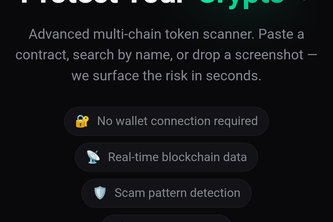
A multi-chain token scanner that uses OCR, smart contract bug scanning, and crypto news feeds to assess token risks.
Key claim
AIDYOR is a tool for retail traders to perform on-chain security checks without needing wallet connections or technical expertise.
What changed
The project was built as a hackathon submission (Devpost entry) with no evidence of prior traction, revenue, or customer adoption.
Single most important open question
Is there any evidence that the product works as described, or that users would pay for it?
What The Product Actually Is
The description states that AIDYOR is a multi-chain token scanner designed to assess risks associated with cryptocurrency tokens. It includes:
- An OCR scanner to extract contract addresses from screenshots.
- A smart contract bug scanner, using static analysis and AI models (e.g., Gemini).
- Integration with security APIs like GoPlus, RugCheck, and BSCTrace.
- A Telegram bot for scanning tokens directly within chat environments.
- A frontend dashboard built with React and TypeScript.
It is described as a zero-friction tool, allowing users to scan tokens without connecting a wallet.
Inference The product appears to be a proof-of-concept or prototype, not a production-ready service. It is built using edge functions (Deno, Supabase) and AI models for risk scoring.
Positioning & Claim Evolution
The author states that AIDYOR was inspired by the $4.6 billion annual loss in the crypto ecosystem due to honeypots, rug pulls, and hidden contract taxes. The product is positioned as a way to democratize crypto security, making institutional-grade tools accessible to retail traders.
It claims to offer:
- AI-enhanced risk analysis
- Zero friction for users
- Real-time scam alerts
- On-chain liquidity and smart contract security indicators
The positioning evolves from a hackathon project into a conceptual tool for retail traders, but there is no evidence of market validation or product-market fit.
Inference The positioning is aspirational, not validated. It reflects the author’s intent rather than demonstrated traction or adoption.
Target Customer & ICP
The description states that AIDYOR targets retail traders who are often left exposed due to lack of technical expertise and access to security tools.
It also mentions that institutional investors have access to dedicated teams, but retail users do not.
There is no further segmentation or definition of the ideal customer profile beyond "retail traders."
Inference The ICP is not clearly defined. It is implied to be a broad category of crypto users who are not technically sophisticated and lack access to security tools.
Business Model & Pricing Evidence
The description does not mention any business model, pricing, or revenue streams.
It states that the product is deployed via a Telegram bot with native Telegram Payments infrastructure, but no details are given about monetization, subscription models, or paid features.
Inference No evidence of a business model or pricing strategy exists in the description. The project appears to be a prototype without commercial intent.
Technical & Delivery Signals
The product is built using:
- Frontend: React 18+, TypeScript, Vite
- Edge Architecture: Supabase, Deno Runtime
- AI Engine: Gemini models for parsing JSON and translating technical data into human-readable risk explanations
- Security APIs: GoPlus, RugCheck, BSCTrace
- OCR Functionality: For extracting contract addresses from screenshots
- Telegram Bot: With native Telegram Payments
It is described as a scalable, zero-friction architecture.
Inference The technical stack suggests a modern, scalable approach. However, the project was built in a hackathon context and lacks evidence of production deployment or performance data.
Traction & Maturity Signals
The description states that this is a hackathon submission (Devpost entry for OpenAI 2026). There is no mention of:
- Revenue
- Customers
- User adoption
- Product usage metrics
- Post-hackathon development or iteration
The team size is listed as 1, and the project was built in a tight hackathon timeline.
Inference No traction or maturity signals are evident. The product is at a very early stage, likely a prototype or proof-of-concept.
Competitive Context
The description does not mention any direct competitors or how AIDYOR differentiates from existing tools in the crypto security space.
It references security APIs like GoPlus, RugCheck, and BSCTrace, but does not explain how AIDYOR integrates or adds value over them.
Inference No competitive positioning or differentiation is evident. The project appears to be a new idea without market context or competitive analysis.
Open Questions & Risks
- No traction or revenue: The project is a hackathon submission with no evidence of adoption.
- Unproven AI integration: The use of AI models (e.g., Gemini) for smart contract analysis is not validated in the description.
- Single founder: Team size is 1, which raises concerns about execution and scalability.
- No monetization strategy: No pricing or business model is described.
- Prototype nature: Built under tight hackathon constraints; no evidence of production readiness.
Inference The project lacks commercial viability indicators. It is a concept with no demonstrated market need or product-market fit.
Questions the description leaves open
- What specific technical challenges remain in scaling the OCR and smart contract scanning components?
- Has the AI risk engine been tested on real-world data, and how accurate are its outputs?
- Are there any plans to monetize the Telegram bot or integrate with existing crypto wallets?
- How do you plan to validate that the product solves a real problem for retail traders?
- What is the roadmap beyond this hackathon prototype?
Overall Assessment
Not evidenced.
The description provides no evidence of:
- Revenue
- Customers
- Product-market fit
- Commercial traction
- Business model or pricing
This project is a self-reported hackathon submission, not a product with demonstrated commercial viability.
Inference There is no basis for investment or partnership at this stage. The project is in an exploratory phase, and further due diligence would require evidence of prototype testing, user feedback, or early traction.
User Stories BotA demo video on every pull request
Get a demo video on every new feature
GitHub App that watches your pull requests and records a narrated, captioned demo.
Save time on demo prep and make informed decisions faster with a video walkthrough of every new feature.
Source
Submitted to the OpenAI 2026 hackathon on Devpost. Project home on Devpost. Back to the full gallery on Devpost.
This competitive analysis was produced by top-founders.com (opens in a new tab)
Generated by a language model from this project's public Devpost page — its tagline, the author's own write-up and any built-with tags listed there — as captured in August 2026. Short quotations are the author's words. It is an opinion on the idea as a business, not on the people behind it, and it reflects the description as published then. If the project has moved on, request a correction below. The analysis is not independent research and contains no verified traction, revenue or customer data.
An independent guide by KFG International LLC — not affiliated with, endorsed by, or connected to Devpost or OpenAI.