

Archive position — measured, not model output
0 likes on Devpost
2,263 of the 7,850 archived projects have more likes, and 5,587 share exactly 0 — so this project's #4,498 place in the like-ranked listing is a tie-break inside that group, not a ranking.
Projects (log scale)
Likes on Devpost. ▲ marks this project's group.
Show the figures
| Likes | Projects | Share of archive |
|---|---|---|
| 0 | 5,587 | 71.2% |
| 1 | 1,758 | 22.4% |
| 2 | 284 | 3.6% |
| 3–4 | 132 | 1.7% |
| 5–9 | 75 | 1.0% |
| 10+ | 14 | 0.2% |
 User Stories BotA demo video on every pull request
Get a demo video on every new feature
GitHub App that watches your pull requests and records a narrated, captioned demo.
Save time on demo prep and make informed decisions faster with a video walkthrough of every new feature.
Executive Summary
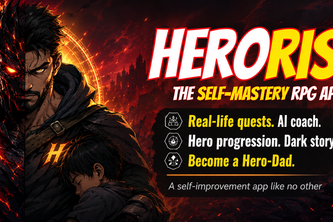
HeroRise is a self-improvement app for dads that uses RPG mechanics to gamify real-life progress. The author states it aims to turn everyday tasks into quests that level up a hero within the game, unlock story elements, and provide AI coaching for personal development. It is built with Firebase and Codex, and currently lacks an AI coach component.
The project is described as a solo effort by one founder (Kereru Moses) who started building it for himself before realizing others might want similar functionality. The app has not yet launched or gained users, and no revenue, customers or traction data are available beyond the author's self-reporting.
The single most important open question is whether the concept of gamifying self-improvement for dads will resonate with a broader audience beyond the founder's personal interests, given that the AI coaching component is not yet implemented and there is little evidence of market demand or competitive positioning.
What The Product Actually Is
The description states HeroRise "turns self-improvement into an RPG for dads" where real-life quests "level up their hero, unlock a dark story and, with AI coaching, rebuild strength, discipline and control."
The app is described as having:
- Quests that players complete
- XP and gold rewards
- Player stats that improve
- Story progression elements
- Combat mechanics
- Card systems
The author states the AI coach component "hasn't been added yet" but was "built with it in mind" and some required infrastructure is already present.
The app is built using Firebase Studio initially, then moved to VS Code with OpenAI and Codex assistance. The description indicates it's a mobile application or web app that uses gamification mechanics to track personal development.
Positioning & Claim Evolution
The author states HeroRise was originally built for "myself" as a dad who likes gaming, gamification and storytelling. It evolved from the founder's personal need to find something that combined habit tracking with storytelling and AI coaching.
The positioning claims:
- "HeroRise turns self-improvement into an RPG for dads"
- "Real-life quests level up their hero"
- "unlock a dark story"
- "with AI coaching, rebuild strength, discipline and control"
The author notes they "knew from the start that HeroRise could work for other people" but initially made it around what they wanted personally. They state there "weren't many direct competitors" after research.
There is no evidence of how positioning has changed or evolved beyond the founder's initial personal use case.
Target Customer & ICP
The description states HeroRise is designed for "dads" who like gaming, gamification and storytelling, and want to improve themselves but would enjoy it more if it felt like "playing a game with a story they actually cared about."
The author identifies their own persona as someone who:
- Likes gaming
- Likes gamification
- Likes good storylines
- Wants to improve themselves
- Enjoys seeing progress in a way that feels real
The description states the founder found there weren't many direct competitors, suggesting this is a niche market segment. The author notes they "think there are other dads like me" who would want this functionality.
No specific demographic data, customer segments or ICP criteria beyond "dads" are provided.
Business Model & Pricing Evidence
The description does not contain any evidence of:
- Revenue streams
- Pricing models
- Monetization strategy
- Subscription tiers
- Freemium structure
- Paid features
The author states the AI coach component "hasn't been added yet" and that they "still made it around what I wanted." There is no indication of how the product will generate revenue or what pricing structure would be used.
Technical & Delivery Signals
The project was built with:
- Firebase Studio initially
- Moved to VS Code for more control
- OpenAI assistance (tried Claude but kept coming back to OpenAI)
- Codex as a major part of development after switching from Firebase Studio
The author states they "started building HeroRise in Firebase Studio" and that it worked well when small but "started making too many mistakes" when the app got bigger. They moved to VS Code because "it started making too many mistakes."
The author reports:
- Learning about APIs, Node servers, hosting, storage and deployment
- Difficulty with AI prompting requiring more context and clearer instructions
- Challenges with code structure and understanding how files fit together
No evidence of technical architecture, scalability considerations or delivery timelines are provided.
Traction & Maturity Signals
The description states:
- The app "hasn't been added yet" (AI coach)
- It's a solo effort by one founder (Kereru Moses)
- The author started building it for themselves
- It "is already much further along than I thought I could get when I first started"
- The project is still being built and the founder "is still learning"
There is no evidence of:
- Users or customers
- Revenue or monetization
- Product-market fit validation
- Market traction
- Customer acquisition
- Usage metrics
The author states they "still made it around what I wanted" suggesting the product is not yet validated with external users.
Competitive Context
The author states they "looked around" and found:
- Habit trackers that give points for completing tasks
- AI coaching apps
- Games with stories
They state they "couldn't find" something that brings all of these together, and that "there weren't many direct competitors."
No specific competitor names or market positioning are mentioned. The author notes they "think there are other dads like me" who would want this functionality.
Open Questions & Risks
Key risks and open questions based on the description:
- Solo founder with no evidence of team or external support
- AI coach component not yet implemented despite being central to the concept
- No revenue, customers or traction data
- The author admits to "working with AI can be frustrating" and "sometimes it misunderstands a clear instruction"
- The app was built by one person without external validation or market testing
- No evidence of product-market fit or customer validation
- Technical challenges noted including code structure issues and AI prompting difficulties
- The project is described as still being built, with the founder stating "I'm still learning"
Questions the description leaves open
- What specific user research or market validation has been conducted beyond personal experience?
- How will the AI coaching component be implemented and what is the timeline for this feature?
- What are the specific mechanics of how real-life actions translate into in-app progress?
- How do you plan to monetize this product and what is your pricing strategy?
- What is your go-to-market strategy for reaching the target audience of dads?
- How will you validate that the gamification approach resonates with users beyond personal preference?
- What are the key technical challenges that remain unresolved in the current build?
- How do you plan to scale beyond a solo founder development model?
- What specific metrics or KPIs will indicate product-market fit success?
- How do you plan to differentiate from existing habit tracking and AI coaching solutions?
Overall Assessment
Not evidenced.
The description provides no evidence of:
- Revenue or financial performance
- Customer base or user traction
- Market validation or product-market fit
- Competitiveness or defensibility
- Team strength or execution capability beyond one founder
- Clear monetization strategy
- Scalability potential
The author states the AI coach "hasn't been added yet" and that they are still learning, indicating the project is in early development. There is no evidence of commercial traction, market validation or proven business model.
The concept appears to be self-reported and unvalidated by external users or customers. The description indicates this is a personal project built by one person with no evidence of external validation or commercial success.
User Stories BotA demo video on every pull request
Get a demo video on every new feature
GitHub App that watches your pull requests and records a narrated, captioned demo.
Save time on demo prep and make informed decisions faster with a video walkthrough of every new feature.
Source
Submitted to the OpenAI 2026 hackathon on Devpost. Project home on Devpost. Back to the full gallery on Devpost.
This competitive analysis was produced by top-founders.com (opens in a new tab)
Generated by a language model from this project's public Devpost page — its tagline, the author's own write-up and any built-with tags listed there — as captured in August 2026. Short quotations are the author's words. It is an opinion on the idea as a business, not on the people behind it, and it reflects the description as published then. If the project has moved on, request a correction below. The analysis is not independent research and contains no verified traction, revenue or customer data.
An independent guide by KFG International LLC — not affiliated with, endorsed by, or connected to Devpost or OpenAI.