

Archive position — measured, not model output
0 likes on Devpost
2,263 of the 7,850 archived projects have more likes, and 5,587 share exactly 0 — so this project's #2,534 place in the like-ranked listing is a tie-break inside that group, not a ranking.
Projects (log scale)
Likes on Devpost. ▲ marks this project's group.
Show the figures
| Likes | Projects | Share of archive |
|---|---|---|
| 0 | 5,587 | 71.2% |
| 1 | 1,758 | 22.4% |
| 2 | 284 | 3.6% |
| 3–4 | 132 | 1.7% |
| 5–9 | 75 | 1.0% |
| 10+ | 14 | 0.2% |
 User Stories BotA demo video on every pull request
Get a demo video on every new feature
GitHub App that watches your pull requests and records a narrated, captioned demo.
Save time on demo prep and make informed decisions faster with a video walkthrough of every new feature.
Executive Summary
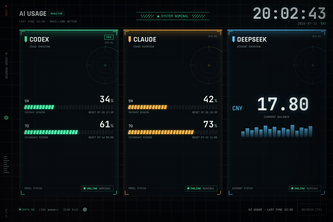
The description states that AI Usage Dashboard is a local-first Windows application built as a dashboard and screensaver for monitoring Codex, Claude, and DeepSeek usage. The author, Jemaine Chen, claims to have developed it during a hackathon using tools like Codex, GPT-5.6, Rust, Tauri, React, and Playwright. It is described as a product that turns an idle Surface into a glanceable command center for AI usage.
Key commercial due-diligence questions:
- Is this a product with real market demand or just a hackathon prototype?
- What is the actual utility of such a dashboard in practice?
- How does it differ from existing solutions, if any?
The single most important open question: Is there evidence of traction, revenue, or customer adoption beyond the author's own development?
What The Product Actually Is
- The description states that AI Usage Dashboard is a "local-first Windows dashboard and screensaver"
- It presents usage data for Codex, Claude, and DeepSeek in a fullscreen interface
- It supports disabling providers, which affects credential discovery, live requests, manual refreshes, and cache presentation
- It includes a synthetic demo mode for judges that uses embedded fixtures and separate preferences
- The author built it using Tauri/Rust/React stack with Playwright and NSIS packaging
Positioning & Claim Evolution
- The description states the product was inspired by the need to monitor multiple AI services without breaking focus
- It positions itself as turning an idle Surface into a "glanceable command center for Codex, Claude, and DeepSeek usage"
- The author claims it makes AI capacity feel like a system resource that is always visible instead of hidden behind multiple tools
- The evolution from v0.2 to v0.3.0 involved adding provider selection with atomic persistence, credential isolation, cache retention, and layout responsiveness
Target Customer & ICP
- Not evidenced. The description does not specify target customers or ideal customer profiles beyond the author's own use case.
Business Model & Pricing Evidence
- Not evidenced. No pricing information, revenue model, or monetization strategy is described in the self-reported content.
Technical & Delivery Signals
- Built with Tauri/Rust/React stack
- Uses Codex and GPT-5.6 for development assistance
- Includes automated tests (44 Rust tests, Playwright checks)
- Supports Windows packaging with NSIS
- Has explicit failure states and last-known-good data preservation
- Implements credential and network isolation for disabled providers
- Features intentional zero-, one-, two-, and three-panel layouts
- Includes a synthetic demo mode for judges
Traction & Maturity Signals
- Not evidenced. No customer data, revenue figures, usage metrics, or adoption indicators are provided.
Competitive Context
- Not evidenced. No information about existing competitive products or market positioning is included in the description.
Open Questions & Risks
- The product appears to be a hackathon prototype with no evidence of commercial traction
- The author states it's "not only a visual prototype" but also a runnable Windows product with installer and tests, suggesting it may have reached a minimum viable product stage
- Privacy concerns are acknowledged as a challenge, particularly around credential handling and preventing leaks into webview/logs/screenshot
- Concurrency issues were noted when disabling providers during refresh operations
- The project was submitted to a hackathon (OpenAI 2026), suggesting it may not have been designed for long-term commercial viability
Questions the description leaves open
- What specific problem are you solving that existing solutions don't address?
- Have you identified any paying customers or users beyond yourself?
- How do you plan to monetize this product, if at all?
- What is your go-to-market strategy for reaching potential users?
- Are there any technical limitations or scalability concerns with the current architecture?
- How does the privacy model handle edge cases in credential management?
- What are the actual usage patterns and frequency of checks that users perform?
Overall Assessment
- Not evidenced. No information about funding rounds, valuation, or partnership opportunities is provided.
The description states this is a self-reported account from the author, Jemaine Chen, and no independent verification exists. The product appears to be a hackathon prototype with some development maturity but lacks evidence of commercial traction or market validation.
User Stories BotA demo video on every pull request
Get a demo video on every new feature
GitHub App that watches your pull requests and records a narrated, captioned demo.
Save time on demo prep and make informed decisions faster with a video walkthrough of every new feature.
Source
Submitted to the OpenAI 2026 hackathon on Devpost. Project home on Devpost. Back to the full gallery on Devpost.
This competitive analysis was produced by top-founders.com (opens in a new tab)
Generated by a language model from this project's public Devpost page — its tagline, the author's own write-up and any built-with tags listed there — as captured in August 2026. Short quotations are the author's words. It is an opinion on the idea as a business, not on the people behind it, and it reflects the description as published then. If the project has moved on, request a correction below. The analysis is not independent research and contains no verified traction, revenue or customer data.
An independent guide by KFG International LLC — not affiliated with, endorsed by, or connected to Devpost or OpenAI.