

Archive position — measured, not model output
0 likes on Devpost
2,263 of the 7,850 archived projects have more likes, and 5,587 share exactly 0 — so this project's #2,536 place in the like-ranked listing is a tie-break inside that group, not a ranking.
Projects (log scale)
Likes on Devpost. ▲ marks this project's group.
Show the figures
| Likes | Projects | Share of archive |
|---|---|---|
| 0 | 5,587 | 71.2% |
| 1 | 1,758 | 22.4% |
| 2 | 284 | 3.6% |
| 3–4 | 132 | 1.7% |
| 5–9 | 75 | 1.0% |
| 10+ | 14 | 0.2% |
 User Stories BotA demo video on every pull request
Get a demo video on every new feature
GitHub App that watches your pull requests and records a narrated, captioned demo.
Save time on demo prep and make informed decisions faster with a video walkthrough of every new feature.
Executive Summary
What the company appears to be
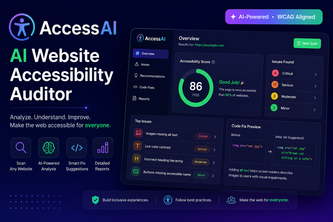
The project described by the author is an AI-powered tool for auditing website accessibility, built as a developer-focused platform that analyzes websites or HTML code using WCAG guidelines and provides AI-generated explanations and fixes.
What changed
This is a self-reported hackathon submission. It does not indicate any prior traction, revenue, or customer base — it is a prototype or proof-of-concept project.
Single most important open question
Is there evidence of product-market fit or early adoption beyond the author’s own development and submission to a hackathon?
What The Product Actually Is
The description states that AI Website Accessibility Auditor is an AI-powered platform that:
- Analyzes websites or pasted HTML code
- Generates an accessibility score based on WCAG guidelines
- Detects issues like missing alt text, low color contrast, and improper heading structures
- Explains each issue in human-friendly language using AI
- Suggests improved HTML code and fixes
- Provides downloadable accessibility reports
- Aims to help developers learn accessibility while improving their websites
The tool is built with HTML5, CSS3, JavaScript (Vanilla JS) and integrates the OpenAI API for AI explanations and suggestions.
The author states this is a frontend-only application that uses modern web technologies and an AI backend for generating insights. It is not described as a SaaS product or platform with ongoing service delivery.
Positioning & Claim Evolution
The author positions the tool as:
- A developer tool to help build more inclusive websites
- An AI-powered assistant that simplifies accessibility auditing
- A learning aid for developers to understand why accessibility matters and how to fix it
- A platform that makes inclusive web development simpler, faster, and more approachable
The project is described as a tool that:
- Combines AI with accessibility best practices
- Focuses on education alongside issue detection
- Aims to make accessibility part of the development workflow rather than an afterthought
The author claims this is a tool for digital inclusion, but no evidence of adoption or usage beyond the project itself is provided.
Target Customer & ICP
The description states that the tool is aimed at:
- Developers who build websites
- Developers of all experience levels (the tool aims to be approachable)
- Those who want to improve accessibility in their web projects
It is described as a developer tool, not a consumer-facing product.
The author does not specify whether this is for individual developers or teams, nor does it describe any segmentation strategy or customer personas beyond general developer audiences.
Business Model & Pricing Evidence
No information is provided about:
- Pricing
- Revenue model
- Monetization strategy
- Subscription plans or usage-based billing
The description states that the tool is a hackathon project, not a commercial product. There is no evidence of any business model or pricing structure.
Technical & Delivery Signals
The author states that the tool was built using:
- Frontend technologies: HTML5, CSS3, JavaScript (Vanilla JS)
- AI integration: OpenAI API for explanations and code suggestions
- User interface: Responsive dashboard with animated progress indicators, interactive cards, and detailed reports
It is described as a frontend-only application that analyzes content and displays results in an intuitive interface.
The author mentions challenges in balancing technical accuracy with user experience, and that prompt engineering was critical to generating useful AI outputs. No evidence of backend infrastructure or scalable delivery mechanisms is provided.
Traction & Maturity Signals
The project is described as:
- A hackathon submission
- Built by a single team member (huraira mazhar)
- Not yet monetized or deployed in production
- Not described as having any users, customers, or revenue
There is no evidence of traction, adoption, or usage beyond the author’s own development and submission to Devpost.
Competitive Context
The author does not reference any existing competitors or market players. The project is described as a new tool that combines AI with accessibility auditing.
No competitive landscape or differentiation from other tools is provided in the description.
Open Questions & Risks
- No traction or revenue: This is a hackathon project, not a product with users or customers.
- Single founder: The team size is listed as 1, which raises questions about execution capacity.
- Unverified claims: The author makes strong claims about impact and usability without evidence of real-world testing or adoption.
- No business model: No indication of how the tool would be monetized or scaled.
- Limited scope: The tool appears to be a prototype with no mention of integration into existing workflows or CI/CD pipelines beyond stated future plans.
These are all inferred risks from the lack of evidence, not facts.
Questions the description leaves open
- What is your plan for scaling beyond a single-person hackathon project?
- Have you tested this tool with real developers? If so, what feedback did you get?
- How do you intend to monetize the product? Is there any revenue model in place?
- Are there any existing tools in the market that perform similar functions?
- What are your plans for integrating with CI/CD pipelines or browser extensions?
- What is the expected timeline for moving from prototype to a production-ready tool?
Overall Assessment
This project is described as a hackathon submission and not a commercial product or platform with traction, users, or revenue.
The description states that this is an author’s own account of a self-built tool. There is no evidence of any business model, customer base, or commercial viability beyond the project itself.
Confidence level: Low — based entirely on self-reported information and no external validation.
Assessment: Not ready for investment or partnership at this stage. The project shows potential but lacks evidence of product-market fit, traction, or a clear path to monetization.
User Stories BotA demo video on every pull request
Get a demo video on every new feature
GitHub App that watches your pull requests and records a narrated, captioned demo.
Save time on demo prep and make informed decisions faster with a video walkthrough of every new feature.
Source
Submitted to the OpenAI 2026 hackathon on Devpost. Project home on Devpost. Back to the full gallery on Devpost.
This competitive analysis was produced by top-founders.com (opens in a new tab)
Generated by a language model from this project's public Devpost page — its tagline, the author's own write-up and any built-with tags listed there — as captured in August 2026. Short quotations are the author's words. It is an opinion on the idea as a business, not on the people behind it, and it reflects the description as published then. If the project has moved on, request a correction below. The analysis is not independent research and contains no verified traction, revenue or customer data.
An independent guide by KFG International LLC — not affiliated with, endorsed by, or connected to Devpost or OpenAI.