

Archive position — measured, not model output
0 likes on Devpost
2,263 of the 7,850 archived projects have more likes, and 5,587 share exactly 0 — so this project's #4,497 place in the like-ranked listing is a tie-break inside that group, not a ranking.
Projects (log scale)
Likes on Devpost. ▲ marks this project's group.
Show the figures
| Likes | Projects | Share of archive |
|---|---|---|
| 0 | 5,587 | 71.2% |
| 1 | 1,758 | 22.4% |
| 2 | 284 | 3.6% |
| 3–4 | 132 | 1.7% |
| 5–9 | 75 | 1.0% |
| 10+ | 14 | 0.2% |
 User Stories BotA demo video on every pull request
Get a demo video on every new feature
GitHub App that watches your pull requests and records a narrated, captioned demo.
Save time on demo prep and make informed decisions faster with a video walkthrough of every new feature.
Executive Summary
What the company appears to be
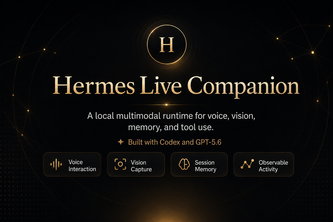
The project described as "Hermes Live Companion" is a self-reported experimental software interface built during OpenAI Build Week. The author states it is a Windows-first multimodal agent runtime that integrates voice, vision, memory, interruption control, tool use, and observable activity — all within a local-first architecture. It uses GPT-5.6 Sol as its reasoning model and Codex as an engineering collaborator.
What changed
There is no evidence of prior versions or changes; this is a single self-reported project submitted to a hackathon. The author describes it as an experiment, not a product in development.
The single most important open question — the commercial due-diligence read
Is there any indication that this represents a viable commercial product or platform, or merely a proof-of-concept? The description contains no evidence of revenue, customers, traction, or business model beyond the author’s own account.
What The Product Actually Is
The description states that Hermes Live Companion is:
- A Windows-first multimodal agent interface.
- Designed to allow users to:
- Speak naturally and receive streamed spoken responses.
- Preserve conversational memory across turns.
- Interrupt the agent during various stages (thinking, tool use, speaking).
- Approve and capture a single camera frame for visual analysis.
- Ask follow-up questions using visual and conversational context.
- Inspect runtime state, model activity, and latency events.
- Reset or stop sessions at any time.
It is built with:
- Frontend: React, TypeScript, Vite, Web Audio API
- Backend: FastAPI, WebSocket communication
- Voice pipeline components:
- Silero VAD for speech detection
- faster-whisper (with optional CUDA)
- Kokoro TTS worker with Edge TTS fallback
- Push-to-interrupt and headphone modes
- Vision processing:
- Single-frame camera capture, preview, validation, analysis by GPT-5.6 Sol, deletion after turn
- Runtime architecture:
- Loopback-only Hermes worker via authenticated JSON-RPC
- Uses GPT-5.6 Sol for session reasoning and tool access
The system is described as local-first, with privacy constraints enforced through:
- No modification of production Hermes installation
- No reuse of desktop tokens or ChatGPT cookies
- Loopback-only networking
- Preservation of approvals
- Verification before release milestones
- No credentials, raw audio, captured images, sessions, logs, or local paths in public package
Inferred: The system is intended to be a runtime environment for multimodal agents with strong emphasis on control, transparency, and privacy.
Positioning & Claim Evolution
The author claims that Hermes Live Companion explores what happens when multiple AI capabilities — chat, voice, vision, tools, memory — are coordinated inside one observable, interruptible session. It is positioned as a local-first control surface, not hidden behind a simple chat box.
It was built during OpenAI Build Week and uses Codex as an engineering collaborator, suggesting a focus on collaborative AI development or AI-assisted software engineering.
The project does not appear to have evolved from prior versions or commercial positioning. It is described as a single experiment, not a product in progress.
Inferred: The author positions this as a research-grade prototype exploring agent runtime design principles, rather than a commercial offering.
Target Customer & ICP
Not evidenced.
The description does not state who the intended users are beyond the author. No customer personas, use cases, or target industries are mentioned.
Business Model & Pricing Evidence
Not evidenced.
There is no mention of pricing, monetization strategy, or business model in the self-reported description.
Technical & Delivery Signals
The system is described as:
- Built with React, TypeScript, Vite, FastAPI
- Uses GPT-5.6 Sol as reasoning engine
- Implements local-first architecture with loopback-only Hermes worker
- Includes voice processing, camera capture, and tool use
- Supports streamed speech output, interruption control, and runtime observability
- Enforces privacy boundaries through:
- No reuse of tokens or cookies
- Loopback-only networking
- No inclusion of sensitive data in public package
The project was submitted to a hackathon, suggesting it is not yet production-ready.
Inferred: The system is technically sophisticated for an experimental runtime, but lacks evidence of scalability, deployment, or integration with existing platforms.
Traction & Maturity Signals
Not evidenced.
There is no evidence of:
- Revenue
- Customers
- Adoption
- Product usage metrics
- Iteration history beyond this single submission
- Production deployment
The project is described as a single experimental version submitted to a hackathon, with no indication of prior development or market traction.
Competitive Context
Not evidenced.
There is no mention of competitors, existing products in the space, or how this compares to other agent runtimes or multimodal interfaces.
Open Questions & Risks
- No commercial evidence: The project is described as a hackathon submission with no indication of business traction.
- Unproven scalability: The system is local-first and uses loopback-only networking; unclear if it can scale beyond experimental use.
- Unverified model claims: GPT-5.6 Sol is mentioned, but there is no evidence that such a model exists or is used in production.
- No privacy audit or compliance data: Though privacy boundaries are enforced, no third-party validation or regulatory alignment is stated.
- Single-person team: The project was built by one individual (Jack Luo), raising questions about long-term maintenance and development capacity.
Questions the description leaves open
- What is the actual business model behind this product?
- How does this differ from existing agent runtimes or multimodal interfaces?
- Is there any plan to commercialize this beyond the hackathon submission?
- What are the technical limitations of scaling this runtime beyond a local-first prototype?
- Are there any third-party integrations or partnerships in development?
- What is the roadmap for future versions, and how will they be validated?
Overall Assessment
Not evidenced.
There is no evidence to support an investment or partnership decision. The project is described as a single experimental submission with no commercial traction, revenue, or customer data. It is not clear whether this represents a viable product or platform for investment or collaboration.
The author states that the system was built as a practical experiment, and there is no indication of further development or market readiness.
User Stories BotA demo video on every pull request
Get a demo video on every new feature
GitHub App that watches your pull requests and records a narrated, captioned demo.
Save time on demo prep and make informed decisions faster with a video walkthrough of every new feature.
Source
Submitted to the OpenAI 2026 hackathon on Devpost. Project home on Devpost. Back to the full gallery on Devpost.
This competitive analysis was produced by top-founders.com (opens in a new tab)
Generated by a language model from this project's public Devpost page — its tagline, the author's own write-up and any built-with tags listed there — as captured in August 2026. Short quotations are the author's words. It is an opinion on the idea as a business, not on the people behind it, and it reflects the description as published then. If the project has moved on, request a correction below. The analysis is not independent research and contains no verified traction, revenue or customer data.
An independent guide by KFG International LLC — not affiliated with, endorsed by, or connected to Devpost or OpenAI.