

Archive position — measured, not model output
1 like on Devpost
505 of the 7,850 archived projects have more likes, and 1,758 share exactly 1 — so this project's #565 place in the like-ranked listing is a tie-break inside that group, not a ranking.
Projects (log scale)
Likes on Devpost. ▲ marks this project's group.
Show the figures
| Likes | Projects | Share of archive |
|---|---|---|
| 0 | 5,587 | 71.2% |
| 1 | 1,758 | 22.4% |
| 2 | 284 | 3.6% |
| 3–4 | 132 | 1.7% |
| 5–9 | 75 | 1.0% |
| 10+ | 14 | 0.2% |
 User Stories BotA demo video on every pull request
Get a demo video on every new feature
GitHub App that watches your pull requests and records a narrated, captioned demo.
Save time on demo prep and make informed decisions faster with a video walkthrough of every new feature.
Executive Summary
What the company appears to be
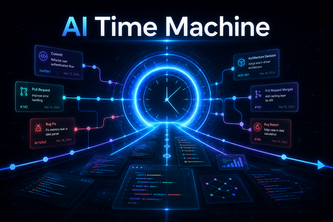
The project described as "AI Time Machine" is a self-reported developer tool that visualizes and explains Git repository history through an interactive interface. It claims to reconstruct the hidden story behind code changes by linking commits, PRs, bugs, and architectural decisions using AI-assisted analysis.
What changed
This is a single-developer project submitted for the OpenAI 2026 hackathon. The author states it was built over time using Python, Git, JavaScript, HTML/CSS, and OpenAI tools like Codex and GPT-5.6. It includes a public demo and source code available on GitHub.
Single most important open question
Is there any evidence of real-world usage or adoption beyond the author's own demonstration project (OrbitCart), or any indication that this tool has moved past prototype status?
What The Product Actually Is
The description states:
- AI Time Machine transforms Git history into an interactive, evidence-backed story of how a codebase evolved.
- It allows developers to explore commits through a visual timeline.
- It supports asking questions about the repository via "Ask the Repo".
- It includes a "Bug Origin Trace" feature that follows problems from introduction through resolution.
- It offers "Real Repo Mode" for analyzing other local Git worktrees.
- The flagship demonstration uses a synthetic project called OrbitCart, which is stored as a real Git repository with 12 commits.
Inference The tool appears to be a code archaeology assistant that leverages AI to interpret Git history and present it in an accessible way, but its core functionality seems limited to static analysis of repositories already available locally or via public demos.
Positioning & Claim Evolution
The description states:
- The product was inspired by the question: “What if a repository could explain its own history?”
- It aims to help developers reconstruct why risky decisions were introduced and how code evolved after bugs appeared.
- It emphasizes trustworthiness through citation validation and deterministic artifact generation.
- It does not make claims about live AI inference or real-time analysis; instead, it uses precomputed artifacts validated at runtime.
Inference Positioning appears to be as a developer tool focused on historical code understanding, not predictive or generative AI. The emphasis is on grounding explanations in verifiable Git events rather than speculative outputs.
Target Customer & ICP
The description states:
- The primary users are developers working with Git repositories.
- It supports both exploration of existing repositories and analysis of local worktrees.
- A public demo exists for general access, suggesting an open-source or community-oriented approach.
Inference The target customer is likely individual developers or small teams who want to understand complex codebases or debug issues more efficiently. There is no evidence of enterprise customers or B2B targeting.
Business Model & Pricing Evidence
Not evidenced.
Explanation
There is no mention in the description of pricing, monetization strategy, or business model. The project is presented as a hackathon submission with open-source code and a public demo.
Technical & Delivery Signals
The description states:
- Built with Python 3.11, Git, JavaScript, HTML/CSS.
- Uses Codex and GPT-5.6 for architecture exploration, implementation, debugging, test creation, UI refinement, and evaluation.
- The hosted application does not require an OpenAI API key or paid model calls.
- Artifacts are generated at build time and replayed at runtime with validation.
- Supports local deployment using only Python and Git.
- Includes 51 application tests plus an OrbitCart regression suite.
- Achieved deterministic grounding regression scorecard of 15/15.
Inference The tool is technically self-contained, deterministic, and designed for offline or low-dependency use. It avoids reliance on external APIs during runtime, which may be a strength in terms of reliability but also limits scalability or real-time capabilities.
Traction & Maturity Signals
Not evidenced.
Explanation
There is no evidence of revenue, customers, user base, or product traction beyond the author’s own demonstration and local testing. The project is described as a hackathon submission with no indication of commercialization or market adoption.
Competitive Context
Not evidenced.
Explanation
No mention of competitors, similar tools, or market positioning in relation to existing solutions for code archaeology or Git history visualization. The description does not reference any comparable products or platforms.
Open Questions & Risks
The description states:
- The tool relies on precomputed artifacts and does not perform live AI inference.
- It handles missing rationale by displaying “not recorded” rather than inventing explanations.
- It avoids API dependencies in the public demo, which may limit its utility for dynamic or real-time use cases.
Inference A key risk is that the tool’s value proposition depends heavily on static analysis and deterministic outputs. If users expect live AI responses or real-time updates, they may find it underperforming. Additionally, the lack of API integration could hinder broader adoption or enterprise scalability.
Questions the description leaves open
- Has the tool been used in any real-world development environments beyond the OrbitCart demo?
- Are there plans to integrate with CI/CD pipelines or IDEs?
- How does it handle large-scale repositories or complex merge histories?
- What is the long-term vision for monetization or product evolution?
- Have you considered how this would scale across teams or organizations?
Overall Assessment
Not evidenced.
Explanation
There is no evidence of funding, valuation, or investment interest in the project. The description indicates it was built as a hackathon submission with no commercial traction or strategic partnerships mentioned. No indication exists that this represents a viable business opportunity for investment or partnership at this stage.
User Stories BotA demo video on every pull request
Get a demo video on every new feature
GitHub App that watches your pull requests and records a narrated, captioned demo.
Save time on demo prep and make informed decisions faster with a video walkthrough of every new feature.
Source
Submitted to the OpenAI 2026 hackathon on Devpost. Project home on Devpost. Back to the full gallery on Devpost.
This competitive analysis was produced by top-founders.com (opens in a new tab)
Generated by a language model from this project's public Devpost page — its tagline, the author's own write-up and any built-with tags listed there — as captured in August 2026. Short quotations are the author's words. It is an opinion on the idea as a business, not on the people behind it, and it reflects the description as published then. If the project has moved on, request a correction below. The analysis is not independent research and contains no verified traction, revenue or customer data.
An independent guide by KFG International LLC — not affiliated with, endorsed by, or connected to Devpost or OpenAI.