

Archive position — measured, not model output
1 like on Devpost
505 of the 7,850 archived projects have more likes, and 1,758 share exactly 1 — so this project's #567 place in the like-ranked listing is a tie-break inside that group, not a ranking.
Projects (log scale)
Likes on Devpost. ▲ marks this project's group.
Show the figures
| Likes | Projects | Share of archive |
|---|---|---|
| 0 | 5,587 | 71.2% |
| 1 | 1,758 | 22.4% |
| 2 | 284 | 3.6% |
| 3–4 | 132 | 1.7% |
| 5–9 | 75 | 1.0% |
| 10+ | 14 | 0.2% |
 User Stories BotA demo video on every pull request
Get a demo video on every new feature
GitHub App that watches your pull requests and records a narrated, captioned demo.
Save time on demo prep and make informed decisions faster with a video walkthrough of every new feature.
Executive Summary
What the company appears to be
A self-contained, browser-based remote lab for digital-logic design education, built by one individual (Mazen Alkhatib), using a Raspberry Pi, AI tools (GPT-5.6 and Codex), and web technologies.
What changed
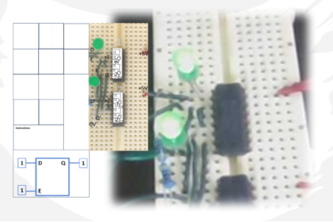
The author transformed a physical Raspberry Pi lab into an online experience accessible from any browser, enabling remote learners to build, test, and observe D-latch circuits in real time. This involved overcoming technical challenges around secure network access, synchronization between virtual and physical systems, and integrating AI for tutoring and assessment.
Single most important open question
Is there a viable educational market or institutional demand for this type of remote lab solution, and how scalable is the current one-person build?
Note: All claims are self-reported and unverified. No revenue, customer data, traction, or commercial evidence is provided beyond what the author states.
What The Product Actually Is
The description states that it is an “AI-assisted, real-time digital-logic lab” where learners:
- Build a D-latch virtually by selecting source and destination connections.
- Test the circuit in simulation and on physical hardware through a live camera feed.
- Practice with AI tutor prompts or take graded exams.
It uses:
- A Raspberry Pi as the physical hardware controller.
- GPT-5.6 and Codex for development assistance.
- SSH tunneling to connect the Pi behind a local network to a Linode server.
- Web application built with HTML, CSS, JavaScript, Python, and Caddy.
- GPIO pins for controlling D and E inputs.
- Live video stream from the Raspberry Pi via a secure tunnel.
Inference: The system appears to be a proof-of-concept prototype rather than a commercial product. It is described as a single-person project with no evidence of institutional or market adoption.
Positioning & Claim Evolution
The author positions this as an educational tool that bridges physical and virtual labs for remote learners, aiming to make digital-logic design accessible from any browser.
Key claims:
- Enables independent access to lab experiments without needing physical presence.
- Combines construction, simulation, real hardware observation, assessment, and AI tutoring in one workflow.
- Solves the challenge of remote access to physical labs using secure networking techniques.
Inference: The positioning reflects a niche educational use case. It is not positioned as a general-purpose tool or platform but as a specific solution for digital-logic learning.
Target Customer & ICP
The description states that the target audience includes:
- Remote learners who lack access to physical labs.
- Students interested in digital-logic design systems.
- Educational institutions seeking to offer remote lab experiences.
No explicit segmentation beyond "remote learners" or "students" is given. The author notes that the system was designed for independent use, suggesting a self-directed learner profile.
Inference: The ICP seems to be individual students or educators in STEM fields, particularly those studying digital logic design. No evidence of institutional or enterprise adoption.
Business Model & Pricing Evidence
There is no mention of pricing, monetization strategy, or business model in the description.
Not evidenced
Technical & Delivery Signals
The system uses:
- SSH tunneling to securely expose a local Raspberry Pi to the internet.
- A Linode server as an intermediary for video and control signals.
- Python-based controller on the Raspberry Pi managing GPIO pins.
- Browser-based UI with real-time updates from physical circuit states.
- AI tools (GPT-5.6, Codex) used during development.
Inference: The technical architecture is functional but likely not production-ready or scalable. It’s a prototype built for demonstration and personal use.
Traction & Maturity Signals
The project was submitted to the OpenAI 2026 hackathon on Devpost. No evidence of:
- Revenue
- Customers
- Users
- Adoption
- Product-market fit
- Institutional partnerships or licensing
Not evidenced
Competitive Context
No mention of competitors, similar products, or market landscape in the description.
Not evidenced
Open Questions & Risks
- Single-person build: The entire system was built by one person (Mazen Alkhatib), raising questions about scalability and long-term maintenance.
- Prototype nature: Described as a hackathon submission, not a commercial product.
- Limited scope: Only supports D-latch circuit; no indication of expansion to other circuits or broader curriculum.
- Technical complexity: Requires secure networking, hardware integration, and synchronization — all of which are high-risk areas for remote access systems.
- No monetization strategy: No evidence of how the solution would be sold or funded.
Inference: The project lacks commercial viability indicators and appears to be a personal or academic endeavor rather than a scalable business.
Questions the description leaves open
- What is the intended educational institution or market segment for this lab?
- Are there any plans to expand beyond D-latch circuits or integrate with existing curricula?
- How do you plan to scale this from one Raspberry Pi to multiple users or labs?
- Have you tested the system with actual students or educators? What feedback did you get?
- Is there a roadmap for monetization or institutional licensing?
- What are the technical limitations of the current architecture that would prevent broader deployment?
Overall Assessment
This is a self-reported, unverified prototype built by one individual as part of a hackathon submission. There is no evidence of traction, revenue, customers, or commercial viability.
Confidence Level: Low
Assessment: Not suitable for investment or partnership at this stage. It may be an interesting educational experiment but lacks the commercial signals necessary to evaluate further.
User Stories BotA demo video on every pull request
Get a demo video on every new feature
GitHub App that watches your pull requests and records a narrated, captioned demo.
Save time on demo prep and make informed decisions faster with a video walkthrough of every new feature.
Source
Submitted to the OpenAI 2026 hackathon on Devpost. Project home on Devpost. Back to the full gallery on Devpost.
This competitive analysis was produced by top-founders.com (opens in a new tab)
Generated by a language model from this project's public Devpost page — its tagline, the author's own write-up and any built-with tags listed there — as captured in August 2026. Short quotations are the author's words. It is an opinion on the idea as a business, not on the people behind it, and it reflects the description as published then. If the project has moved on, request a correction below. The analysis is not independent research and contains no verified traction, revenue or customer data.
An independent guide by KFG International LLC — not affiliated with, endorsed by, or connected to Devpost or OpenAI.