

Archive position — measured, not model output
1 like on Devpost
505 of the 7,850 archived projects have more likes, and 1,758 share exactly 1 — so this project's #569 place in the like-ranked listing is a tie-break inside that group, not a ranking.
Projects (log scale)
Likes on Devpost. ▲ marks this project's group.
Show the figures
| Likes | Projects | Share of archive |
|---|---|---|
| 0 | 5,587 | 71.2% |
| 1 | 1,758 | 22.4% |
| 2 | 284 | 3.6% |
| 3–4 | 132 | 1.7% |
| 5–9 | 75 | 1.0% |
| 10+ | 14 | 0.2% |
 User Stories BotA demo video on every pull request
Get a demo video on every new feature
GitHub App that watches your pull requests and records a narrated, captioned demo.
Save time on demo prep and make informed decisions faster with a video walkthrough of every new feature.
Executive Summary
The description states that the project is an "AI-Powered ESS Digital Twin" — a browser-based interactive 3D visualization of energy storage systems (ESS), including substations, batteries, power flows and monitoring. The author describes building a prototype using Blender, Three.js and React, with simulated data to demonstrate interactivity. No revenue, customers or traction are evidenced.
What changed: The author self-reports an evolution from conventional 2D dashboards to an interactive 3D digital twin experience, incorporating power-flow, thermal, alarm and camera visualizations in a browser environment.
Single most important open question: Is there any evidence of real-world integration with BMS, EMS or SCADA systems? The description states this is the "next stage" but does not confirm current connectivity or data ingestion capabilities.
What The Product Actually Is
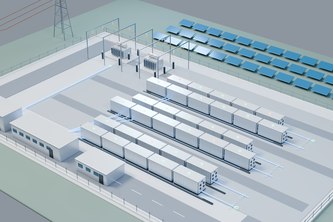
The description states that the product is a browser-based interactive 3D digital twin for energy storage systems (ESS). It includes:
- A 220 kV substation with transformers, busbars, gantries, breakers and insulators
- Transmission lines, photovoltaic arrays and wind turbines
- 32 battery energy storage containers with a total modeled capacity of 160 MWh
- A five-level asset hierarchy from station to container, cluster, pack and cell
- SOC, SOH, voltage, current, power and equipment-status visualization
- Global and cell-level temperature monitoring
- Animated AC, DC and high-voltage power-flow paths
- Alarm localization, event playback and abnormal thermal effects
- Nanoparticle gas sensing for VOC, hydrogen and carbon monoxide monitoring
- Interactive security cameras, picture-in-picture views and drone inspection
The product is described as a prototype using simulated operational data to demonstrate interaction workflows.
Evidence: The author's own write-up describes the components and functionality. No evidence of actual deployment or live data integration is provided.
Positioning & Claim Evolution
The description states that the project was inspired by cinematic industrial ESS visualizations and aims to rebuild this experience as an interactive digital twin, rather than a prerecorded video. It positions itself as a tool for exploring energy storage sites in real-time with rich visualizations and interactivity.
The author claims to have evolved from conventional 2D dashboards to a fully interactive 3D environment that allows users to rotate the site, select equipment, inspect asset hierarchies and observe operating effects directly in the browser.
Evidence: The author's own account of inspiration and goals. No evidence of market positioning or competitive differentiation beyond self-description.
Target Customer & ICP
The description does not state a specific target customer or ideal customer profile (ICP). It describes an interactive digital twin for energy storage systems, which may be relevant to operators, engineers or managers of renewable energy and ESS sites. However, no explicit customer segment is named.
Evidence: Not evidenced. The project is described in general terms without specifying who would use it or how it would be monetized.
Business Model & Pricing Evidence
The description does not provide any information on pricing, licensing, or business model. It only describes a prototype built for a hackathon and states that the next stage involves connecting to real data sources via APIs, MQTT or OPC UA.
Evidence: Not evidenced. No mention of monetization, pricing tiers, or customer acquisition strategy.
Technical & Delivery Signals
The description states that:
- All site-specific 3D equipment was modeled in Blender
- Assets were exported as semantic GLB assets with stable node names to allow identification and control
- The application uses React, TypeScript, Three.js and React Three Fiber
- WebGL particle systems provide thermal fields, alarm effects, power-flow tracers and sensor visualizations
- SVG and CSS are used for dashboards, charts and single-line diagrams
- OpenAI Codex assisted with automation, debugging and testing
The author also mentions challenges such as maintaining performance, connecting 2D topology to 3D scenes, camera transitions and GPU usage.
Evidence: The author's own technical write-up. No evidence of production deployment or scalability beyond the prototype.
Traction & Maturity Signals
The description states that this is a prototype built for a hackathon (OpenAI 2026). It includes simulated data to demonstrate workflows, but no real-world integration or live usage is evidenced.
Evidence: Not evidenced. No revenue, customers, user base, or adoption metrics are provided.
Competitive Context
The description does not mention any competitors or existing solutions in the energy digital twin space. The author focuses on their own innovation rather than positioning against others.
Evidence: Not evidenced. No competitive analysis or market landscape is described.
Open Questions & Risks
- Prototype-only status: The project is described as a hackathon prototype with simulated data, not a production-ready solution.
- No real-world integration: The next stage involves connecting to BMS, EMS or SCADA systems, but no such integration exists yet.
- Unproven commercial viability: No evidence of pricing, customers or monetization strategy.
- Limited team size: Only one team member is mentioned, which may limit execution capacity.
- No traction or adoption: No users, revenue or customer feedback are reported.
Inference: The project appears to be an early-stage concept with no demonstrated commercial traction or integration into real systems.
Questions the description leaves open
- What is the current status of data integration with BMS, EMS or SCADA systems?
- Has the prototype been tested in any real-world energy storage environments?
- Are there any potential customers or partners interested in using this solution?
- How does the team plan to scale beyond a single-person development effort?
- What is the intended business model for monetizing this digital twin platform?
Overall Assessment
The description states that this is a prototype built for a hackathon and not yet integrated with real systems or data sources. No evidence of revenue, customers or traction is provided.
Confidence: Low — based entirely on self-reported information without independent corroboration.
Assessment: Not evidenced as a viable commercial opportunity at this stage. The project shows technical capability in 3D visualization and simulation but lacks any demonstrated market readiness or integration with real operational systems. It may be an early-stage idea or proof-of-concept, not yet a product ready for investment or partnership.
User Stories BotA demo video on every pull request
Get a demo video on every new feature
GitHub App that watches your pull requests and records a narrated, captioned demo.
Save time on demo prep and make informed decisions faster with a video walkthrough of every new feature.
Source
Submitted to the OpenAI 2026 hackathon on Devpost. Project home on Devpost. Back to the full gallery on Devpost.
This competitive analysis was produced by top-founders.com (opens in a new tab)
Generated by a language model from this project's public Devpost page — its tagline, the author's own write-up and any built-with tags listed there — as captured in August 2026. Short quotations are the author's words. It is an opinion on the idea as a business, not on the people behind it, and it reflects the description as published then. If the project has moved on, request a correction below. The analysis is not independent research and contains no verified traction, revenue or customer data.
An independent guide by KFG International LLC — not affiliated with, endorsed by, or connected to Devpost or OpenAI.