

Archive position — measured, not model output
1 like on Devpost
505 of the 7,850 archived projects have more likes, and 1,758 share exactly 1 — so this project's #570 place in the like-ranked listing is a tie-break inside that group, not a ranking.
Projects (log scale)
Likes on Devpost. ▲ marks this project's group.
Show the figures
| Likes | Projects | Share of archive |
|---|---|---|
| 0 | 5,587 | 71.2% |
| 1 | 1,758 | 22.4% |
| 2 | 284 | 3.6% |
| 3–4 | 132 | 1.7% |
| 5–9 | 75 | 1.0% |
| 10+ | 14 | 0.2% |
 User Stories BotA demo video on every pull request
Get a demo video on every new feature
GitHub App that watches your pull requests and records a narrated, captioned demo.
Save time on demo prep and make informed decisions faster with a video walkthrough of every new feature.
Executive Summary
The project described by the caller is a self-reported prototype for an AI-powered railway track deformation monitoring system. The author, a mechanical engineer with experience in railway measurement, developed this tool to automate the analysis of geodetic railway measurements. It accepts structured CSV data and generates interactive HTML and PDF reports with annotated displacement diagrams and deformation interval detection.
The system uses a hybrid approach combining neural networks and deterministic engineering checks. It is built using Python, PyTorch, FastAPI, Docker, and supports multi-label deformation localization across multiple measurement days. The author states that the tool was developed primarily with synthetic data and has not yet been validated on real-world datasets.
Key commercial due-diligence questions include: Is there a clear path to validating the system with anonymized real data? What is the actual market need for this type of tool in railway maintenance operations? How does this solution compare to existing methods used by railway operators?
The single most important open question is whether the author's confidence in the concept translates into viable commercial traction or adoption, given that no revenue, customers or operational validation have been evidenced.
What The Product Actually Is
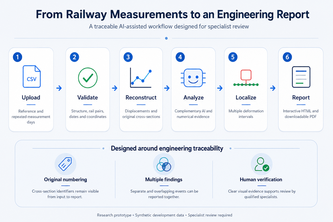
The description states that the system accepts structured CSV files containing initial reference measurements and subsequent day measurements. It validates these files before processing them to preserve physical rail data, cross-section numbers, measurement dates, coordinate sequences, and physical distances along tracks.
The system analyzes vertical, lateral, and longitudinal displacement and can locate multiple deformation patterns at different or overlapping positions rather than assigning single general labels to entire track segments.
Results are presented as:
- Interactive HTML reports
- Annotated displacement diagrams
- Detected deformation intervals
- Views of development across measurement days
- Tables of findings
- Downloadable PDF reports
The system also recognizes large unmeasured spans like bridges, keeping measured sides separate without inventing measurements or deformation curves across missing areas.
Positioning & Claim Evolution
The author's own write-up describes the product as an automated solution for railway track deformation monitoring that addresses practical difficulties in interpreting repeated track measurements. The positioning appears to be:
- A hybrid AI-engineering system for railway measurement analysis
- Designed to standardize measurements without losing physical meaning
- Focused on human review rather than fully autonomous decision-making
- Built for railway specialists who need to quickly review measured points, cross-sections, displacement curves, and measurement history
The claim evolution shows a progression from identifying a problem in the author's workplace ("the problem of automatically turning these measurements into a clear and useful deformation analysis remained open") to developing a solution that combines AI with deterministic engineering analysis.
Target Customer & ICP
Not evidenced. The description does not specify target customers or ideal customer profiles beyond the author's own professional background as a railway measurement technician. No information is provided about:
- Specific railway operators or maintenance companies
- End-user roles (engineers, survey specialists, etc.)
- Geographic markets or rail systems targeted
- Customer segments or buying criteria
Business Model & Pricing Evidence
Not evidenced. The description provides no information about:
- Revenue streams
- Pricing models
- Customer acquisition strategies
- Monetization approaches
- Sales cycles or distribution methods
Technical & Delivery Signals
The system is built with:
- Python, PyTorch, FastAPI
- Docker deployment for small Linux servers
- CPU-only processing (no GPU requirements)
- Hybrid pipeline combining neural networks and numerical engineering checks
- Strict CSV validation
- Multi-label deformation localization
- Support for multiple measurement days
- Bridge and measurement-gap handling
- Browser-based file upload
- Protected report archive
The author states that GPT-5.6 was used during development but is not part of the deployed runtime. The system processes files locally by specialized models rather than sending data to general-purpose language models.
Traction & Maturity Signals
Not evidenced. The description indicates:
- This is a research and demonstration prototype
- Developed primarily with synthetic data
- Not safety-certified
- Findings must be reviewed by qualified specialists before operational decisions
- Company director is aware and excited about the project
- Preparing real measurement data for validation
- Next steps include validation with anonymized real campaigns
No revenue, customer adoption, or usage metrics are provided.
Competitive Context
Not evidenced. The description does not mention:
- Existing solutions in railway track deformation monitoring
- Competitors or substitutes
- Market size or competitive landscape
- Differentiation from current tools used by railway operators
Open Questions & Risks
The author's own write-up identifies several risks and limitations:
- The system is a prototype developed primarily with synthetic data, not real-world validation
- It is not safety-certified and requires specialist review before operational decisions
- The author acknowledges that synthetic success does not equal operational validation
- Real measurements contain instrument behavior, environmental effects, maintenance changes, and unexpected conditions not perfectly representable in advance
- The system's findings must be reviewed by qualified railway and geotechnical specialists before influencing operational or maintenance decisions
Additionally, the project is a solo effort with no team mentioned beyond the author. There is no evidence of:
- Commercial traction or customer validation
- Revenue generation or business model development
- Market demand confirmation
- Scalability considerations
Questions the description leaves open
- What specific railway operators or maintenance companies have shown interest in this solution?
- How will you validate the system with anonymized real measurement campaigns?
- What are the technical requirements for deploying this system at scale in railway operations?
- How do you plan to address the need for specialist review of findings before operational decisions?
- What is your timeline and approach for transitioning from prototype to validated solution?
- Have you identified any regulatory or certification requirements for railway safety applications?
- What are the key performance indicators that will define success beyond initial validation?
Overall Assessment
Not evidenced. The description does not provide information about:
- Current funding status
- Valuation or investment interest
- Partnership opportunities
- Commercial viability metrics
- Exit potential or market positioning
The author states this is a research and demonstration prototype, not yet validated with real data, and that the company director is excited but no commercial arrangements are described. The project appears to be in early development phase without demonstrated traction or business model.
User Stories BotA demo video on every pull request
Get a demo video on every new feature
GitHub App that watches your pull requests and records a narrated, captioned demo.
Save time on demo prep and make informed decisions faster with a video walkthrough of every new feature.
Source
Submitted to the OpenAI 2026 hackathon on Devpost. Project home on Devpost. Back to the full gallery on Devpost.
This competitive analysis was produced by top-founders.com (opens in a new tab)
Generated by a language model from this project's public Devpost page — its tagline, the author's own write-up and any built-with tags listed there — as captured in August 2026. Short quotations are the author's words. It is an opinion on the idea as a business, not on the people behind it, and it reflects the description as published then. If the project has moved on, request a correction below. The analysis is not independent research and contains no verified traction, revenue or customer data.
An independent guide by KFG International LLC — not affiliated with, endorsed by, or connected to Devpost or OpenAI.