

Archive position — measured, not model output
0 likes on Devpost
2,263 of the 7,850 archived projects have more likes, and 5,587 share exactly 0 — so this project's #2,533 place in the like-ranked listing is a tie-break inside that group, not a ranking.
Projects (log scale)
Likes on Devpost. ▲ marks this project's group.
Show the figures
| Likes | Projects | Share of archive |
|---|---|---|
| 0 | 5,587 | 71.2% |
| 1 | 1,758 | 22.4% |
| 2 | 284 | 3.6% |
| 3–4 | 132 | 1.7% |
| 5–9 | 75 | 1.0% |
| 10+ | 14 | 0.2% |
 User Stories BotA demo video on every pull request
Get a demo video on every new feature
GitHub App that watches your pull requests and records a narrated, captioned demo.
Save time on demo prep and make informed decisions faster with a video walkthrough of every new feature.
Executive Summary
What the company appears to be
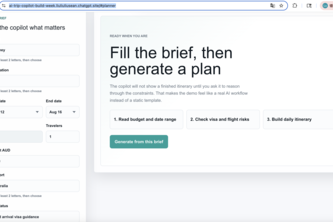
The project described as "AI Trip Copilot" is a self-reported MVP built for the OpenAI 2026 hackathon. It claims to turn structured travel briefs into personalized, explainable itineraries using AI tools like GPT-5.6 and OpenAI Codex. The author states this is an MVP with a demo flow that includes input standardization, plan generation, and reasoning explanation.
What changed
The project was submitted as part of a hackathon, indicating it is in early-stage development. No commercial traction or revenue evidence is provided.
Single most important open question
Is the author's stated product capable of delivering consistent, reliable travel planning at scale, or is this a proof-of-concept that requires further development to be viable?
What The Product Actually Is
The description states:
- AI Trip Copilot is an MVP built for OpenAI Build Week.
- It takes a standardized travel brief (origin, destination, dates, passport, budget, etc.) and generates a structured itinerary.
- The demo includes visa checklist, flight strategy, budget breakdown, day-by-day plan, risk checks, and explanation of the plan.
- It uses OpenAI Codex with GPT-5.6 for development and deployment.
- The frontend is built using Next.js, React, TypeScript, and Tailwind CSS.
- It is deployed via Sites to a public URL.
Inference The product is an AI-powered travel planning assistant that uses structured inputs and deterministic logic in its MVP form.
Positioning & Claim Evolution
The description states:
- The product aims to be a “planning partner” that turns scattered travel constraints into one practical plan.
- It positions itself as a tool that makes travel planning less messy, by turning user inputs into structured outputs.
- The author claims it is not trying to become a full travel platform but focuses on the core itinerary generation flow.
Inference The positioning is focused on simplifying and structuring travel planning through AI, with an emphasis on explainability and usability in a demo context.
Target Customer & ICP
The description states:
- The product targets travelers who want to plan trips with constraints like budget, visa rules, and must-have activities.
- It is designed for users who may be overwhelmed by the process of planning travel across multiple tabs or sources.
Inference The ICP appears to be self-planning travelers — likely millennials or Gen Z — who are comfortable using digital tools but want a structured, AI-assisted experience.
Business Model & Pricing Evidence
The description states:
- No pricing model or monetization strategy is described.
- The MVP uses a deterministic planning model and does not connect to external APIs for live data or payments.
Inference No evidence of a business model or pricing structure exists in the provided description.
Technical & Delivery Signals
The description states:
- Built with GitHub, GPT-5.6, Next.js, React, Tailwind CSS, TypeScript, and OpenAI Codex.
- The MVP uses a deterministic planning model for demo purposes.
- It includes a structured input form, plan generation flow, and explanation of the plan.
- Future integration would involve live OpenAI model calls, flight/visa APIs, and collaborative features.
Inference The technical stack is modern and aligned with AI product development. The MVP is functional but not yet connected to live data or monetization systems.
Traction & Maturity Signals
The description states:
- This is an MVP submitted for a hackathon.
- No revenue, customer base, or adoption metrics are provided.
- It is described as a demoable end-to-end flow with no external API integrations.
Inference No traction or maturity evidence exists beyond the hackathon submission.
Competitive Context
The description states:
- No direct competitors are named.
- The product is positioned as an AI-powered travel assistant, but no market analysis or competitive positioning is provided.
Inference No competitive context is evident in the description — it does not describe how this compares to existing tools or platforms.
Open Questions & Risks
The description states:
- The MVP uses a deterministic model and does not yet integrate with live APIs.
- It is a hackathon project, not a commercial product.
- No evidence of user testing, feedback loops, or scalability planning.
Inference Key risks include lack of real-world data integration, unproven AI performance in dynamic environments, and no clear path to commercial viability.
Questions the description leaves open
- What are the key assumptions about user behavior and input quality that underpin this MVP?
- How does the product plan to scale beyond a deterministic model into live data integration?
- Are there any plans for monetization or revenue generation beyond the MVP stage?
- What is the roadmap for integrating external APIs (e.g., flight, visa, budget)?
- How would the product handle edge cases or unexpected user inputs?
Overall Assessment
The description states:
- This is an MVP submitted to a hackathon.
- No evidence of traction, revenue, or customer adoption exists.
Inference This project is in early-stage development and lacks commercial viability indicators. It may be a promising idea with potential for further development but is not yet ready for investment or partnership discussions.
User Stories BotA demo video on every pull request
Get a demo video on every new feature
GitHub App that watches your pull requests and records a narrated, captioned demo.
Save time on demo prep and make informed decisions faster with a video walkthrough of every new feature.
Source
Submitted to the OpenAI 2026 hackathon on Devpost. Project home on Devpost. Back to the full gallery on Devpost.
This competitive analysis was produced by top-founders.com (opens in a new tab)
Generated by a language model from this project's public Devpost page — its tagline, the author's own write-up and any built-with tags listed there — as captured in August 2026. Short quotations are the author's words. It is an opinion on the idea as a business, not on the people behind it, and it reflects the description as published then. If the project has moved on, request a correction below. The analysis is not independent research and contains no verified traction, revenue or customer data.
An independent guide by KFG International LLC — not affiliated with, endorsed by, or connected to Devpost or OpenAI.