

Archive position — measured, not model output
1 like on Devpost
505 of the 7,850 archived projects have more likes, and 1,758 share exactly 1 — so this project's #566 place in the like-ranked listing is a tie-break inside that group, not a ranking.
Projects (log scale)
Likes on Devpost. ▲ marks this project's group.
Show the figures
| Likes | Projects | Share of archive |
|---|---|---|
| 0 | 5,587 | 71.2% |
| 1 | 1,758 | 22.4% |
| 2 | 284 | 3.6% |
| 3–4 | 132 | 1.7% |
| 5–9 | 75 | 1.0% |
| 10+ | 14 | 0.2% |
 User Stories BotA demo video on every pull request
Get a demo video on every new feature
GitHub App that watches your pull requests and records a narrated, captioned demo.
Save time on demo prep and make informed decisions faster with a video walkthrough of every new feature.
Executive Summary
What the company appears to be
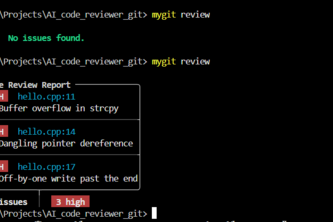
The project described is a local, C++-based Git wrapper named mygit (AI_Git_Reviewer_local) that integrates with a local LLM for code review and commit validation. It operates without cloud dependencies or network calls, using structured output from a grammar-guided LLM to enforce code quality and prevent problematic commits.
What changed
The author describes building a fully local, reliable, and fast code review tool that avoids common pitfalls of cloud-based tools (e.g., parsing errors, data exposure), with an emphasis on reliability through GBNF grammar enforcement, native Git integration, and caching mechanisms.
Single most important open question
Is there any evidence of adoption or usage beyond the authors' own development? The project is self-reported as a hackathon submission with no mention of external users, revenue, or traction.
What The Product Actually Is
The description states that mygit is a C++20 CLI wrapper around Git. It reviews staged diffs using a local LLM, enforces structured output via GBNF grammar, and blocks commits with critical issues. It also generates Conventional Commit messages and stores all assessments in SQLite.
- The tool integrates with libgit2 for native Git operations, bypassing shell parsing.
- It uses a RAG pipeline to retrieve semantically related code from the repository.
- A daemonized model server and multiple caching layers aim to reduce latency.
- It supports graceful degradation when embeddings or models are not available.
Inference: The product is described as a developer tool for local, automated code review in Git workflows. It is not a SaaS offering, nor does it appear to be a marketplace or platform.
Positioning & Claim Evolution
The author claims the project was built in response to two failures:
- A cloud-based LLM parser that crashed due to malformed JSON.
- The lack of control and privacy offered by cloud code review tools.
This led to a positioning around local, reliable, and fast code review with guarantees instead of hopes.
- The tool is described as fully local, with no network calls or API keys.
- It is built for developer workflows, not enterprise or product teams.
- The author emphasizes reliability through structure, using GBNF to enforce JSON output rather than relying on prompt engineering.
Claim: This is a developer tool that improves code quality by enforcing local, structured LLM-based review in Git workflows.
Not evidenced: No claims about market fit, customer feedback, or competitive positioning beyond self-description.
Target Customer & ICP
The description states the product is built for developers who want local, fast, and reliable code review in their Git workflow.
- It targets users of Git, especially those working with C++ projects.
- The tool is designed to be used by individuals or small teams, not large enterprises.
- It assumes a technical user base familiar with CLI tools and Git internals.
Inference: The ICP likely includes developers using C++ in local environments, who value control over their code review process.
Not evidenced: No evidence of customer segments, personas, or usage beyond the authors’ own development.
Business Model & Pricing Evidence
The description does not mention any pricing, monetization, or business model.
- The tool is described as a local CLI utility, with no indication of paid features or subscriptions.
- It is built for personal or internal use and not presented as a commercial product.
Not evidenced: No revenue model, pricing structure, or monetization strategy.
Technical & Delivery Signals
The project is built in C++20, using libraries such as:
- libgit2 for Git operations
- llama.cpp with GBNF for LLM inference
- ONNX Runtime, FAISS, Tree-sitter for RAG pipeline
- SQLite for storing review history
Key technical features include:
- Grammar-guided output to prevent parsing errors
- Native Git integration (no shell calls)
- Daemonized model server with caching layers
- Incremental indexing and content-addressed cache
- Graceful degradation when components are missing
Inference: The tool is built for performance, reliability, and developer experience.
Not evidenced: No evidence of scalability, deployment, or production usage beyond the authors’ own use.
Traction & Maturity Signals
The project is described as a hackathon submission (OpenAI 2026) and has no evidence of:
- Revenue
- Customers
- Adoption
- Product-market fit
- External feedback or usage
Not evidenced: No traction, adoption, or user data.
Competitive Context
The author mentions that cloud-based code review tools were a motivation for the project. However, there is no mention of:
- Specific competitors
- Market size or landscape
- Prior art in local LLM tools for Git
Inference: The tool may compete with cloud-based LLM code review tools (e.g., GitHub Copilot, SonarQube, etc.), but no direct comparison or competitive positioning is provided.
Open Questions & Risks
- No external adoption or feedback — the project is self-reported and not validated by users.
- High technical complexity — built in C++ with many dependencies (e.g., ONNX Runtime, CUDA, FAISS), which may limit accessibility.
- Limited scope — focused on Git workflows, not broader development tooling or enterprise needs.
- Hackathon project — likely not production-ready or scalable beyond the authors’ own use.
Inference: The tool is experimental and unproven in real-world usage.
Not evidenced: No evidence of risks being mitigated or addressed.
Questions the description leaves open
- What was the motivation for choosing C++ over other languages?
- How does the tool handle large repositories or complex codebases?
- Has it been tested on real-world projects beyond the authors’ own?
- Are there plans to support other version control systems (e.g., Mercurial, SVN)?
- What is the expected latency for a typical commit review?
- How do you plan to scale or extend this tool beyond personal use?
Overall Assessment
Not evidenced.
The project is described as a hackathon submission, with no evidence of:
- Revenue
- Customers
- Product-market fit
- Traction
- Commercial viability
Inference: This is an experimental, developer-focused tool that may have potential for further development but lacks any commercial or market validation.
User Stories BotA demo video on every pull request
Get a demo video on every new feature
GitHub App that watches your pull requests and records a narrated, captioned demo.
Save time on demo prep and make informed decisions faster with a video walkthrough of every new feature.
Source
Submitted to the OpenAI 2026 hackathon on Devpost. Project home on Devpost. Back to the full gallery on Devpost.
This competitive analysis was produced by top-founders.com (opens in a new tab)
Generated by a language model from this project's public Devpost page — its tagline, the author's own write-up and any built-with tags listed there — as captured in August 2026. Short quotations are the author's words. It is an opinion on the idea as a business, not on the people behind it, and it reflects the description as published then. If the project has moved on, request a correction below. The analysis is not independent research and contains no verified traction, revenue or customer data.
An independent guide by KFG International LLC — not affiliated with, endorsed by, or connected to Devpost or OpenAI.