

Archive position — measured, not model output
0 likes on Devpost
2,263 of the 7,850 archived projects have more likes, and 5,587 share exactly 0 — so this project's #6,236 place in the like-ranked listing is a tie-break inside that group, not a ranking.
Projects (log scale)
Likes on Devpost. ▲ marks this project's group.
Show the figures
| Likes | Projects | Share of archive |
|---|---|---|
| 0 | 5,587 | 71.2% |
| 1 | 1,758 | 22.4% |
| 2 | 284 | 3.6% |
| 3–4 | 132 | 1.7% |
| 5–9 | 75 | 1.0% |
| 10+ | 14 | 0.2% |
 User Stories BotA demo video on every pull request
Get a demo video on every new feature
GitHub App that watches your pull requests and records a narrated, captioned demo.
Save time on demo prep and make informed decisions faster with a video walkthrough of every new feature.
Executive Summary
The project described by the caller is a railway control simulator with an AI fault advisor, built as a hackathon submission for the OpenAI 2026 hackathon. The author states that it simulates railway operations including track circuits, signals, point machines and train movements, and includes an AI component that advises dispatchers and crews on faults and writes incident reports after recovery. The AI is designed to never touch controls, only advise — a safety boundary by design.
The description indicates this is a single-person project with no external team or funding mentioned. It was built using Python and PySide6, with an OpenAI-compatible LLM backend (gpt-5.6-terra), and uses a two-agent development workflow involving Claude Code and Codex CLI. The author emphasizes that the AI does not execute commands, and that deterministic replay is preserved by keeping AI messages separate from domain state.
What changed: The project appears to be a proof-of-concept or prototype built in a short timeframe (a hackathon), with no evidence of commercial traction, revenue, or customer adoption. It is described as educational and safety-focused, not production-ready.
Most important open question: Is this an educational tool for railway training, or does it have potential to evolve into a safety-critical operational system? The description states the AI only advises, but there is no evidence of how this would scale or integrate with real-world systems beyond the simulator.
What The Product Actually Is
The description states that the project is:
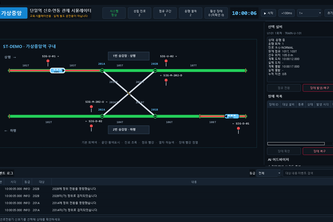
- A railway control simulator for a virtual single station, including:
- Track diagrams with 12 track circuits, 4 point machines, 6 signals, and 8 routes.
- Support for route setting, occupancy, fault indications, fail-safe interlocking.
- Automatic train operations on a timetable, recording stops, departures, and delays.
- An AI Fault Advisor that:
- Reads an immutable snapshot of the station state when a fault occurs.
- Generates dispatcher notifications, crew cautions, and recommended actions.
- Writes incident reports after fault recovery, including timeline, affected trains, estimated cause, and suggestions to prevent recurrence.
- Built with:
- A pure-Python domain model separated from UI (PySide6).
- An OpenAI-compatible client, defaulting to gpt-5.6-terra.
- A two-agent development workflow using Claude Code and Codex CLI.
The author emphasizes that the AI never executes commands, only advises, and that AI messages are kept separate from domain state to preserve deterministic replay.
Positioning & Claim Evolution
The description states:
- The project is an educational railway control simulator.
- It was built to reduce human error in fault response, not replace human judgment.
- The AI advisor helps with drafting notifications and incident reports, based on real-time state data.
- A key design principle is that the AI must not operate equipment — this is a safety boundary by design.
The author frames the project as a test of AI boundaries in safety-critical domains, where the AI’s role is advisory only. There is no claim about commercial deployment, production readiness, or integration with live systems.
This positioning is self-reported and unverified. The project is described as a hackathon prototype, not a product or service.
Target Customer & ICP
The description states:
- The author works as a field technician on the railway.
- The simulator is designed to help dispatchers and field staff in fault response.
- It is intended for educational use, possibly training personnel in railway operations and incident reporting.
There is no evidence of:
- Specific customer segments beyond the author’s own role.
- Any commercial or institutional users.
- A defined ICP (Ideal Customer Profile).
The project appears to be aimed at railway professionals or training institutions, but no explicit target customer list or persona is provided.
Business Model & Pricing Evidence
The description states:
- The project is a hackathon submission, not a commercial product.
- There is no mention of pricing, licensing, or monetization strategies.
- No evidence of revenue, customers, or sales channels.
Not evidenced: Any business model or pricing structure.
Technical & Delivery Signals
The description states:
- Built with:
- Pure-Python domain model separated from UI (PySide6).
- An OpenAI-compatible client, defaulting to gpt-5.6-terra.
- A two-agent development workflow using Claude Code and Codex CLI.
- Key technical features:
- Fail-safe interlocking for route setting, occupancy, and fault indications.
- Immutable snapshots for AI input.
- Non-blocking LLM generation, handled by worker threads.
- Error isolation: AI failures do not affect simulation or replay.
- Deterministic replay preserved by separating AI messages from domain state.
- Challenges overcome:
- Maintaining determinism despite non-deterministic LLM responses.
- Non-blocking generation during LLM calls.
- Fixing a design gap in departure handling.
The author also mentions:
- 85 regression tests passing at submission.
- Development workflow halved feature development time.
- Use of gpt-5.6-terra for both build-time and runtime AI tasks.
Traction & Maturity Signals
The description states:
- This is a hackathon project submitted to the OpenAI 2026 hackathon.
- No evidence of:
- Revenue, customers, or adoption.
- Product-market fit or user feedback.
- Post-submission development or deployment.
There is no evidence of traction beyond the author’s own account. The project is described as a proof-of-concept, not a product in use.
Competitive Context
The description states:
- No mention of competitors or market analysis.
- The author does not reference existing railway simulators, AI fault systems, or safety-critical control platforms.
Not evidenced: Any competitive landscape or positioning relative to other tools in the railway or AI domains.
Open Questions & Risks
- Unverified claims: All features and design decisions are self-reported.
- No commercial traction: The project is a hackathon submission, with no evidence of adoption or revenue.
- Single-person development: No team, funding, or external support mentioned — raises questions about scalability or long-term viability.
- Prototype nature: The author explicitly states this is a proof-of-concept, not a production-ready system.
- AI safety boundary: While the AI is designed to not operate controls, there is no evidence of how this would be enforced in real-world systems beyond simulation.
Questions the description leaves open
- What are the specific use cases for this simulator beyond training?
- How does the AI’s advisory role translate into a real-world safety-critical system?
- Is there any plan to integrate with live railway systems, or is it purely educational?
- What would be the next steps in terms of development, testing, and deployment?
- How do you plan to scale beyond a single station or extend functionality?
- Are there any real-world fault case studies or data sources used for training the AI?
- What is the long-term vision for this project — educational tool, commercial product, or research prototype?
Overall Assessment
The description states that this is a hackathon submission, not a commercial venture.
There is no evidence of:
- Revenue
- Customers
- Product-market fit
- Team or funding
- Commercial viability
Assessment: This is a proof-of-concept prototype with educational and safety-focused intent. It does not appear to be a viable investment or partnership opportunity at this stage, as it lacks commercial traction, scalability, or clear monetization.
The project may have potential for future development, but no evidence supports its readiness for commercial deployment or investment.
User Stories BotA demo video on every pull request
Get a demo video on every new feature
GitHub App that watches your pull requests and records a narrated, captioned demo.
Save time on demo prep and make informed decisions faster with a video walkthrough of every new feature.
Source
Submitted to the OpenAI 2026 hackathon on Devpost. Project home on Devpost. Back to the full gallery on Devpost.
This competitive analysis was produced by top-founders.com (opens in a new tab)
Generated by a language model from this project's public Devpost page — its tagline, the author's own write-up and any built-with tags listed there — as captured in August 2026. Short quotations are the author's words. It is an opinion on the idea as a business, not on the people behind it, and it reflects the description as published then. If the project has moved on, request a correction below. The analysis is not independent research and contains no verified traction, revenue or customer data.
An independent guide by KFG International LLC — not affiliated with, endorsed by, or connected to Devpost or OpenAI.