

Archive position — measured, not model output
0 likes on Devpost
2,263 of the 7,850 archived projects have more likes, and 5,587 share exactly 0 — so this project's #2,503 place in the like-ranked listing is a tie-break inside that group, not a ranking.
Projects (log scale)
Likes on Devpost. ▲ marks this project's group.
Show the figures
| Likes | Projects | Share of archive |
|---|---|---|
| 0 | 5,587 | 71.2% |
| 1 | 1,758 | 22.4% |
| 2 | 284 | 3.6% |
| 3–4 | 132 | 1.7% |
| 5–9 | 75 | 1.0% |
| 10+ | 14 | 0.2% |
 User Stories BotA demo video on every pull request
Get a demo video on every new feature
GitHub App that watches your pull requests and records a narrated, captioned demo.
Save time on demo prep and make informed decisions faster with a video walkthrough of every new feature.
Executive Summary
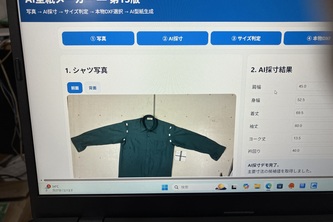
The description states that AI PatternMaker-Photo to SewingPattern is a prototype tool combining 50 years of garment-making experience with AI to convert garment photos into measurements and sewing patterns. The author reports using a reference marker, front/back photographs, and ChatGPT to build the system. It is described as a workflow that estimates dimensions from images and generates pattern components such as front body, back body, sleeve, and collar. The long-term goal includes connecting with professional apparel CAD workflows and formats like DXF. No revenue, customers, or traction data are evidenced.
Key Open Question
What is the actual commercial viability of this prototype, given that it is described as a single-person project with no evidence of product-market fit, revenue, or adoption?
What The Product Actually Is
The description states that AI PatternMaker is a prototype workflow that turns garment photographs into measurements and sewing-pattern components. It uses:
- A 10 cm x 10 cm reference marker placed with the garment.
- Front and back photographs for visual information about proportions and construction.
- AI to identify boundaries, estimate dimensions, and generate pattern pieces (front body, back body, back yoke, sleeve, collar).
- Reference patterns and professional CAD data for accuracy.
It is described as a system that combines AI with experienced garment-making knowledge to improve pattern creation. The author notes that ChatGPT was used as an AI development partner to help build the interface and prototype.
Inference It appears to be a proof-of-concept tool, not a commercial product, based on its description as a "prototype workflow" and the single-person team.
Positioning & Claim Evolution
The author states that the project combines decades of practical garment-making experience with modern AI. The tagline claims it makes professional pattern creation faster and easier by turning garment photos into measurements and sewing patterns.
Inference The positioning is to bridge traditional garment-making expertise with AI, targeting users who want to streamline or automate pattern creation. The claim evolution suggests a shift from manual, time-consuming methods to an automated solution using AI.
Target Customer & ICP
The description does not state specific customer segments or personas. It implies the tool could be useful for individuals or businesses involved in garment sewing and manufacturing, but no explicit target customer is named.
Inference The likely ICP includes amateur sewers, small-scale pattern makers, or fashion students who want to create patterns from existing garments. However, this is inferred from the context of the project and not explicitly stated.
Business Model & Pricing Evidence
There is no evidence in the description of a business model or pricing structure. The project is described as a prototype submitted to a hackathon, with no mention of monetization, licensing, or sales channels.
Inference No commercial business model has been evidenced; it appears to be an experimental tool without a defined revenue path.
Technical & Delivery Signals
The author reports:
- Use of a reference marker for scale.
- Front and back photographs for clarity.
- AI tools (including ChatGPT) for development.
- Integration with professional CAD formats like DXF.
- Iterative improvements using reference patterns and real-world data.
Inference The technical approach shows an experimental, iterative design process. It is not clear if the tool is scalable or production-ready.
Traction & Maturity Signals
The description states that this is a prototype submitted to a hackathon. There is no evidence of revenue, customers, user adoption, or product maturity beyond its initial development phase.
Inference No traction or maturity signals are evidenced; it remains in early-stage development.
Competitive Context
There is no mention of competitors or existing solutions in the description. The author does not reference similar tools or platforms that might already exist for pattern creation or garment analysis.
Inference No competitive context is provided, which leaves open questions about market saturation or differentiation.
Open Questions & Risks
- Single-person team: The project is built by one individual (若井 幹雄), raising questions about scalability and long-term development.
- Prototype status: It is described as a prototype submitted to a hackathon, not a commercial product.
- Technical limitations: Challenges include perspective, fabric wrinkles, hidden seams, and the difficulty of converting visual measurements into meaningful pattern geometry.
- Lack of commercial evidence: No revenue, customers, or adoption data are provided.
Inference The project is at a very early stage with no demonstrated traction or commercial viability. Risks include technical feasibility, scalability, and lack of market validation.
Questions the description leaves open
- What specific use cases or user groups do you expect to adopt this tool?
- How do you plan to validate the accuracy of measurements and pattern outputs?
- Are there any existing partnerships or customers in the fashion or sewing industry?
- What are your plans for scaling beyond a single-person prototype?
- How will you integrate with professional CAD systems like DXF, and what is the timeline for that?
- What is the expected path to monetization?
Overall Assessment
The description states that AI PatternMaker-Photo to SewingPattern is a prototype submitted to an OpenAI hackathon. It is not evidenced to have any revenue, customers, or traction. The project is described as experimental and built by one person.
Inference At this stage, it is not a viable investment or partnership opportunity based on the lack of commercial evidence, product-market fit, or scalability. It may be an interesting idea for further development but lacks the signals needed to assess its potential for growth or return.
User Stories BotA demo video on every pull request
Get a demo video on every new feature
GitHub App that watches your pull requests and records a narrated, captioned demo.
Save time on demo prep and make informed decisions faster with a video walkthrough of every new feature.
Source
Submitted to the OpenAI 2026 hackathon on Devpost. Project home on Devpost. Back to the full gallery on Devpost.
This competitive analysis was produced by top-founders.com (opens in a new tab)
Generated by a language model from this project's public Devpost page — its tagline, the author's own write-up and any built-with tags listed there — as captured in August 2026. Short quotations are the author's words. It is an opinion on the idea as a business, not on the people behind it, and it reflects the description as published then. If the project has moved on, request a correction below. The analysis is not independent research and contains no verified traction, revenue or customer data.
An independent guide by KFG International LLC — not affiliated with, endorsed by, or connected to Devpost or OpenAI.