

Archive position — measured, not model output
0 likes on Devpost
2,263 of the 7,850 archived projects have more likes, and 5,587 share exactly 0 — so this project's #2,504 place in the like-ranked listing is a tie-break inside that group, not a ranking.
Projects (log scale)
Likes on Devpost. ▲ marks this project's group.
Show the figures
| Likes | Projects | Share of archive |
|---|---|---|
| 0 | 5,587 | 71.2% |
| 1 | 1,758 | 22.4% |
| 2 | 284 | 3.6% |
| 3–4 | 132 | 1.7% |
| 5–9 | 75 | 1.0% |
| 10+ | 14 | 0.2% |
 User Stories BotA demo video on every pull request
Get a demo video on every new feature
GitHub App that watches your pull requests and records a narrated, captioned demo.
Save time on demo prep and make informed decisions faster with a video walkthrough of every new feature.
Executive Summary
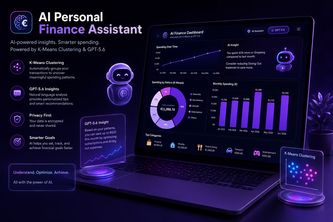
The description states that "AI Personal Finance Assistant" is a personal finance tool built as a hackathon project by one developer (Olga Aksenova). The app analyzes bank statements using Python-based machine learning and AI to uncover spending patterns, with features like clustering, GPT-powered insights, and visualizations. It is presented as a self-contained application that processes CSV or Excel files uploaded by users.
The author claims the tool aims to make personal finance analysis accessible without requiring financial expertise. The project was submitted to an OpenAI hackathon and has no evidence of revenue, customers, or traction beyond its own description.
Most important open question
Is there any indication that this project will evolve into a commercial product with sustainable business model, or is it purely experimental?
What The Product Actually Is
The description states:
- A tool that analyzes bank statements
- Uses Python-based machine learning (pandas, scikit-learn) and AI (GPT-5.6)
- Processes .csv or .xlsx files up to 5 MB
- Groups merchants into spending patterns using K-means clustering
- Provides explanations of spending behavior via GPT-5.6
- Features a responsive Streamlit dashboard with Plotly visualizations
The author describes it as an application that "unites AI and machine learning" to help users understand their spending without needing financial expertise.
Inference Based on the technical stack, this appears to be a prototype or proof-of-concept built for demonstration purposes rather than a production-grade SaaS offering. The use of Streamlit suggests a lightweight frontend framework typically used in data science prototyping.
Positioning & Claim Evolution
The description states:
- The app aims to "change" how people view their spending by revealing hidden patterns
- It seeks to be "useful and easy to use, yet still powerful 'under the hood'"
- It is positioned as a tool that helps users understand why they spend money, not just what they spent
- The author emphasizes it's meant to be "meaningful from day one" and something she'd genuinely use herself
Inference The positioning appears to be evolving from a personal utility (a hackathon project) toward a broader consumer finance tool. However, there is no evidence of market research or user feedback beyond the creator’s own experience.
Target Customer & ICP
The description states:
- The target audience is people who struggle with understanding where their money goes
- Users are described as those who have "dozens of recurring payments and hundreds of transactions every month"
- The tool is intended for individuals who don't want to spend hours analyzing spreadsheets or be finance experts
Inference Based on the description, the ICP seems to be individual consumers with moderate-to-high transaction volumes but limited financial literacy or time to analyze spending. However, no segmentation data or customer personas are provided.
Business Model & Pricing Evidence
The description states:
- No explicit pricing model is mentioned
- The tool is described as a "personal finance assistant" that processes uploaded files
- There is no mention of subscriptions, usage fees, or monetization strategies
- The author mentions future features like downloadable PDF reports and budgeting tools, but does not link these to revenue generation
Inference There is no evidence of any business model or pricing structure. The project appears to be a prototype with no indication of commercial viability or monetization plans.
Technical & Delivery Signals
The description states:
- Built entirely in Python
- Uses pandas for data processing, scikit-learn for clustering, and GPT-5.6 for insights
- Deployed using Streamlit dashboard with Plotly visualizations
- Files are parsed into DataFrames, normalized, and feature-engineered before clustering
- Privacy is protected by not sending raw transaction data to GPT; only aggregated statistics are used
Inference The technical approach shows a clear understanding of data science workflows (clustering, feature engineering), but the delivery method (Streamlit) suggests a prototype or MVP rather than a scalable SaaS platform. The use of GPT-5.6 implies integration with an API-based AI service.
Traction & Maturity Signals
The description states:
- This is a hackathon project submitted to the OpenAI 2026 hackathon
- The team consists of one person (Olga Aksenova)
- No mention of users, customers, or adoption metrics
- No revenue data, usage statistics, or product performance indicators are provided
Inference There is no evidence of traction or maturity beyond the initial development phase. The project has not been deployed in a production environment or tested with real users.
Competitive Context
The description states:
- No direct competitors are named
- The author notes that most people have "dozens of recurring payments and hundreds of transactions every month"
- The app aims to provide insights beyond what is visible in bank statements
Inference While the concept overlaps with personal finance tools, there is no evidence of competitive analysis or awareness of existing solutions in this space. The lack of competitor references makes it difficult to assess positioning.
Open Questions & Risks
The description states:
- The project is a single-person effort
- No revenue, customers, or traction data are available
- The app uses GPT-5.6, which may raise concerns about scalability and cost
- Streamlit-based UI may not scale well for enterprise-level deployment
- The tool only supports English language input
Inference Key risks include lack of team capacity, unclear monetization strategy, potential dependency on external APIs (GPT), and limited scalability due to prototype architecture. There is no evidence of any risk mitigation or long-term planning.
Questions the description leaves open
- What is the plan for scaling beyond a single developer?
- How does the team intend to monetize this tool, if at all?
- Are there any plans to support additional languages or internationalization?
- Has the founder considered privacy and data security implications of handling financial data?
- What are the technical limitations of the current architecture that would prevent it from becoming a full SaaS product?
- How does the team plan to acquire users or build a customer base?
Overall Assessment
The description states:
- This is a hackathon project with no evidence of commercial traction
- The author intends to continue developing features like budgeting, alerts, and forecasting
- No funding rounds, revenue, or headcount data are available
Inference At this stage, the project lacks sufficient evidence to support investment or partnership interest. It appears to be a personal prototype with no clear path to commercialization or scalability. The lack of any business model, customer base, or financial indicators makes it difficult to assess its potential for growth or return on investment.
User Stories BotA demo video on every pull request
Get a demo video on every new feature
GitHub App that watches your pull requests and records a narrated, captioned demo.
Save time on demo prep and make informed decisions faster with a video walkthrough of every new feature.
Source
Submitted to the OpenAI 2026 hackathon on Devpost. Project home on Devpost. Back to the full gallery on Devpost.
This competitive analysis was produced by top-founders.com (opens in a new tab)
Generated by a language model from this project's public Devpost page — its tagline, the author's own write-up and any built-with tags listed there — as captured in August 2026. Short quotations are the author's words. It is an opinion on the idea as a business, not on the people behind it, and it reflects the description as published then. If the project has moved on, request a correction below. The analysis is not independent research and contains no verified traction, revenue or customer data.
An independent guide by KFG International LLC — not affiliated with, endorsed by, or connected to Devpost or OpenAI.