

Archive position — measured, not model output
0 likes on Devpost
2,263 of the 7,850 archived projects have more likes, and 5,587 share exactly 0 — so this project's #2,502 place in the like-ranked listing is a tie-break inside that group, not a ranking.
Projects (log scale)
Likes on Devpost. ▲ marks this project's group.
Show the figures
| Likes | Projects | Share of archive |
|---|---|---|
| 0 | 5,587 | 71.2% |
| 1 | 1,758 | 22.4% |
| 2 | 284 | 3.6% |
| 3–4 | 132 | 1.7% |
| 5–9 | 75 | 1.0% |
| 10+ | 14 | 0.2% |
 User Stories BotA demo video on every pull request
Get a demo video on every new feature
GitHub App that watches your pull requests and records a narrated, captioned demo.
Save time on demo prep and make informed decisions faster with a video walkthrough of every new feature.
Executive Summary
What the company appears to be
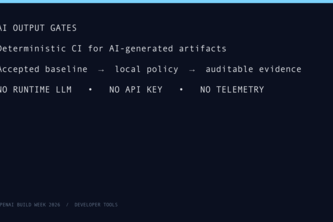
The project described as "AI Output Gates" is a deterministic, local continuous integration (CI) tool for AI-generated artifacts. It allows teams to define accepted baselines and evaluate new changes against them using policy checks, without relying on external APIs or cloud services.
What changed
This is a self-reported developer tool built during a hackathon. No prior version or commercial history is evident. The author states that it was developed using GPT-5.6 and Codex for design refinement and implementation but the final product runs fully locally with no runtime LLM or external API calls.
Single most important open question
Is there any evidence of real-world usage, adoption, or traction beyond the hackathon submission?
What The Product Actually Is
The description states that AI Output Gates:
- Records an accepted local baseline.
- Evaluates a candidate against this baseline using deterministic gates.
- Classifies findings as new, resolved, or unchanged.
- Applies an explicit checked-in policy.
- Emits outputs in JSON, Markdown, SARIF, and offline HTML evidence packs.
- Runs fully locally with no model API key required.
- Makes no runtime LLM or external API calls.
- Sends no artifact data to a hosted service.
Inference The tool appears to be a CLI-based developer utility designed for code review and CI gate enforcement in AI-assisted development workflows.
Positioning & Claim Evolution
The author claims:
- AI-generated changes can look finished before they are safe to merge.
- Model self-review is useful but not a stable CI signal.
- Teams need a deterministic layer that answers: “did this candidate regress from an accepted artifact?”
- The tool provides inspectable, deterministic policy enforcement.
Inference The positioning appears to be a local-first, deterministic CI gate for AI-generated code or artifacts — targeting developers and teams who want to ensure quality and compliance without cloud dependencies.
Target Customer & ICP
The description does not state:
- Who the target customer is.
- Whether the tool targets individual developers or enterprise teams.
- What specific use cases or industries it addresses.
Not evidenced.
Business Model & Pricing Evidence
The description does not state:
- How the product will be monetized.
- Whether it is open-source, freemium, or paid.
- If there are any pricing tiers or plans.
Not evidenced.
Technical & Delivery Signals
The author states:
- The CLI is built with Node.js 20 and TypeScript using Node built-ins.
- Stable SHA-256 fingerprints ensure reproducibility.
- SARIF 2.1.0 integrates with code scanning.
- The HTML report contains no scripts, remote fonts, analytics, or network assets.
- GPT-5.6 and Codex were used during development but not in runtime.
Inference The tool is built for developers, with a focus on deterministic behavior and local execution. It appears to be a lightweight CLI utility with strong emphasis on privacy and auditability.
Traction & Maturity Signals
The author states:
- 70 automated tests pass in the repository.
- A deliberate regression fails at 22/100 with a delta of -78.
- The accepted README passes at 100/100 with a delta of 0.
- The package works directly from the public GitHub tag.
- Desktop, mobile, keyboard, contrast, secret, and offline-asset checks pass.
Not evidenced No evidence of customer adoption, revenue, or usage beyond the hackathon submission. No data on how many users or teams are using it.
Competitive Context
The description does not state:
- Who the competitors are.
- What similar tools already exist in the market.
- How this product differentiates from existing CI or code quality tools.
Not evidenced.
Open Questions & Risks
- The tool is a hackathon submission with no prior commercial traction.
- No evidence of real-world usage or adoption.
- No mention of any funding, team size beyond one person, or roadmap beyond the next steps listed.
- The author states that the product runs fully locally and makes no external calls — this may limit its utility in enterprise environments where integration with CI/CD pipelines is required.
- The project has not been independently verified or audited.
Inference The tool is experimental and unproven. It lacks commercial viability indicators, such as customers, revenue, or a clear go-to-market strategy.
Questions the description leaves open
- What are the actual use cases you've seen in practice for this tool?
- Have you tested it with real teams or CI pipelines?
- How do you plan to monetize this product?
- Is there a roadmap beyond the next steps mentioned in the write-up?
- Are there any plans to integrate with existing CI/CD platforms or code scanning tools?
- What is your long-term vision for the tool and its market fit?
Overall Assessment
Not evidenced.
The project is a hackathon submission with no evidence of traction, revenue, customers, or commercialization. It is not clear whether it has moved beyond prototype stage or if there are any plans to build it into a product.
The author states that the tool is deterministic and fully local, which may appeal to privacy-conscious developers but does not indicate scalability or enterprise readiness. Without further evidence of adoption, market demand, or business model, this project cannot be evaluated as a viable investment or partnership opportunity at this time.
Confidence Low. The entire analysis is based on self-reported information with no external validation.
User Stories BotA demo video on every pull request
Get a demo video on every new feature
GitHub App that watches your pull requests and records a narrated, captioned demo.
Save time on demo prep and make informed decisions faster with a video walkthrough of every new feature.
Source
Submitted to the OpenAI 2026 hackathon on Devpost. Project home on Devpost. Back to the full gallery on Devpost.
This competitive analysis was produced by top-founders.com (opens in a new tab)
Generated by a language model from this project's public Devpost page — its tagline, the author's own write-up and any built-with tags listed there — as captured in August 2026. Short quotations are the author's words. It is an opinion on the idea as a business, not on the people behind it, and it reflects the description as published then. If the project has moved on, request a correction below. The analysis is not independent research and contains no verified traction, revenue or customer data.
An independent guide by KFG International LLC — not affiliated with, endorsed by, or connected to Devpost or OpenAI.