

Archive position — measured, not model output
0 likes on Devpost
2,263 of the 7,850 archived projects have more likes, and 5,587 share exactly 0 — so this project's #5,614 place in the like-ranked listing is a tie-break inside that group, not a ranking.
Projects (log scale)
Likes on Devpost. ▲ marks this project's group.
Show the figures
| Likes | Projects | Share of archive |
|---|---|---|
| 0 | 5,587 | 71.2% |
| 1 | 1,758 | 22.4% |
| 2 | 284 | 3.6% |
| 3–4 | 132 | 1.7% |
| 5–9 | 75 | 1.0% |
| 10+ | 14 | 0.2% |
 User Stories BotA demo video on every pull request
Get a demo video on every new feature
GitHub App that watches your pull requests and records a narrated, captioned demo.
Save time on demo prep and make informed decisions faster with a video walkthrough of every new feature.
Executive Summary
Company: NurseFlow AI
Self-reported basis: The description is entirely self-reported and unverified; it contains no evidence of revenue, customers, or traction.
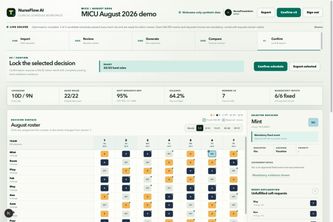
What the company appears to be: A prototype tool for generating ICU nurse shift schedules using constraint solving and AI-assisted normalization, with human approval built in.
What changed: The project was submitted as a hackathon entry (Devpost, OpenAI 2026) and includes a public repository with synthetic data and test cases.
Single most important open question: Is there any evidence of real-world use or feedback from hospital schedulers?
What The Product Actually Is
The description states that NurseFlow AI:
- Imports pseudonymous nurse request sheets
- Normalizes ambiguous request values for human review
- Creates multiple ICU roster candidates using a solver (Google OR-Tools CP-SAT)
- Supports the MICU form, discarding employee codes and notes before processing
- Uses GPT-5.6 via OpenAI Responses API to suggest normalization and explain solver evidence
- Does not generate rosters directly; instead, CP-SAT creates assignments, a validator checks them, and a human scheduler approves
- Exports review-ready workbooks using ExcelJS and openpyxl
- Stores confirmed versions in Supabase with immutable history when matching staged rosters exist
- Is admin-only, with JWT session authentication and protected server boundaries
Inference: The system is a hybrid workflow tool combining constraint solving, AI interpretation of ambiguous data, and human decision-making. It is not an autonomous scheduling engine but a decision-support platform.
Positioning & Claim Evolution
The description states:
- NurseFlow AI aims to make nurse scheduling faster and more explainable without letting AI make the final staffing decision
- It supports existing MICU forms while anonymizing data
- The tool emphasizes human control, auditability, and explainability over automation
- It is positioned as a solution for high-stakes operational documents in ICU settings
Inference: The positioning reflects a cautious approach to AI adoption in sensitive environments like healthcare. It avoids claims of full autonomy or replacement of human schedulers.
Target Customer & ICP
The description states:
- The tool targets hospital ICU schedulers
- It supports the MICU form, suggesting alignment with specific institutional workflows
- It is admin-only and designed for internal use by scheduling teams
Inference: The ICP appears to be internal hospital staff responsible for ICU nurse scheduling, likely in large institutions where staffing complexity is high.
Business Model & Pricing Evidence
Not evidenced.
The description does not mention pricing models, monetization strategies, or any business model beyond the hackathon prototype.
Technical & Delivery Signals
The description states:
- Built with Next.js, React, TypeScript, FastAPI, Python, Supabase
- Uses Google OR-Tools CP-SAT for scheduling constraints
- GPT-5.6 via OpenAI Responses API for normalization and explanation
- Implements admin-only JWT authentication and server-to-server boundaries
- Includes 117 web test cases, 58 solver tests, clean dependency audits, and responsive browser QA
- Public repository with synthetic pseudonymous sample data
Inference: The technical stack suggests a modern, secure, and test-driven development approach. The use of constraint solving and structured AI outputs indicates attention to correctness and explainability.
Traction & Maturity Signals
Not evidenced.
There is no mention of users, customers, revenue, or adoption beyond the hackathon submission and prototype.
Competitive Context
Not evidenced.
The description does not reference competitors or market positioning beyond its own claims.
Open Questions & Risks
- Unverified claims: All features and capabilities are self-reported and unverified.
- No traction evidence: No customers, revenue, or usage data provided.
- Prototype-only status: The project is a hackathon submission with no indication of production deployment or pilot use.
- Limited scope: The tool is admin-only and designed for internal use; unclear if it can scale to broader hospital systems.
- AI dependency risks: Reliance on GPT-5.6 raises questions about consistency, cost, and availability in a production setting.
Questions the description leaves open
- What specific constraints are encoded in the Google OR-Tools solver?
- How does the system handle edge cases or unexpected inputs from nurse requests?
- Are there any real-world pilots or feedback loops with hospital schedulers?
- What is the plan for identity management and MFA integration?
- How is data privacy ensured beyond anonymization in the prototype?
- Is there a roadmap for moving from prototype to production-ready deployment?
Overall Assessment
Not evidenced.
There is no evidence of revenue, customers, or traction to assess viability or investment potential. The project is described as a hackathon prototype with no indication of commercialization or market readiness.
User Stories BotA demo video on every pull request
Get a demo video on every new feature
GitHub App that watches your pull requests and records a narrated, captioned demo.
Save time on demo prep and make informed decisions faster with a video walkthrough of every new feature.
Source
Submitted to the OpenAI 2026 hackathon on Devpost. Project home on Devpost. Back to the full gallery on Devpost.
This competitive analysis was produced by top-founders.com (opens in a new tab)
Generated by a language model from this project's public Devpost page — its tagline, the author's own write-up and any built-with tags listed there — as captured in August 2026. Short quotations are the author's words. It is an opinion on the idea as a business, not on the people behind it, and it reflects the description as published then. If the project has moved on, request a correction below. The analysis is not independent research and contains no verified traction, revenue or customer data.
An independent guide by KFG International LLC — not affiliated with, endorsed by, or connected to Devpost or OpenAI.