

Archive position — measured, not model output
0 likes on Devpost
2,263 of the 7,850 archived projects have more likes, and 5,587 share exactly 0 — so this project's #2,496 place in the like-ranked listing is a tie-break inside that group, not a ranking.
Projects (log scale)
Likes on Devpost. ▲ marks this project's group.
Show the figures
| Likes | Projects | Share of archive |
|---|---|---|
| 0 | 5,587 | 71.2% |
| 1 | 1,758 | 22.4% |
| 2 | 284 | 3.6% |
| 3–4 | 132 | 1.7% |
| 5–9 | 75 | 1.0% |
| 10+ | 14 | 0.2% |
 User Stories BotA demo video on every pull request
Get a demo video on every new feature
GitHub App that watches your pull requests and records a narrated, captioned demo.
Save time on demo prep and make informed decisions faster with a video walkthrough of every new feature.
Executive Summary
What the company appears to be
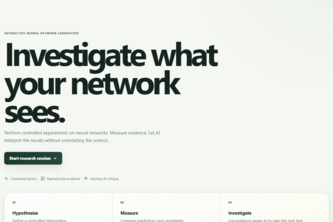
The author describes AI Neural Scientist as an educational tool that enables users to perform controlled artificial neural-network lesion experiments in an interactive neuroscience laboratory. It is built for learners and students to understand how neural networks behave under controlled conditions, using a deterministic evaluation engine and GPT-5.6 as a cautious research collaborator.
What changed
This project was submitted to the OpenAI Build Week 2026 hackathon. The author states that it evolved from an idea to build a tool that encourages experimentation rather than observation in machine learning education, inspired by neuroscience practices and Neuralink.
Single most important open question
Is there any evidence of user adoption or traction beyond the single developer's prototype? The description does not indicate whether the tool has been used by students, educators, or institutions.
What The Product Actually Is
The description states that AI Neural Scientist is a full-stack research platform for performing controlled artificial neural-network lesion experiments. It transforms a trained MNIST CNN into an interactive laboratory where users can:
- Formulate hypotheses
- Temporarily disable individual feature channels or hidden neurons
- Compare baseline and lesioned performance deterministically
- Inspect accuracy changes, confusion matrices, and confidence intervals
- Receive feedback from GPT-5.6 in the form of evidence-aware critique
- Save and export experiments as PDFs, Markdown, or LaTeX reports
It uses PyTorch for backend execution, FastAPI for API services, Next.js/React for frontend UI, and integrates with OpenAI GPT-5.6 to provide structured scientific feedback.
Evidence
- The write-up explicitly describes the functionality.
- Technology tags include: ai, codex, deep, education, explainable, fastapi, gpt-5.6, javascript, machine-learning, mnist, neuroscience, next.js, openai, python, pytorch, react, reportlab, research, sqlite, torchvision, trustworthy, typescript.
Inference The product is a prototype educational tool focused on teaching neural network interpretability through experimentation.
Positioning & Claim Evolution
The author positions AI Neural Scientist as an evidence-first interactive neuroscience laboratory for controlled artificial neural-network lesion experiments. It is described as a tool that teaches scientific understanding through carefully designed valid experiments, measured evidence, and replication — not just black-box observation.
It aims to encourage experimentation over passive learning, inspired by how neuroscientists study the brain.
Evidence
- The author explicitly states: “I wanted to enter the OpenAI Build Week 2026 and enter the education category as I want to build a tool that encourages experimentation rather than just observation.”
- It is described as teaching “scientific understanding comes from carefully designed valid experiments, measured evidence and replication of these experiments.”
Inference The positioning reflects an intent to democratize scientific learning in machine learning through controlled experimentation.
Target Customer & ICP
The description states that the tool is intended for students and learners who are studying neural networks and machine learning for the first time. It also mentions a goal to make it usable to a broad range of users, including those unfamiliar with advanced ML concepts.
Evidence
- “I wanted to build a tool that encourages experimentation rather than just observation.”
- “I wanted the interface to feel like a modern research application while remaining understandable to students who are learning about neural networks and machine learning for the first time.”
Inference The primary ICP appears to be undergraduate or beginner-level learners in computer science, data science, or AI education.
Business Model & Pricing Evidence
Not evidenced. The description does not contain any information on pricing models, monetization strategies, or business structure beyond the author's personal development effort.
Technical & Delivery Signals
The product is built using:
- Frontend: Next.js, React, TypeScript
- Backend: PyTorch, FastAPI, SQLite
- AI integration: GPT-5.6 via structured data packets
- Tools used for development: Codex (AI engineering collaborator)
It includes features like:
- Deterministic evaluation
- Paired bootstrap confidence intervals
- Structured experiment logging and export capabilities
- Scientific guardrails to prevent overstatement of conclusions
Evidence
- The write-up details the stack and technical architecture.
- GPT-5.6 is integrated as a cautious collaborator, not a source of truth.
Inference The tool shows strong engineering discipline in building a reproducible, scientific platform with clear separation between measured data and AI interpretation.
Traction & Maturity Signals
Not evidenced. There is no mention of users, customers, or adoption beyond the single developer’s prototype. No revenue, usage metrics, or product-market fit indicators are provided.
Competitive Context
Not evidenced. The description does not reference competitors or similar tools in the market for educational AI or neural network interpretability platforms.
Open Questions & Risks
- Single Developer: Only one team member is listed (T Kalvin), which raises concerns about scalability and long-term maintenance.
- No Traction: No evidence of user adoption, customer feedback, or real-world usage beyond the prototype.
- Limited Scope: Currently focused only on MNIST dataset; future plans are speculative without execution history.
- Dependency on GPT-5.6: Reliance on a proprietary model with unclear availability or cost implications.
- Unverified Claims: All claims about functionality and impact are self-reported, unverified.
Questions the description leaves open
- What specific educational outcomes have you observed from using this tool?
- Have you tested it with actual students or educators? If so, what were their feedbacks?
- How do you plan to scale beyond the MNIST dataset and current architecture?
- Is there any intention to monetize the platform? If yes, how?
- What are the technical limitations of relying on GPT-5.6 for scientific critique?
- Are there plans to support multi-user collaboration or cloud deployment?
Overall Assessment
Not evidenced. No financials, funding rounds, or partnership history are available. The description does not indicate any commercial traction or investment interest.
The author describes a promising educational prototype with strong technical execution and clear intent to improve machine learning education through scientific experimentation. However, due to the lack of evidence for user adoption, revenue, or market validation, there is insufficient basis for an investment or partnership decision at this stage.
Confidence Level Low — based entirely on self-reported project description.
User Stories BotA demo video on every pull request
Get a demo video on every new feature
GitHub App that watches your pull requests and records a narrated, captioned demo.
Save time on demo prep and make informed decisions faster with a video walkthrough of every new feature.
Source
Submitted to the OpenAI 2026 hackathon on Devpost. Project home on Devpost. Back to the full gallery on Devpost.
This competitive analysis was produced by top-founders.com (opens in a new tab)
Generated by a language model from this project's public Devpost page — its tagline, the author's own write-up and any built-with tags listed there — as captured in August 2026. Short quotations are the author's words. It is an opinion on the idea as a business, not on the people behind it, and it reflects the description as published then. If the project has moved on, request a correction below. The analysis is not independent research and contains no verified traction, revenue or customer data.
An independent guide by KFG International LLC — not affiliated with, endorsed by, or connected to Devpost or OpenAI.