

Archive position — measured, not model output
0 likes on Devpost
2,263 of the 7,850 archived projects have more likes, and 5,587 share exactly 0 — so this project's #2,498 place in the like-ranked listing is a tie-break inside that group, not a ranking.
Projects (log scale)
Likes on Devpost. ▲ marks this project's group.
Show the figures
| Likes | Projects | Share of archive |
|---|---|---|
| 0 | 5,587 | 71.2% |
| 1 | 1,758 | 22.4% |
| 2 | 284 | 3.6% |
| 3–4 | 132 | 1.7% |
| 5–9 | 75 | 1.0% |
| 10+ | 14 | 0.2% |
 User Stories BotA demo video on every pull request
Get a demo video on every new feature
GitHub App that watches your pull requests and records a narrated, captioned demo.
Save time on demo prep and make informed decisions faster with a video walkthrough of every new feature.
Executive Summary
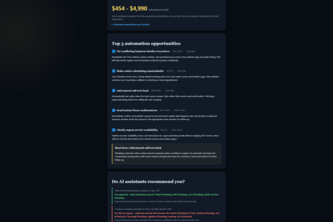
The description states that AI Opportunity Snapshot is a tool that takes a local service business name and returns a shareable report with an opportunity score, estimated revenue left on the table, automation recommendation, and AI visibility check — all powered by GPT-5.6 and deployed via Cloudflare Workers. The author claims to have built it solo in one session using Codex, with deterministic code for numeric outputs and model-backed research.
What changed: The project is described as a self-contained, production-ready tool built during a hackathon, with no evidence of prior development or traction beyond the author's own testing.
The single most important open question — commercial due-diligence read: Is there a viable market need for this type of AI-powered opportunity scoring and visibility analysis for local service businesses? The description does not substantiate any customer validation, revenue, or adoption.
What The Product Actually Is
The description states that AI Opportunity Snapshot is a tool that:
- Takes a business name as input
- Researches it live using GPT-5.6
- Returns a shareable report with:
- An opportunity score (with plain-language band)
- Estimated monthly revenue left on the table (with assumptions printed)
- The first automation to build for that specific business (with reasoning)
- AI visibility check: whether AI assistants recommend that business today
- Provides permanent shareable link and raw JSON output
- Is deployed via Cloudflare Workers and built with Astro, TypeScript, and Codex
The author claims the tool was built in one session using GPT-5.6 and Codex, with deterministic code handling numeric outputs and model-backed research for facts.
Positioning & Claim Evolution
The description states that the product is positioned as a tool to help local service business owners understand their opportunity gaps — specifically:
- Missed calls quietly leak revenue
- Businesses with thin web presence never get recommended by AI assistants
The author claims this addresses a problem they observe in their consulting practice, where business owners "can feel something is off but have no number attached to it."
The evolution of the claim appears to be from an idea (a tool that gives numbers to intuitions) to a product (a self-contained tool that delivers reports with deterministic numeric outputs and model-backed research).
Target Customer & ICP
The description states that the target customer is local service companies, as evidenced by:
- The author's own practice: "I run an AI consulting business for local service companies"
- The problem described: "missed calls quietly leak revenue" and "businesses with a thin web presence never get recommended when someone asks an AI assistant for a plumber or a roofer"
The ICP appears to be business owners or consultants working with local service businesses, who want quantifiable insights into their opportunity gaps.
Business Model & Pricing Evidence
Not evidenced. The description does not state anything about pricing, monetization, or business model.
Technical & Delivery Signals
The description states that the tool was built using:
- Codex (for writing code)
- GPT-5.6
- Astro 6 SSR application
- Cloudflare Workers deployment
- TypeScript
- Vitest (for testing)
The author claims to have built, tested, and deployed the entire project solo in one session during a hackathon.
Key technical details:
- The model powers the product at runtime through two passes: web search for research, then structured-output call returning typed JSON
- One deliberate design rule: the model never produces dollar amounts; all estimates are computed deterministically in code from printed assumptions
- 61 unit tests, all passing
- The tool is live and accessible via a URL without login
Traction & Maturity Signals
Not evidenced. The description does not state any customer data, usage metrics, revenue, or adoption beyond the author's own testing.
The author claims to have built, tested, and deployed the tool solo in one session during a hackathon, with 61/61 tests passing and three verified golden reports spanning the scoring range.
Competitive Context
Not evidenced. The description does not mention any competitors or competitive landscape.
Open Questions & Risks
- The product is described as a solo-built hackathon project with no evidence of traction or customer validation
- The author states that model-backed runs take 1–2 minutes, which exceeds Cloudflare's detached-work window — this raises questions about scalability and performance
- The tool is described as being built in one session using Codex, which may raise concerns about maintainability and long-term viability
- There is no evidence of any revenue, customers, or adoption beyond the author’s own testing
Questions the description leaves open
- What specific local service business types are you targeting, and how did you identify them?
- How do you plan to validate demand for this tool among your target customers?
- What is your strategy for scaling beyond a solo-built hackathon project?
- How do you intend to monetize this product, if at all?
- Have you tested the accuracy of the model's research and scoring in real-world scenarios?
- What are the technical limitations or bottlenecks that could prevent scaling?
Overall Assessment
Not evidenced. The description does not provide any information about funding, valuation, or investment interest.
The project is described as a solo-built hackathon product with no evidence of traction, revenue, or customer validation. It appears to be an experimental tool with limited commercial viability at this stage. The lack of any data on adoption, usage, or monetization makes it difficult to assess its potential for investment or partnership.
User Stories BotA demo video on every pull request
Get a demo video on every new feature
GitHub App that watches your pull requests and records a narrated, captioned demo.
Save time on demo prep and make informed decisions faster with a video walkthrough of every new feature.
Source
Submitted to the OpenAI 2026 hackathon on Devpost. Project home on Devpost. Back to the full gallery on Devpost.
This competitive analysis was produced by top-founders.com (opens in a new tab)
Generated by a language model from this project's public Devpost page — its tagline, the author's own write-up and any built-with tags listed there — as captured in August 2026. Short quotations are the author's words. It is an opinion on the idea as a business, not on the people behind it, and it reflects the description as published then. If the project has moved on, request a correction below. The analysis is not independent research and contains no verified traction, revenue or customer data.
An independent guide by KFG International LLC — not affiliated with, endorsed by, or connected to Devpost or OpenAI.