

Archive position — measured, not model output
0 likes on Devpost
2,263 of the 7,850 archived projects have more likes, and 5,587 share exactly 0 — so this project's #2,495 place in the like-ranked listing is a tie-break inside that group, not a ranking.
Projects (log scale)
Likes on Devpost. ▲ marks this project's group.
Show the figures
| Likes | Projects | Share of archive |
|---|---|---|
| 0 | 5,587 | 71.2% |
| 1 | 1,758 | 22.4% |
| 2 | 284 | 3.6% |
| 3–4 | 132 | 1.7% |
| 5–9 | 75 | 1.0% |
| 10+ | 14 | 0.2% |
 User Stories BotA demo video on every pull request
Get a demo video on every new feature
GitHub App that watches your pull requests and records a narrated, captioned demo.
Save time on demo prep and make informed decisions faster with a video walkthrough of every new feature.
Executive Summary
What the company appears to be
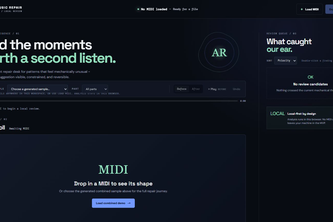
The project described by the caller is a browser-based MIDI review tool named "AI Music Repair Studio". The author states that it is a local-first application that parses MIDI files in the browser, identifies suspicious musical patterns (such as repetition, large melodic leaps, and density spikes), and presents these findings with plain-language explanations. It allows users to preview constrained repairs before applying them, maintains Before/After comparisons, and supports undo, local playback, and repaired MIDI export.
What changed
The project is presented as a hackathon submission (Devpost entry for OpenAI 2026 hackathon). There is no evidence of prior versions or development history beyond this single self-reported description. It appears to be an MVP built in a short timeframe using Vite, React, and TypeScript.
Single most important open question
Is there any evidence that the tool has been used by musicians or students in real-world workflows? The author claims it supports local-first MIDI review and human-in-the-loop repair, but no traction data, customer feedback, or usage metrics are provided.
What The Product Actually Is
The description states:
- AI Music Repair Studio is a local-first MIDI review desk.
- It parses MIDI in the browser, using technologies like @tonejs/midi and Web Audio oscillators.
- It maps notes to an SVG piano roll, identifies musical patterns (repetition, large melodic leaps, density spikes), and explains each candidate in plain language.
- It shows a constrained repair as a visible diff before applying it.
- It supports Before/After comparison, undo, local playback, and repaired MIDI export.
- The tool does not claim objective musical correctness; instead, it highlights places where a human may want to listen and decide.
Inference The product is a browser-based application that performs heuristic analysis of MIDI data without relying on external AI services or cloud APIs.
Positioning & Claim Evolution
The author states:
- The tool aims to provide a "focused second pair of eyes" that explains what it noticed, without pretending to replace musical judgment.
- It is designed for musicians, arrangers, and students who want to identify unusual passages in MIDI files.
- It is not an automatic music critic or unconstrained MIDI rewriting service, but a review assistant.
Inference The positioning appears to be that of a human-in-the-loop tool for MIDI editing, not an autonomous AI composer or editor. The claim evolution seems to emphasize explainability and reversibility, rather than automation.
Target Customer & ICP
The description states:
- The intended users are musicians, arrangers, and students.
- It is designed to help those who can "hear that a passage feels unusual" but don’t immediately know which notes or patterns deserve closer attention.
Inference The target customer profile is likely music creators or educators, with a focus on interactive MIDI review and editing workflows. The ICP appears to be narrow, centered around users of MIDI-based music creation tools.
Business Model & Pricing Evidence
Not evidenced.
Explanation
There is no mention of pricing, monetization strategy, or business model in the description. No evidence of revenue streams, subscriptions, or paid features is provided.
Technical & Delivery Signals
The description states:
- Built with Vite, React, TypeScript, and other web technologies.
- Uses @tonejs/midi for MIDI parsing, SVG for visualization, and Web Audio oscillators for playback.
- MIDI stays local in the browser; no API keys or remote AI endpoints are required.
- The MVP includes test fixtures, visible diffs, and deterministic behavior to support testing and explanation.
Inference The delivery approach is lightweight, web-based, and self-contained. It emphasizes local processing, transparency, and reversibility in its design.
Traction & Maturity Signals
Not evidenced.
Explanation
There is no evidence of users, customers, or adoption beyond the author’s own description. No metrics, usage data, or feedback from real-world use are provided. The project is described as a hackathon submission, suggesting it is in an early stage.
Competitive Context
Not evidenced.
Explanation
No mention of competitors, existing tools, or market positioning is included in the description. There is no indication of how this tool compares to other MIDI editors or review tools.
Open Questions & Risks
- No traction or user feedback: The project is described as a hackathon submission with no evidence of real-world usage.
- Limited scope and functionality: It is explicitly stated to be a review assistant, not an AI composer or full editor, which may limit its appeal.
- Self-reported only: All claims are unverified; there is no independent validation of the tool’s performance or utility.
- No monetization strategy: There is no indication of how this would become a sustainable business.
Questions the description leaves open
- What specific user problems does this tool solve, and how do you know?
- Are there any real-world users or beta testers who have provided feedback on the tool’s utility?
- How does the tool handle edge cases in MIDI data that are not covered by the current heuristics?
- Is there a plan to expand beyond the current browser-based MVP, such as adding cloud features or API access?
- What is the long-term vision for monetization or product evolution?
Overall Assessment
Not evidenced.
Explanation
There is no evidence of revenue, customers, traction, or financials to support an investment or partnership decision. The project is described as a single-person hackathon submission with no indication of scalability or commercial viability. Any potential for growth or monetization remains speculative without further data.
User Stories BotA demo video on every pull request
Get a demo video on every new feature
GitHub App that watches your pull requests and records a narrated, captioned demo.
Save time on demo prep and make informed decisions faster with a video walkthrough of every new feature.
Source
Submitted to the OpenAI 2026 hackathon on Devpost. Project home on Devpost. Back to the full gallery on Devpost.
This competitive analysis was produced by top-founders.com (opens in a new tab)
Generated by a language model from this project's public Devpost page — its tagline, the author's own write-up and any built-with tags listed there — as captured in August 2026. Short quotations are the author's words. It is an opinion on the idea as a business, not on the people behind it, and it reflects the description as published then. If the project has moved on, request a correction below. The analysis is not independent research and contains no verified traction, revenue or customer data.
An independent guide by KFG International LLC — not affiliated with, endorsed by, or connected to Devpost or OpenAI.