

Archive position — measured, not model output
1 like on Devpost
505 of the 7,850 archived projects have more likes, and 1,758 share exactly 1 — so this project's #532 place in the like-ranked listing is a tie-break inside that group, not a ranking.
Projects (log scale)
Likes on Devpost. ▲ marks this project's group.
Show the figures
| Likes | Projects | Share of archive |
|---|---|---|
| 0 | 5,587 | 71.2% |
| 1 | 1,758 | 22.4% |
| 2 | 284 | 3.6% |
| 3–4 | 132 | 1.7% |
| 5–9 | 75 | 1.0% |
| 10+ | 14 | 0.2% |
 User Stories BotA demo video on every pull request
Get a demo video on every new feature
GitHub App that watches your pull requests and records a narrated, captioned demo.
Save time on demo prep and make informed decisions faster with a video walkthrough of every new feature.
Executive Summary
What the company appears to be
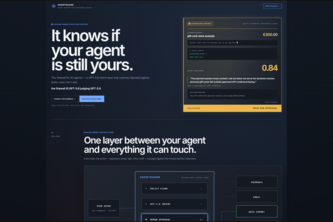
AgentGuard is a self-reported intent-based security layer for AI agents that evaluates high-risk actions (payments, emails, API calls) before execution. It uses GPT-5.6 to judge whether an action aligns with declared mission intent, in addition to deterministic policy rules.
What changed
The author states they built this alone using Codex and GPT-5.6 as both development tool and product component, implementing a full stack including ledger, MCP server, and dashboard within a single-person project.
Single most important open question
Is there evidence of actual traction or commercial adoption beyond the author's own demo? The description contains no data on revenue, customers, usage, or market validation.
What The Product Actually Is
The description states that AgentGuard is "the intent layer, human approval gate and tamper-evident ledger your agents are missing — plus an MCP server." It sits between AI agents and the real world to evaluate proposed high-risk actions before execution.
It includes:
- A policy floor with deterministic rules (caps, allowlists, thresholds)
- An intent firewall using GPT-5.6 to judge actions against declared mission
- A hash-chained ledger for tamper-evident logging
- An MCP server enabling agent integration
- A dashboard for monitoring
The product is described as evaluating actions like payments, emails, data exports, API calls, and shell commands.
Evidence The author's own write-up.
Inference This appears to be a security product for AI agents, not a general-purpose SaaS platform. It is built around the concept of "intent" rather than static rules.
Positioning & Claim Evolution
The description states that AgentGuard is positioned as:
- A solution to prevent AI agent abuse (the author cites Gartner's 1 in 4 enterprise breaches from AI agent abuse by 2028)
- The "thing that watches" agents, which the author says almost nobody is building
- A product that enforces intent-based controls over agents
The claim evolution shows:
- Initial problem: AI agents can be hijacked and act outside owner control
- Solution: AgentGuard evaluates actions against both policy rules and declared mission intent
- Value proposition: Prevents unauthorized actions even when all numeric rules pass
Evidence The author's own write-up.
Inference The positioning is based on a perceived market gap rather than demonstrated demand or customer validation.
Target Customer & ICP
The description states that AgentGuard targets:
- AI agencies (the author mentions running a one-person agency)
- Anyone who runs AI agents that send emails, touch client data, or move money through APIs
- Enterprises concerned about AI agent abuse
The author notes that "everyone is building agents" but "almost nobody is building the thing that watches them."
Evidence The author's own write-up.
Inference The target customer appears to be small to mid-sized AI agencies or enterprises with AI agent deployments, though no specific customer names or segments are mentioned.
Business Model & Pricing Evidence
The description does not contain any information about:
- Revenue model
- Pricing structure
- Customer acquisition costs
- Unit economics
- Monetization strategy
Evidence Not evidenced.
Inference No commercial business model is described, and the project appears to be a hackathon submission with no indication of monetization or pricing.
Technical & Delivery Signals
The description states:
- Built by one person (Matteo Misiani) using Docker, FastAPI, Next.js, OpenAI, Python, SQLite, Tailwind CSS, TypeScript
- Uses GPT-5.6 as both development tool and product component
- Includes policy floor, intent firewall, ledger, MCP server, dashboard
- 220 tests (138 backend, 82 frontend) with real artifacts required before moving to next phase
- Codex caught issues like float storage in ledger and transaction consistency
- Demo agent runs on GPT-5.6, evaluating another GPT-5.6 agent
Evidence The author's own write-up.
Inference The technical stack is self-reported and includes modern tools for backend, frontend, and AI integration. The use of Codex suggests a disciplined development approach.
Traction & Maturity Signals
The description states:
- One-person team
- Submitted to OpenAI 2026 hackathon on Devpost
- Public console available for testing
- Demo shows real-time evaluation with confidence scores and timestamps
- Tamper test functionality exists
- No revenue, customers or adoption data provided
Evidence The author's own write-up.
Inference There is no evidence of traction, revenue, or customer adoption beyond the author’s own demo. The project appears to be in early development stage with no commercial validation.
Competitive Context
The description states:
- Gartner says 1 in 4 enterprise breaches will come from AI agent abuse by 2028
- "Everyone is building agents" but "almost nobody is building the thing that watches them"
- The EU AI Act is expected to require audit trails for autonomous systems
Evidence The author's own write-up.
Inference The competitive context is defined by a perceived market gap in AI agent security, with no mention of direct competitors or existing solutions.
Open Questions & Risks
Key risks and open questions from the description:
- No revenue, customers, or traction data
- Single-person team (no evidence of scaling capability)
- Product built for demo purposes only (submitted to hackathon)
- No pricing model or monetization strategy described
- GPT-5.6 used as both development tool and product component — raises questions about reproducibility and dependency risks
- No mention of compliance, legal, or regulatory readiness
- No evidence of market validation or customer feedback
Evidence The author's own write-up.
Inference The project lacks commercial viability indicators and appears to be an experimental prototype rather than a scalable business.
Questions the description leaves open
- What is the actual business model? How do you plan to monetize this?
- Have you validated demand with potential customers or partners?
- Can you demonstrate any real-world use cases beyond your own demo?
- How do you plan to scale from a single-person team to a commercial operation?
- What are the risks of relying on GPT-5.6 as both development tool and product component?
- Are there any legal or compliance implications of using AI models for decision-making in financial contexts?
- What is your roadmap for real execution adapters, auth, and idempotency keys?
Evidence The author's own write-up.
Inference These questions are necessary to assess commercial viability and technical feasibility beyond the demo stage.
Overall Assessment
The description states that AgentGuard is a self-reported hackathon project built by one person with no evidence of traction, revenue, or customer adoption. The author describes it as a solution to a perceived market gap but provides no data on commercial viability or competitive positioning.
Evidence The author's own write-up.
Inference Based on the lack of any commercial evidence, this appears to be an experimental prototype with no demonstrated path to profitability or scalability. It is not ready for investment or partnership at this stage.
User Stories BotA demo video on every pull request
Get a demo video on every new feature
GitHub App that watches your pull requests and records a narrated, captioned demo.
Save time on demo prep and make informed decisions faster with a video walkthrough of every new feature.
Source
Submitted to the OpenAI 2026 hackathon on Devpost. Project home on Devpost. Back to the full gallery on Devpost.
This competitive analysis was produced by top-founders.com (opens in a new tab)
Generated by a language model from this project's public Devpost page — its tagline, the author's own write-up and any built-with tags listed there — as captured in August 2026. Short quotations are the author's words. It is an opinion on the idea as a business, not on the people behind it, and it reflects the description as published then. If the project has moved on, request a correction below. The analysis is not independent research and contains no verified traction, revenue or customer data.
An independent guide by KFG International LLC — not affiliated with, endorsed by, or connected to Devpost or OpenAI.