

Archive position — measured, not model output
0 likes on Devpost
2,263 of the 7,850 archived projects have more likes, and 5,587 share exactly 0 — so this project's #2,360 place in the like-ranked listing is a tie-break inside that group, not a ranking.
Projects (log scale)
Likes on Devpost. ▲ marks this project's group.
Show the figures
| Likes | Projects | Share of archive |
|---|---|---|
| 0 | 5,587 | 71.2% |
| 1 | 1,758 | 22.4% |
| 2 | 284 | 3.6% |
| 3–4 | 132 | 1.7% |
| 5–9 | 75 | 1.0% |
| 10+ | 14 | 0.2% |
 User Stories BotA demo video on every pull request
Get a demo video on every new feature
GitHub App that watches your pull requests and records a narrated, captioned demo.
Save time on demo prep and make informed decisions faster with a video walkthrough of every new feature.
Executive Summary
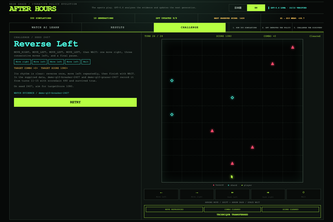
What the company appears to be: AFTER HOURS is a browser-based single-screen demo project that visualizes AI learning through a deterministic arcade game (NEON GRAZE). It uses GPT-5.6 Luna to propose bounded policy changes for AI agents, which are then tested and validated in a ten-generation loop. The system records 300 verified replays across three AI players, with audit seeds held out for validation. The final output is a "Technique" — an evidence-backed strategy that can be challenged by humans.
What changed: The project started from the author's frustration with opaque AI learning demos and evolved into a structured, replayable system where AI decisions are visible and auditable. It introduces a novel interface for demonstrating AI behavior through deterministic simulation, policy mutation, and human challenge.
The single most important open question: Is there any evidence of commercial traction or product-market fit beyond this hackathon demo? The description states no revenue, customers, or adoption data — only a self-reported technical demonstration.
Note: This analysis is based entirely on the author's own description. No external verification or historical data is available. All claims are self-reported and unverified.
What The Product Actually Is
- The description states that AFTER HOURS is a browser-based single-screen game built around NEON GRAZE, a deterministic arcade game.
- It features three AI players with different initial policies who play 300 simulations across ten generations.
- GPT-5.6 Luna proposes bounded policy changes between generations; these are validated by deterministic code and recorded as replays.
- The system includes three modes: WATCH AI LEARN, RESULTS, and CHALLENGE.
- A final "Technique" is synthesized after nine strategy stages and one culture stage.
- The interface uses a shared TypeScript engine for simulation, verification, playback, and human play.
- Replay data stores seed and legal actions to allow reconstruction of runs and rejection of modified scores.
Inference: The product is not a commercial SaaS offering but a technical demonstration or prototype. It does not appear to have any monetization mechanism or customer base.
Positioning & Claim Evolution
- The description states the project was inspired by frustration with opaque AI learning demos.
- The author claims that the system makes failure visible and allows others to inspect decisions.
- The positioning centers on transparency, auditability, and human transferability of AI discoveries.
- It positions itself as a tool for demonstrating AI behavior in a way that is both interpretable and testable.
- The claim evolves from a personal frustration (how does AI learn?) into a structured system for showing learning loops.
Inference: The positioning reflects an academic or experimental approach to AI explainability, not a commercial product aimed at users or customers.
Target Customer & ICP
- Not evidenced. No mention of target customer segments, personas, or use cases beyond the author’s own experience.
- The system is described as a single-screen demo with no indication of intended audience or buyer type.
- It is built for judges in a hackathon context and not for end-users or customers.
Finding: No evidence of defined ICP or target customer base.
Business Model & Pricing Evidence
- Not evidenced. No mention of pricing, monetization strategy, or business model.
- The project is described as a demo submitted to a hackathon — no indication of any revenue-generating mechanism.
Finding: No evidence of a business model or pricing structure.
Technical & Delivery Signals
- Built with TypeScript and React; uses Codex for development and review.
- Uses deterministic engine shared across simulation, verification, playback, and human play.
- Replay data includes seed and legal actions to allow reconstruction.
- GPT-5.6 Luna is used only for interpreting behavior and proposing bounded policy changes — not for controlling game turns.
- Structured JSON output, schema validation, read-only sandbox, input/output hashes, token/latency records, replay references, and fallback labels are used.
- The system runs locally without an API key; all data is checked in.
- Includes 65 automated tests and browser-level happy-path coverage.
- A public demo video was generated via a reproducible Codex-authored pipeline.
Inference: The technical architecture shows strong engineering rigor, but it is not designed for scale or production use. It is a prototype with limited commercial applicability.
Traction & Maturity Signals
- Not evidenced. No mention of users, customers, revenue, adoption, or usage metrics.
- The project was submitted to a hackathon and is described as a demo.
- There are no signs of product-market fit or traction beyond the author’s own testing.
Finding: No evidence of traction or maturity beyond prototype stage.
Competitive Context
- Not evidenced. No mention of competitors, market landscape, or competitive positioning.
- The project does not appear to be directly competing with any existing commercial products in AI learning or game balancing.
Finding: No evidence of competitive context or market positioning.
Open Questions & Risks
- The system is a single-person hackathon demo with no evidence of scalability or production readiness.
- It uses a local Codex login and cannot be treated like a hosted API — limiting its replicability.
- The project does not appear to have any commercial viability or monetization strategy.
- The final output (Technique) is only transferable via human challenge, which may limit broader adoption.
- No evidence of team size beyond one person; no indication of future development plans or funding.
Inference: The risk of commercial failure is high due to lack of traction, scalability, and business model.
Questions the description leaves open
- What is the intended use case for this system beyond the demo?
- Are there any plans to expand beyond one game engine (NEON GRAZE)?
- How would you scale this system if it were to be used in a commercial setting?
- Is there any plan to monetize or deploy this outside of hackathon contexts?
- What are the technical limitations of using GPT-5.6 Luna in this way, and how do they affect scalability?
Overall Assessment
- Not evidenced. No information on funding rounds, valuation, or investment interest.
- The project is described as a single-person hackathon submission with no indication of commercial potential.
- It lacks any signs of traction, product-market fit, or business model.
Assessment: This is a technical prototype with strong engineering execution but no evidence of commercial viability or investment-ready status. It does not appear to be a candidate for growth equity or partnership investment at this stage.
User Stories BotA demo video on every pull request
Get a demo video on every new feature
GitHub App that watches your pull requests and records a narrated, captioned demo.
Save time on demo prep and make informed decisions faster with a video walkthrough of every new feature.
Source
Submitted to the OpenAI 2026 hackathon on Devpost. Project home on Devpost. Back to the full gallery on Devpost.
This competitive analysis was produced by top-founders.com (opens in a new tab)
Generated by a language model from this project's public Devpost page — its tagline, the author's own write-up and any built-with tags listed there — as captured in August 2026. Short quotations are the author's words. It is an opinion on the idea as a business, not on the people behind it, and it reflects the description as published then. If the project has moved on, request a correction below. The analysis is not independent research and contains no verified traction, revenue or customer data.
An independent guide by KFG International LLC — not affiliated with, endorsed by, or connected to Devpost or OpenAI.