

Archive position — measured, not model output
0 likes on Devpost
2,263 of the 7,850 archived projects have more likes, and 5,587 share exactly 0 — so this project's #2,334 place in the like-ranked listing is a tie-break inside that group, not a ranking.
Projects (log scale)
Likes on Devpost. ▲ marks this project's group.
Show the figures
| Likes | Projects | Share of archive |
|---|---|---|
| 0 | 5,587 | 71.2% |
| 1 | 1,758 | 22.4% |
| 2 | 284 | 3.6% |
| 3–4 | 132 | 1.7% |
| 5–9 | 75 | 1.0% |
| 10+ | 14 | 0.2% |
 User Stories BotA demo video on every pull request
Get a demo video on every new feature
GitHub App that watches your pull requests and records a narrated, captioned demo.
Save time on demo prep and make informed decisions faster with a video walkthrough of every new feature.
Executive Summary
What the company appears to be
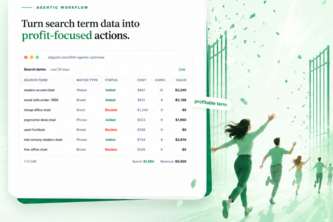
AdgOptz is a self-reported SaaS product that claims to optimize Google Ads search terms using AI-powered intent extraction and optimization. It positions itself as an automated solution for managing ad spend, reallocating budgets, and increasing revenue.
What changed
The project was submitted to the OpenAI 2026 hackathon, indicating it is in early development or prototype stage. The author describes building a "100% agentic agency-style SaaS" using tools like Codex and OpenClaw, suggesting an experimental or proof-of-concept approach.
Single most important open question
Is there any evidence of actual revenue, customers, or product-market fit beyond the founder's self-reported claims?
Note
This analysis is based entirely on the author's own description. No independent verification or third-party data is available. All statements are self-reported and unverified.
What The Product Actually Is
The description states that AdgOptz "optimizes Google Ads search terms to maximize revenue" and prevents "wasted ad spend." It claims to reallocate advertising budgets to increase revenue, profit, and market share through qualified conversions.
It is described as a "100% agentic agency-style SaaS," suggesting an AI-driven platform that operates autonomously or semi-autonomously without human intervention in its core processes.
Inference The product appears to be an automated tool for Google Ads management, but no technical specifications, UI screenshots, or functional details are provided. The author mentions using OpenClaw and Codex, which may indicate reliance on AI APIs or models for intent extraction and optimization.
Positioning & Claim Evolution
The project is positioned as a solution to the manual labor of reviewing "tens of thousands of Google Ads search terms every day." It claims to automate this process and improve ad performance by reallocating budgets.
The author states they built it using OpenClaw, then switched to Codex for cost savings. This suggests an evolution in tooling or approach during development.
Claim
The product aims to "free humans" from repetitive tasks.
Inference The positioning implies a shift from manual labor to AI automation, but there is no evidence of actual user feedback or adoption patterns.
Target Customer & ICP
The description states that AdgOptz targets users who manage Google Ads and want to optimize their search terms for better revenue. It is implied to be aimed at advertisers, agencies, or marketers managing large ad spend.
Inference The target customer likely includes small to mid-sized businesses or digital marketing teams with significant Google Ads budgets. However, no explicit segmentation or customer personas are provided.
Business Model & Pricing Evidence
There is no evidence of pricing structure, subscription tiers, or monetization strategy in the description. The author mentions using Stripe, which implies a potential payment integration but does not confirm actual sales or pricing models.
Claim
The business model is SaaS-based.
Inference No information on revenue streams, pricing plans, or customer acquisition costs is available.
Technical & Delivery Signals
The project was built with the following technologies:
- Frontend: React, Tailwind
- Backend: Express.js, Node.js
- Database: PostgreSQL
- Hosting: Vercel, Vite
- Payment: Stripe
- Email: Mailjet
- AI tools: OpenClaw, Codex
- Infrastructure: Neon
Inference The stack suggests a modern full-stack SaaS architecture with some AI integration. However, no evidence of actual product delivery or user-facing features is provided.
Traction & Maturity Signals
The author claims to have won the OpenAI Build Week and advanced to TechCrunch Disrupt finals. They also state their goal is to raise $6 million in funding.
Inference These are self-reported achievements and goals, not verified outcomes or traction metrics. There is no evidence of revenue, customers, or product usage beyond the project submission.
Competitive Context
The description does not mention any competitors or direct market positioning against existing tools for Google Ads optimization. It implies a niche in intent extraction and optimization but does not define how it differs from other platforms like Google Ads' own tools or third-party solutions.
Inference The competitive landscape is unclear, as no comparison to existing products or market differentiation is described.
Open Questions & Risks
- No revenue or customer data: The project lacks any evidence of monetization or real-world usage.
- Unverified claims: All stated outcomes are self-reported without external validation.
- Founder solo operation: A single-member team may limit execution capacity and scalability.
- Funding goals vs. reality: The stated goal of raising $6 million is not backed by traction or product maturity.
Inference Without verified data, the project appears to be in a pre-product-market-fit phase with high uncertainty around viability.
Questions the description leaves open
- What specific Google Ads optimization problems does your solution solve that existing tools don’t?
- Have you validated demand from actual advertisers or agencies?
- Can you demonstrate any working prototype or early user feedback?
- How do you plan to scale beyond the current AI tooling (OpenClaw, Codex)?
- What is your go-to-market strategy for reaching potential customers?
- Do you have any existing users or pilot customers?
Overall Assessment
Not evidenced.
There is no evidence of revenue, customer traction, or product-market fit to support an investment or partnership decision. The project appears to be in early development or prototype stage, with only self-reported claims about functionality and ambition.
Confidence Low. This analysis is based solely on the author's own description, which lacks any verifiable data or evidence of commercial viability.
User Stories BotA demo video on every pull request
Get a demo video on every new feature
GitHub App that watches your pull requests and records a narrated, captioned demo.
Save time on demo prep and make informed decisions faster with a video walkthrough of every new feature.
Source
Submitted to the OpenAI 2026 hackathon on Devpost. Project home on Devpost. Back to the full gallery on Devpost.
This competitive analysis was produced by top-founders.com (opens in a new tab)
Generated by a language model from this project's public Devpost page — its tagline, the author's own write-up and any built-with tags listed there — as captured in August 2026. Short quotations are the author's words. It is an opinion on the idea as a business, not on the people behind it, and it reflects the description as published then. If the project has moved on, request a correction below. The analysis is not independent research and contains no verified traction, revenue or customer data.
An independent guide by KFG International LLC — not affiliated with, endorsed by, or connected to Devpost or OpenAI.