

Archive position — measured, not model output
0 likes on Devpost
2,263 of the 7,850 archived projects have more likes, and 5,587 share exactly 0 — so this project's #4,297 place in the like-ranked listing is a tie-break inside that group, not a ranking.
Projects (log scale)
Likes on Devpost. ▲ marks this project's group.
Show the figures
| Likes | Projects | Share of archive |
|---|---|---|
| 0 | 5,587 | 71.2% |
| 1 | 1,758 | 22.4% |
| 2 | 284 | 3.6% |
| 3–4 | 132 | 1.7% |
| 5–9 | 75 | 1.0% |
| 10+ | 14 | 0.2% |
 User Stories BotA demo video on every pull request
Get a demo video on every new feature
GitHub App that watches your pull requests and records a narrated, captioned demo.
Save time on demo prep and make informed decisions faster with a video walkthrough of every new feature.
Executive Summary
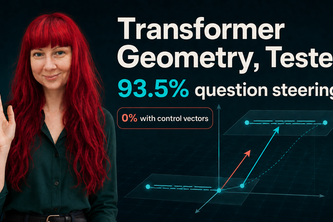
The description states that "Geometric Linguistic Transformations" (GLT) is an independent research project by Anna Simakova, exploring whether linguistic transformations within transformer models leave repeatable geometric traces in embedding space. The author reports using AI tools like Codex and GPT-5.6 to implement experiments and analyze results, with a focus on understanding how changes such as negation or tense affect embeddings. The project is described as a reproducible research workflow containing scripts, datasets, analysis pipelines, and experimental results across multiple architectures.
The key change noted in the description is that during OpenAI Build Week, the project was not turned into a demo app but instead had its repository improved for clarity and testability, including adding a new "GLT-STEER" behavior-level track. The most important open question is whether the geometric patterns identified are robust enough to be considered meaningful beyond surface-level clues or artifacts of implementation.
This analysis is based entirely on self-reported information from the author's own description — no external verification or traction data is provided.
What The Product Actually Is
The description states that GLT is a research project focused on discovering and testing reusable geometric directions for linguistic transformations inside transformer embedding spaces. It involves:
- Taking two related sentences (e.g., "She is happy." vs. "She is not happy.")
- Converting them into numerical embeddings
- Calculating the difference between embeddings (delta vector)
- Investigating whether these deltas contain information beyond what's present in either endpoint sentence
The project includes:
- Experiment scripts
- Controlled linguistic datasets
- Embedding extraction and analysis pipelines
- Baselines for source-only, target-only, concatenation, and delta approaches
- Semantic and holdout experiments
- Statistical controls
- Result tables and figures
- Reproducible report builders
- Draft research papers
- Reviewer-response notes
- A dated research diary
The author emphasizes that this is a working and reproducible research workflow, not a commercial product or service.
Positioning & Claim Evolution
The description indicates the project began with inspiration from Lie algebra and the question of whether ideas from it could be useful for understanding transformers. However, the current results do not prove that transformers contain a Lie algebra — this remains an open question.
The core claim evolved from:
- Initial curiosity about applying Lie algebra to transformers
- Testing whether transformations leave geometric traces in embedding space
- Investigating if these patterns are consistent across different types of linguistic changes (negation, questions, tense)
- Determining if the delta vectors contain information not already present in the transformed sentence
The author notes that early results were sometimes misleading and that some "perfect" findings were later shown to be due to surface clues rather than deep generalization. The project now positions itself as a reproducible research effort with documented boundary conditions where delta vectors do not perform well.
Target Customer & ICP
Not evidenced. The description does not specify any target customer or ideal customer profile (ICP). It describes the work as an independent research program and does not indicate who would use or benefit from its findings beyond the researcher herself.
Business Model & Pricing Evidence
Not evidenced. There is no mention of any business model, pricing strategy, monetization approach, or revenue streams in the description. The project is described as a research effort without commercial application.
Technical & Delivery Signals
The description states that:
- The work was built using Codex and GPT-5.6 as coding and research partners
- Most code was written by Codex with human oversight and decision-making
- AI tools helped implement experiment pipelines, refactor scripts, generate datasets, run comparisons, calculate statistical results, build reports, and document experiments
- The author made decisions about which results were important, suspicious, or needed further testing
- GPT-5.6 helped return to mathematical concepts, explain unfamiliar ideas, read papers, formulate objections, and turn questions into testable experiments
The technical approach involves:
- Using transformer models to convert sentences into embeddings
- Calculating differences between embeddings (delta vectors)
- Comparing these deltas across different linguistic transformations
- Testing various architectures and evaluation settings
Traction & Maturity Signals
Not evidenced. The description does not provide any traction data, customer adoption metrics, revenue figures, or maturity indicators beyond the fact that it's a research repository with reproducible workflows and experimental results.
Competitive Context
Not evidenced. There is no mention of competitors, market positioning, or competitive landscape in the provided description.
Open Questions & Risks
Inferences based on self-reported information:
- The project appears to be an independent research effort without commercial traction or customer validation
- The author explicitly states that results have been found to be misleading and that some early "perfect" findings were later shown to be due to surface clues rather than deep generalization
- There is no evidence of any product-market fit, revenue, or adoption metrics
- The project's positioning as a research effort suggests it may not yet be ready for commercial application
- The use of AI tools (Codex, GPT-5.6) raises questions about whether the work represents genuine scientific discovery or merely automated experimentation
Questions the description leaves open
- What specific hypotheses were tested and what evidence supports or contradicts them?
- How does the project plan to transition from research to potential commercial application, if at all?
- What are the key limitations of the current approach that prevent broader applicability?
- Has there been any peer review or independent validation of the research findings?
- What would constitute a successful outcome for this research in terms of scientific contribution?
- How does the project intend to address concerns about surface-level patterns being mistaken for deeper geometric structures?
- Are there any plans to publish the research or make it available beyond the repository?
Overall Assessment
Not evidenced. The description provides no information about valuation, funding rounds, investment interest, or partnership opportunities. It describes an independent research project without indicating any commercial or investment readiness.
User Stories BotA demo video on every pull request
Get a demo video on every new feature
GitHub App that watches your pull requests and records a narrated, captioned demo.
Save time on demo prep and make informed decisions faster with a video walkthrough of every new feature.
Source
Submitted to the OpenAI 2026 hackathon on Devpost. Project home on Devpost. Back to the full gallery on Devpost.
This competitive analysis was produced by top-founders.com (opens in a new tab)
Generated by a language model from this project's public Devpost page — its tagline, the author's own write-up and any built-with tags listed there — as captured in August 2026. Short quotations are the author's words. It is an opinion on the idea as a business, not on the people behind it, and it reflects the description as published then. If the project has moved on, request a correction below. The analysis is not independent research and contains no verified traction, revenue or customer data.
An independent guide by KFG International LLC — not affiliated with, endorsed by, or connected to Devpost or OpenAI.