

Archive position — measured, not model output
0 likes on Devpost
2,263 of the 7,850 archived projects have more likes, and 5,587 share exactly 0 — so this project's #2,333 place in the like-ranked listing is a tie-break inside that group, not a ranking.
Projects (log scale)
Likes on Devpost. ▲ marks this project's group.
Show the figures
| Likes | Projects | Share of archive |
|---|---|---|
| 0 | 5,587 | 71.2% |
| 1 | 1,758 | 22.4% |
| 2 | 284 | 3.6% |
| 3–4 | 132 | 1.7% |
| 5–9 | 75 | 1.0% |
| 10+ | 14 | 0.2% |
 User Stories BotA demo video on every pull request
Get a demo video on every new feature
GitHub App that watches your pull requests and records a narrated, captioned demo.
Save time on demo prep and make informed decisions faster with a video walkthrough of every new feature.
Executive Summary
What the company appears to be
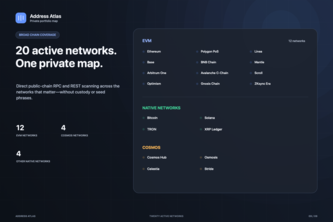
Address Atlas is a self-reported native macOS application that enables users to track their cryptocurrency portfolio across 20 blockchain networks without surrendering custody of their assets. It claims to support public wallet balances, tokens, staking, rewards, and exchange holdings (via read-only API connections), all within a zero-custody framework.
What changed
The project is described as a personal effort by one developer, Hovtum Girgin, built over time with engineering assistance from OpenAI Codex. It evolved from a prototype into a product with rigorous testing and security design, including crash-durable file handling, concurrency control, and encrypted vaults.
Single most important open question
Is there any evidence of user adoption or revenue generation beyond the author’s own claims?
Note: This analysis is based solely on the self-reported project description provided by the author. No external verification, traction data, or financial metrics are available.
What The Product Actually Is
The description states that Address Atlas is a native macOS application designed to provide users with a unified view of their cryptocurrency portfolio. It supports:
- Public wallet balances across 20 active blockchain networks
- Native assets, ERC-20, SPL and TRC-20 tokens
- Cosmos delegated stake and unclaimed rewards
- XRP Ledger issued currencies
- Read-only balances from Binance, Coinbase Advanced Trade and Kraken
- Custom tokens and manually recorded holdings
- Current USD valuations and historical portfolio snapshots
It is built using Swift and SwiftUI for the macOS app layer, and a sync service using Next.js, TypeScript, PostgreSQL, WebAuthn passkeys, Docker, and Caddy.
Claim: The product does not require seed phrases or private keys.
Evidence: The description states that users never enter a seed phrase, private key or signing credential. Exchange connections use balance-only API permissions—never trading or withdrawal access.
Claim: It uses an encrypted vault stored locally.
Evidence: Portfolio data, exchange credentials, settings and history are stored inside an AES-256-GCM encrypted SQLite vault protected by macOS Keychain.
Claim: Sync functionality exists but does not expose plaintext portfolio data.
Evidence: The sync-only service stores only an opaque encrypted snapshot; the server cannot access wallet addresses, balances, labels, exchange credentials or portfolio history.
Positioning & Claim Evolution
The author positions Address Atlas as a tool that answers:
“Can someone see their complete crypto portfolio without giving up custody, sharing a seed phrase, or creating a central database of their financial life?”
This framing suggests a shift from traditional portfolio trackers—often criticized for requiring full custody or exposing sensitive data—to one that emphasizes privacy, local-first design, and zero-custody architecture.
Claim: The product is built around privacy as an architectural property.
Evidence: The author states: “Privacy is an architectural property, not a settings toggle.” This implies the product’s design is intentionally structured to uphold privacy at every layer.
Claim: It avoids centralization and data exposure.
Evidence: No seed phrases, no central database, and encrypted sync with no plaintext access on the server side.
Target Customer & ICP
The description does not explicitly name target customers or personas. However, it implies a user base that:
- Tracks cryptocurrency holdings across multiple networks
- Values privacy and security
- Uses macOS natively
- Is comfortable managing their own keys and wallets
- May be interested in staking rewards, cross-chain assets, and exchange balances
Claim: The product targets users who want full visibility without sacrificing control.
Evidence: The author’s stated goal is to help people see their complete portfolio without surrendering custody or sharing sensitive data.
Claim: It appeals to privacy-conscious crypto users.
Evidence: The emphasis on zero-custody, no seed phrases, and encrypted storage indicates alignment with users who prioritize security and autonomy.
Business Model & Pricing Evidence
There is no evidence in the description of a business model or pricing structure. The product is described as a personal project built by one developer and submitted to a hackathon.
Claim: No commercial model is evident.
Evidence: The description does not mention any monetization strategy, subscription plans, freemium tiers, or paid features.
Technical & Delivery Signals
The technical stack includes:
- macOS native app (Swift, SwiftUI)
- Blockchain APIs for Bitcoin, EVM, Solana, TRON, XRP Ledger, Cosmos-based networks
- Encrypted vault using SQLite and AES-256-GCM
- Sync service with Next.js, TypeScript, PostgreSQL, WebAuthn passkeys
- Use of OpenAI Codex for engineering support
Claim: The product uses rigorous engineering practices.
Evidence: Over 1,100 automated tests including real PostgreSQL integration tests, Swift concurrency checking, Thread Sanitizer runs, encrypted backup drills, and fresh-database recovery.
Claim: It handles complex edge cases like concurrency, crash recovery, and data normalization.
Evidence: The description details handling of stale async operations, cross-process vault locking, atomic Keychain replacement, and recovery proofs.
Traction & Maturity Signals
There is no evidence of user adoption, revenue, or customer base. The project is described as a personal effort by one developer.
Claim: No traction data is provided.
Evidence: The description does not include any metrics on users, downloads, revenue, or customer engagement.
Claim: The product has reached a mature state.
Evidence: The author notes that the project now includes more than 1,100 automated tests and has undergone extensive quality assurance including real-world scenarios like crash recovery and database integrity checks.
Competitive Context
The description does not reference competitors or market positioning beyond general crypto portfolio tracking tools. However, it implies a niche in privacy-focused, zero-custody solutions.
Claim: It competes with traditional portfolio trackers.
Evidence: The author contrasts Address Atlas with existing tools that “often miss part of the picture” and require users to centralize sensitive financial data.
Claim: It differentiates itself via local-first architecture and no custody.
Evidence: The emphasis on zero-custody, no seed phrases, and encrypted storage sets it apart from centralized dashboards or custodial platforms.
Open Questions & Risks
- No commercial traction or revenue evidence — the project is described as a personal effort with no known users or monetization.
- Single-person team — raises concerns about scalability, maintenance, and long-term support.
- Limited distribution channel — only mentions macOS native app and notarized distribution as next step.
- Unproven market demand — while the author describes a need, there is no evidence of actual user interest or validation.
- No third-party verification — all claims are self-reported.
Inference: The lack of any commercial metrics or user data suggests that this is an early-stage idea or prototype, not yet validated in the market.
Questions the description leaves open
- What is your plan for monetization and scaling beyond a single developer?
- Have you conducted any user research or interviews to validate demand?
- How do you intend to distribute the app beyond macOS and notarized builds?
- Are there any known performance limitations or scalability constraints at scale?
- What are the specific risks associated with relying on public RPC endpoints for data accuracy?
- How do you plan to handle regulatory compliance or legal considerations in portfolio tracking?
Overall Assessment
Not evidenced: There is no evidence of revenue, customers, or commercial traction to support an investment or partnership decision.
Inference: The project appears to be a well-engineered prototype with strong technical execution and clear value proposition for privacy-conscious crypto users. However, without evidence of market validation or user adoption, it cannot be evaluated as a viable business opportunity at this stage.
The author’s claims about privacy, architecture, and engineering rigor are compelling but unverified in practice. The product is not yet proven to have traction or commercial viability.
User Stories BotA demo video on every pull request
Get a demo video on every new feature
GitHub App that watches your pull requests and records a narrated, captioned demo.
Save time on demo prep and make informed decisions faster with a video walkthrough of every new feature.
Source
Submitted to the OpenAI 2026 hackathon on Devpost. Project home on Devpost. Back to the full gallery on Devpost.
This competitive analysis was produced by top-founders.com (opens in a new tab)
Generated by a language model from this project's public Devpost page — its tagline, the author's own write-up and any built-with tags listed there — as captured in August 2026. Short quotations are the author's words. It is an opinion on the idea as a business, not on the people behind it, and it reflects the description as published then. If the project has moved on, request a correction below. The analysis is not independent research and contains no verified traction, revenue or customer data.
An independent guide by KFG International LLC — not affiliated with, endorsed by, or connected to Devpost or OpenAI.