

Archive position — measured, not model output
0 likes on Devpost
2,263 of the 7,850 archived projects have more likes, and 5,587 share exactly 0 — so this project's #2,323 place in the like-ranked listing is a tie-break inside that group, not a ranking.
Projects (log scale)
Likes on Devpost. ▲ marks this project's group.
Show the figures
| Likes | Projects | Share of archive |
|---|---|---|
| 0 | 5,587 | 71.2% |
| 1 | 1,758 | 22.4% |
| 2 | 284 | 3.6% |
| 3–4 | 132 | 1.7% |
| 5–9 | 75 | 1.0% |
| 10+ | 14 | 0.2% |
 User Stories BotA demo video on every pull request
Get a demo video on every new feature
GitHub App that watches your pull requests and records a narrated, captioned demo.
Save time on demo prep and make informed decisions faster with a video walkthrough of every new feature.
Executive Summary
What the company appears to be: ActionGate is a self-reported human-in-the-loop safety gate for AI-generated work-item changes in meeting workflows. The author states it uses GPT-5.6 for semantic extraction, deterministic Python rules for classification (PASS, WARN, BLOCK), and a Streamlit interface for review. It does not write directly to external systems but exports proposals only.
What changed: The project is described as a response to the problem of AI-generated meeting summaries becoming false work items without human review. It introduces a structured workflow where AI proposes changes, deterministic rules classify them, and humans approve or reject.
Single most important open question: Is there evidence that this system has been tested in real-world use cases beyond the synthetic evaluation described? The author states no revenue, customers, or traction data exist beyond their own testing.
Note: This analysis is based entirely on self-reported information from the project description. No independent verification or historical data are available. All claims are attributed to the author's own account and should be treated as unverified assertions.
What The Product Actually Is
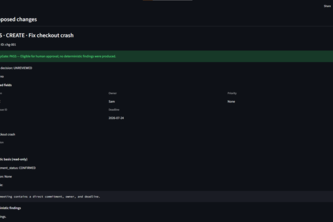
The description states that ActionGate is a "human-in-the-loop safety gate for AI-generated work-item changes." It uses GPT-5.6 to propose structured operations, targets, fields, rationale, and supporting evidence from meeting content.
Deterministic Python rules classify each proposal as:
- PASS — eligible for human approval
- WARN — requires explicit risk acceptance
- BLOCK — approval remains unavailable due to failed condition
A human reviewer can inspect evidence, compare with existing issues, edit selected fields, approve, explicitly accept warnings, or reject. It distinguishes between creating new work items and updating existing ones, showing read-only diffs for updates.
The application never writes directly to GitHub or other systems; it produces proposal-only JSON and Markdown exports.
Claim: ActionGate is a structured workflow tool that separates AI semantic extraction from deterministic policy enforcement and final human authority.
Evidence: The author's write-up explicitly describes this architecture.
Positioning & Claim Evolution
The author states they did not want to build another meeting summary tool, but instead created a "clear boundary between AI interpretation and consequential action."
Their core positioning is:
- AI proposes
- Deterministic rules verify
- Humans approve
They emphasize that the model does not become the final authority. The system is built around the principle of separating semantic extraction from policy enforcement and human decision-making.
Claim: ActionGate positions itself as a safety gate that prevents AI-generated work items from becoming false or unsupported without human review.
Evidence: The author explicitly states this in both the inspiration and what it does sections.
Target Customer & ICP
The description does not name specific customers or personas. It is framed as a tool for teams using meeting workflows where AI summaries might generate incorrect work items.
It appears designed for organizations that rely on structured issue tracking systems (e.g., GitHub, Jira) and want to prevent AI misinterpretations from creating false or duplicated tasks.
Claim: ActionGate targets teams working in structured issue-tracking environments who want to avoid AI-generated errors in their workflows.
Evidence: Not explicitly stated; inferred from the use case described.
Business Model & Pricing Evidence
There is no evidence of a business model, pricing structure, or monetization strategy in the description. The author states that the project was submitted to a hackathon and does not mention any revenue, customers, or sales activities.
Claim: No information provided about how ActionGate would be monetized.
Evidence: Not evidenced.
Technical & Delivery Signals
The application is built with:
- Python
- Streamlit
- Pydantic
- OpenAI API (GPT-5.6)
- Codex for development assistance
It separates responsibilities:
- GPT-5.6 proposes structured changes
- Pydantic validates output
- Deterministic rules compute PASS/WARN/BLOCK
- Streamlit presents interface
- Human makes final decision
The author mentions:
- 132 automated tests passing
- Offline deterministic evaluation matched 16 of 16 fixed cases
- 0 of 12 unsafe cases incorrectly passed
- 0 of 9 critical unsafe cases incorrectly passed
Claim: The system uses a layered technical architecture with clear separation between AI, validation, and human control.
Evidence: Described in the "How I built it" section.
Traction & Maturity Signals
The description states that this is a hackathon submission. There is no evidence of:
- Revenue
- Customers
- Users
- Adoption
- Product-market fit
- Any traction beyond the author’s own testing and synthetic evaluation
Claim: No traction or maturity signals are evident.
Evidence: The project is described as a hackathon entry with no external validation.
Competitive Context
The description does not mention competitors or existing tools in this space. It focuses on the unique design of separating AI, rules, and human review rather than comparing to other platforms.
Claim: No competitive landscape or market positioning information provided.
Evidence: Not evidenced.
Open Questions & Risks
- The system is described as a hackathon project with no real-world testing beyond synthetic evaluation.
- It does not integrate with any external systems directly, which may limit its utility in practice.
- There is no evidence of user feedback or iteration beyond the author’s own tests.
- The lack of revenue, customers, or traction raises questions about commercial viability.
Inference: Without real-world use cases or product-market fit, the risk of failure in a commercial environment is high.
Evidence: Not evidenced directly, but implied by absence of any traction data.
Questions the description leaves open
- What specific types of meetings or workflows does ActionGate aim to support?
- How would you test and validate the safety gate in real-world use cases?
- Have you considered how to scale this system for larger teams or organizations?
- What are the potential integration points with existing work management systems (e.g., Jira, GitHub)?
- How do you plan to handle edge cases that were not covered in your synthetic evaluation?
- Is there any feedback from early users or internal stakeholders beyond your own testing?
Note: These questions are based on the self-reported nature of the project and aim to probe for evidence missing in the description.
Overall Assessment
There is no evidence that ActionGate has reached a stage where it could be considered for investment or partnership. It is described as a hackathon submission with no revenue, customers, or traction data.
The author's own write-up indicates that this is an experimental system built to explore the concept of AI safety gates in meeting workflows, not a product ready for market deployment.
Claim: ActionGate is not yet at a stage suitable for investment or partnership.
Evidence: The project is described as a hackathon submission with no commercial evidence.
User Stories BotA demo video on every pull request
Get a demo video on every new feature
GitHub App that watches your pull requests and records a narrated, captioned demo.
Save time on demo prep and make informed decisions faster with a video walkthrough of every new feature.
Source
Submitted to the OpenAI 2026 hackathon on Devpost. Project home on Devpost. Back to the full gallery on Devpost.
This competitive analysis was produced by top-founders.com (opens in a new tab)
Generated by a language model from this project's public Devpost page — its tagline, the author's own write-up and any built-with tags listed there — as captured in August 2026. Short quotations are the author's words. It is an opinion on the idea as a business, not on the people behind it, and it reflects the description as published then. If the project has moved on, request a correction below. The analysis is not independent research and contains no verified traction, revenue or customer data.
An independent guide by KFG International LLC — not affiliated with, endorsed by, or connected to Devpost or OpenAI.