

Archive position — measured, not model output
0 likes on Devpost
2,263 of the 7,850 archived projects have more likes, and 5,587 share exactly 0 — so this project's #6,249 place in the like-ranked listing is a tie-break inside that group, not a ranking.
Projects (log scale)
Likes on Devpost. ▲ marks this project's group.
Show the figures
| Likes | Projects | Share of archive |
|---|---|---|
| 0 | 5,587 | 71.2% |
| 1 | 1,758 | 22.4% |
| 2 | 284 | 3.6% |
| 3–4 | 132 | 1.7% |
| 5–9 | 75 | 1.0% |
| 10+ | 14 | 0.2% |
 User Stories BotA demo video on every pull request
Get a demo video on every new feature
GitHub App that watches your pull requests and records a narrated, captioned demo.
Save time on demo prep and make informed decisions faster with a video walkthrough of every new feature.
Executive Summary
Company: RAYSTAR LAITS Audio-Visual Frequency Studio
Self-reported basis: The description is entirely self-reported and unverified, based on a Devpost submission for the OpenAI 2026 hackathon. No external corroboration or additional data points are available.
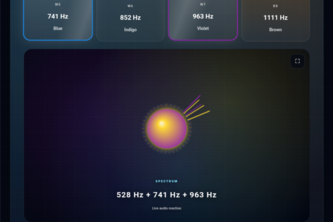
What it appears to be: A browser-based Web Audio application that combines audio frequencies with visual elements (colour-linked, symbolic bells), live visualization, modulation controls, and an optional donation panel. It is built using web technologies and designed for use within a WordPress environment.
What changed: The project was submitted as part of a hackathon — no indication of prior development or commercial activity.
Single most important open question: Is this a prototype or proof-of-concept, or does it represent a functional product with traction or monetization potential?
What The Product Actually Is
The description states that RAYSTAR LAITS Audio-Visual Frequency Studio is “a browser-based Web Audio experience combining colour-linked frequencies, 13 symbolic bells, live visualisation, modulation controls and an optional donation panel.”
- Claimed functionality: A real-time audio-visual experience using Web Audio API.
- Technical stack: Built with HTML5, CSS3, JavaScript, PHP, WordPress, and other web technologies.
- Design elements: Includes dynamic visualizations, colour mapping to frequencies, symbolic bells, and modulation controls.
- Monetization feature: Optional donation panel.
Inference: The product is likely a browser-based audio-visual tool, possibly for creative or experimental use. It may be intended for integration into WordPress sites via shortcode or plugin.
Not evidenced: No details on performance, user interaction, or actual usage.
Positioning & Claim Evolution
The author describes the product as an “audio-visual frequency studio” that combines multiple sensory elements (sound and visual) in a browser environment. It is positioned as a creative tool with symbolic and interactive components.
Claim: This is a browser-based audio-visual experience.
Inference: The positioning suggests it may be aimed at artists, developers, or creators interested in experimental media.
Not evidenced: No evidence of prior positioning, branding, or evolution of claims. No mention of target audience or use cases beyond the self-description.
Target Customer & ICP
The description does not identify a specific customer segment or ideal customer profile (ICP).
- Claimed use case: A browser-based audio experience with visualizations and modulation.
- Inference: Likely targets developers, artists, or creators working in creative media or interactive design.
Not evidenced: No evidence of actual users, customer personas, or market segmentation.
Business Model & Pricing Evidence
The description mentions an “optional donation panel,” which implies a possible freemium or open-source model with optional monetization.
- Claimed business model: Possibly based on donations or open-source with optional paid features.
- Inference: If the product is open-source or free to use, revenue may come from voluntary contributions or premium upgrades.
Not evidenced: No pricing structure, monetization strategy, or revenue model beyond a donation panel.
Technical & Delivery Signals
The project is built using web technologies including:
- HTML5
- CSS3
- JavaScript
- PHP
- WordPress
- Web Audio API
- Visualisation and dynamic elements
Claimed delivery method: Browser-based experience, possibly integrated into WordPress via shortcode or plugin.
Inference: The use of modern web standards suggests a lightweight, accessible tool. The mention of “accessibility” and “responsive” implies attention to usability.
Not evidenced: No information on scalability, performance, or deployment architecture.
Traction & Maturity Signals
The project was submitted to the OpenAI 2026 hackathon — no evidence of prior traction, adoption, or commercial use.
- Claimed maturity: Prototype or hackathon submission.
- Inference: Likely early-stage development with no demonstrated user base or revenue.
Not evidenced: No metrics, customer feedback, or usage data.
Competitive Context
The description does not provide any information on competitors or market positioning.
- Claimed niche: Audio-visual browser experience.
- Inference: May compete with tools like Web Audio API playgrounds, interactive music visualizers, or creative media platforms.
Not evidenced: No competitive analysis, pricing, or differentiation strategy.
Open Questions & Risks
- Risk of prototype-only status: Submitted to a hackathon — no indication of further development or commercialization.
- Lack of monetization clarity: Only an optional donation panel is mentioned — unclear if this is sufficient for sustainability.
- No evidence of traction or adoption: No users, feedback, or market validation.
- Unproven scalability: Built with web technologies but no information on performance or delivery at scale.
Open question: The project appears to be a self-contained hackathon submission with no evidence of commercial viability or long-term strategy.
Questions the description leaves open
- What is the intended use case for this tool, and who are the target users?
- Is this a prototype or a fully functional product? If it's a prototype, what’s the roadmap to commercialization?
- How does the optional donation panel work, and what revenue model is being considered?
- Are there any plans to expand beyond the current browser-based experience or integrate with other platforms?
- What are the technical limitations or scalability concerns of this approach?
Overall Assessment
Not evidenced: No evidence of traction, revenue, or commercial viability.
Assessment: Based on the self-reported description, this appears to be a hackathon submission or early-stage prototype. There is no indication of product-market fit, monetization, or user adoption. The project lacks any commercial due-diligence signals beyond its existence as a browser-based audio-visual tool with optional donations.
Confidence level: Low — the evidence is minimal and self-reported only.
User Stories BotA demo video on every pull request
Get a demo video on every new feature
GitHub App that watches your pull requests and records a narrated, captioned demo.
Save time on demo prep and make informed decisions faster with a video walkthrough of every new feature.
Source
Submitted to the OpenAI 2026 hackathon on Devpost. Project home on Devpost. Back to the full gallery on Devpost.
This competitive analysis was produced by top-founders.com (opens in a new tab)
Generated by a language model from this project's public Devpost page — its tagline and any built-with tags listed there, since the author published no write-up — as captured in August 2026. Short quotations are the author's words. It is an opinion on the idea as a business, not on the people behind it, and it reflects the description as published then. If the project has moved on, request a correction below. The analysis is not independent research and contains no verified traction, revenue or customer data.
An independent guide by KFG International LLC — not affiliated with, endorsed by, or connected to Devpost or OpenAI.