

Archive position — measured, not model output
0 likes on Devpost
2,263 of the 7,850 archived projects have more likes, and 5,587 share exactly 0 — so this project's #2,324 place in the like-ranked listing is a tie-break inside that group, not a ranking.
Projects (log scale)
Likes on Devpost. ▲ marks this project's group.
Show the figures
| Likes | Projects | Share of archive |
|---|---|---|
| 0 | 5,587 | 71.2% |
| 1 | 1,758 | 22.4% |
| 2 | 284 | 3.6% |
| 3–4 | 132 | 1.7% |
| 5–9 | 75 | 1.0% |
| 10+ | 14 | 0.2% |
 User Stories BotA demo video on every pull request
Get a demo video on every new feature
GitHub App that watches your pull requests and records a narrated, captioned demo.
Save time on demo prep and make informed decisions faster with a video walkthrough of every new feature.
Executive Summary
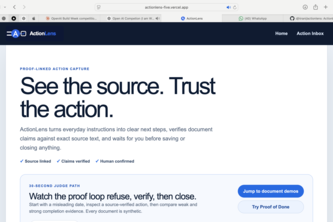
ActionLens is a self-reported document-processing tool that claims to convert official letters, emails, and instructions into verified actions with source-backed evidence. The author states it uses GPT-5.6 for understanding documents and extracting structured data, and implements deterministic code verification to ensure recommendations are traceable to the original text. It is built as a local-first browser application using IndexedDB, with no retention of uploaded files. The system requires explicit human confirmation before saving any AI-generated action.
The project appears to be a solo effort by Jhaman Hirani, who describes it as an attempt to solve the problem of missed deadlines due to unclear or complex official language. It is positioned as a privacy-first tool that avoids AI hallucination by enforcing verification through code rather than relying on model confidence alone.
The single most important open question is: What actual user base or traction exists beyond the author's own testing and evaluation suite?
What The Product Actually Is
The description states that ActionLens turns letters, emails, and instructions into proof-linked actions. It claims to propose deadlines, tasks, reminders, and payments from uploaded documents.
It uses GPT-5.6 for document understanding, structured extraction, photo transcription, and scam-signal detection.
The system is built as a local-first application using IndexedDB, where saved actions and history remain in the browser. Original uploaded files are not retained.
Every AI-generated action requires explicit user confirmation before being saved.
The author claims that verification is enforced by deterministic code rather than model behavior alone.
Inference: The product appears to be an AI-powered document parser with a focus on trustworthiness through evidence linking and human confirmation, rather than a general-purpose summarizer or assistant.
Positioning & Claim Evolution
The description states that ActionLens was inspired by the difficulty people have in converting official language into actionable tasks—especially when tired, scared, or in a second language.
It positions itself as an alternative to traditional AI summarizers, emphasizing proof-linked actions and deterministic verification over model confidence.
The author claims to have built a system where “AI proposes. Code verifies. You decide.”
It is described as a privacy-first workflow that avoids storing uploaded files and requires explicit human confirmation before saving any action.
Inference: The positioning evolved from solving a personal problem (missed deadlines in public administration) into a broader tool for trust in AI-generated actions, with an emphasis on evidence-based outputs and user control.
Target Customer & ICP
The description states that real obligations arrive buried inside official letters—councils, hospitals, landlords, tax offices, universities.
It targets people who are "scared, tired, or in a second language" when dealing with official documents.
It is described as being built for individuals who struggle to convert complex or unclear official language into actionable tasks.
Inference: The ICP appears to be individuals or small businesses who regularly encounter complex official communications and need help extracting clear actions from them. It may also appeal to those concerned about AI hallucination in sensitive contexts.
Business Model & Pricing Evidence
Not evidenced.
The description does not mention any pricing model, monetization strategy, or business model. There is no indication of whether the tool will be offered as a freemium service, subscription, or one-time purchase.
Technical & Delivery Signals
Built with: api, codex, css, gpt-5.6, indexeddb, next.js, openai, playwright, react, tailwind, typescript, vercel, vitest
The system is local-first using IndexedDB.
Original uploaded files are not retained.
Every AI-generated action requires explicit user confirmation before being saved.
Development was done conversationally with Codex and GPT-5.6.
An adversarial evaluation suite was built to test for hallucination traps and misleading letters.
Inference: The technical stack suggests a modern web application with strong emphasis on privacy and deterministic behavior. The use of Codex and GPT-5.6 implies reliance on large language models, but the architecture is designed to prevent over-reliance on model output through code-based verification.
Traction & Maturity Signals
Not evidenced.
There is no mention of users, customers, revenue, or adoption beyond the author’s own testing and evaluation suite.
The project was submitted to a hackathon (OpenAI 2026), but there is no indication of follow-up traction or product development post-hackathon.
Competitive Context
Not evidenced.
There is no mention of competitors or existing solutions in this space. The description does not compare ActionLens to other tools or platforms that might perform similar functions.
Open Questions & Risks
- Solo team: Only one member listed (Jhaman Hirani), which raises concerns about scalability, maintenance, and long-term development.
- No traction or revenue evidence: The project is described as a hackathon submission with no indication of real-world usage or monetization.
- Unverified claims: All claims are self-reported and unverified. No third-party validation or data on performance exists.
- Limited scope: The system only handles document parsing and action extraction, without integration into workflows or external systems.
- Privacy vs. utility trade-off: While local-first and privacy-focused, the lack of cloud storage or sharing features may limit usefulness for collaborative environments.
Questions the description leaves open
- What specific types of documents have you tested with? How many different formats?
- Have you conducted any user testing beyond your own adversarial evaluation suite?
- Are there plans to integrate with calendar, task management, or other productivity tools?
- What is the expected path to monetization or scaling beyond a personal tool?
- How do you plan to handle edge cases like multi-language documents or ambiguous instructions?
- Is there any intention to open-source parts of the system or make it available as an API?
Overall Assessment
Not evidenced.
There is no evidence of revenue, customer base, or traction that would support a commercial due-diligence read. The project appears to be a solo effort built during a hackathon with no indication of market validation or product-market fit beyond the author’s own use case.
The description is self-reported and unverified, and lacks any data on performance, adoption, or financial viability.
Confidence level: Low. This analysis is based entirely on a single self-reported write-up from one individual, with no external corroboration or evidence of traction.
User Stories BotA demo video on every pull request
Get a demo video on every new feature
GitHub App that watches your pull requests and records a narrated, captioned demo.
Save time on demo prep and make informed decisions faster with a video walkthrough of every new feature.
Source
Submitted to the OpenAI 2026 hackathon on Devpost. Project home on Devpost. Back to the full gallery on Devpost.
This competitive analysis was produced by top-founders.com (opens in a new tab)
Generated by a language model from this project's public Devpost page — its tagline, the author's own write-up and any built-with tags listed there — as captured in August 2026. Short quotations are the author's words. It is an opinion on the idea as a business, not on the people behind it, and it reflects the description as published then. If the project has moved on, request a correction below. The analysis is not independent research and contains no verified traction, revenue or customer data.
An independent guide by KFG International LLC — not affiliated with, endorsed by, or connected to Devpost or OpenAI.