

Archive position — measured, not model output
0 likes on Devpost
2,263 of the 7,850 archived projects have more likes, and 5,587 share exactly 0 — so this project's #2,293 place in the like-ranked listing is a tie-break inside that group, not a ranking.
Projects (log scale)
Likes on Devpost. ▲ marks this project's group.
Show the figures
| Likes | Projects | Share of archive |
|---|---|---|
| 0 | 5,587 | 71.2% |
| 1 | 1,758 | 22.4% |
| 2 | 284 | 3.6% |
| 3–4 | 132 | 1.7% |
| 5–9 | 75 | 1.0% |
| 10+ | 14 | 0.2% |
 User Stories BotA demo video on every pull request
Get a demo video on every new feature
GitHub App that watches your pull requests and records a narrated, captioned demo.
Save time on demo prep and make informed decisions faster with a video walkthrough of every new feature.
Executive Summary
What the company appears to be
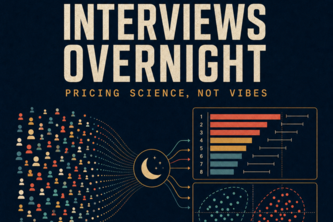
A Thousand Interviews Overnight is a synthetic customer research tool built using AI (GPT-5.6, Codex) and TypeScript. It generates structured, weighted synthetic respondents to test product hypotheses, pricing, and market fit without relying on enthusiastic feedback. The system aims to help founders identify credible willingness to pay before investing in real-world interviews.
What changed
The project was submitted as part of the OpenAI 2026 hackathon. It represents a self-contained prototype that combines AI-driven interviewing with deterministic analytics for structured output and dashboard visualization.
Single most important open question
Does this tool produce actionable insights that improve real-world customer discovery, or is it merely a novel but limited simulation?
This analysis is based entirely on the author’s own description of the project. No external verification, revenue data, customer names, or traction evidence is available.
What The Product Actually Is
The description states that A Thousand Interviews Overnight:
- Runs structured synthetic customer interviews against a proposed product, target market and pricing hypothesis.
- Creates a weighted panel of synthetic respondents with different roles, company sizes, geographies, pain levels and purchasing authority.
- Interviews each respondent separately using a fixed research guide.
- Deliberately looks for rejection, indifference, weak authority, credible alternatives and pricing resistance.
- Produces structured outputs including pain intensity, budget authority, purchase assessment, objections, must-have status and price thresholds.
- Groups respondents into evidence-based segments.
- Calculates a payer-evidence score for each segment.
- Produces Van Westendorp-style price analysis.
- Displays results through an interactive dashboard with segment rankings, objections, pricing ranges, respondent maps, quotes and full transcripts.
The system uses GPT-5.6 for panel creation and interviewing, and deterministic local analytics for analysis and visualization.
The product is described as a command-line tool that generates synthetic interviews and outputs them into a static Next.js dashboard. It does not appear to be a hosted SaaS offering or an API-based service.
Positioning & Claim Evolution
The description states:
- The goal is not to replace real customer discovery, but to help founders develop sharper hypotheses before spending weeks on recruitment and analysis.
- The system is designed to behave like a sceptical market-research process, not an enthusiastic brainstorming partner.
- It aims to expose the gap between interest and credible willingness to pay.
- Outputs are explicitly presented as synthetic and directional, intended to improve the next round of real-world research.
The positioning emphasizes:
- Anti-sycophantic interviewing
- Structured, evidence-based outputs
- Preparing for real customer interviews
- Avoiding false sales forecasts
The claim evolution shows a shift from general AI tools to a specific, purpose-built research assistant that challenges assumptions rather than confirms them.
Target Customer & ICP
The description states:
- The tool is aimed at founders who are developing product hypotheses and testing market fit.
- It is intended for use before real-world customer interviews.
- The system is designed to help teams arrive at real customer conversations better prepared, less biased and more willing to hear that enthusiasm is not revenue.
There is no explicit mention of:
- Specific industries or verticals
- Company size or role-based personas beyond general "founders"
- Use cases beyond early-stage hypothesis testing
The ICP appears to be early-stage founders or product teams working on unproven ideas, but the description does not define a clear segment.
Business Model & Pricing Evidence
The description states:
- The tool is built as a local command-line application.
- It uses no hosted model credentials in the public viewer.
- The final dashboard is a static Next.js application.
- No pricing information or monetization strategy is mentioned.
There is no evidence of a business model, pricing plan, or revenue streams. The tool appears to be a prototype or hackathon submission with no indication of commercial intent.
Technical & Delivery Signals
The description states:
- Built with TypeScript, and uses Codex, GPT-5.6.
- A local command-line runner manages the full research process.
- Each response is validated against strict JSON schemas.
- Results are checkpointed after every completed interview.
- Deterministic analysis runs locally across structured outputs.
- The system includes features like resume support, call-budget enforcement, rate-limit handling and diagnostics.
- The dashboard is a static application with no browser-based model calls.
Technical signals suggest a well-engineered prototype focused on local execution and reproducibility. There is no evidence of cloud-hosted services or API integrations.
Traction & Maturity Signals
The description states:
- Two demonstration studies each interviewed 50 synthetic respondents.
- The system was built for the OpenAI 2026 hackathon.
- It includes automated tests, type checking, static build verification and CI.
- No mention of real-world usage, customers or adoption.
There is no evidence of traction, revenue, or customer base. The project appears to be a prototype with no commercial deployment or user feedback.
Competitive Context
The description does not mention any competitors or similar tools.
No competitive landscape is evident in the provided description.
Open Questions & Risks
- Unproven utility: There is no evidence that synthetic results improve real-world outcomes.
- Limited scope: The tool is a prototype and not a commercial product.
- No validation against real customers: The system’s effectiveness has not been tested in comparison with actual interviews.
- Self-reported claims only: All assertions are unverified and based on the author's own account.
- No monetization strategy: No indication of how this would be turned into a business.
The tool is experimental, lacks commercial traction, and does not address whether synthetic results translate to real-world insights.
Questions the description leaves open
- What specific improvements in real-world customer interviews have you observed after using this tool?
- How do you plan to validate that synthetic results align with actual purchasing behavior?
- Have you tested the system with any real users or teams beyond the hackathon?
- Is there a roadmap for turning this into a commercial product, and what are the key steps?
- What are the limitations of the current approach in terms of accuracy or generalizability?
- How do you plan to calibrate the synthetic panel to reflect real-world diversity?
Overall Assessment
The description states that this is a hackathon submission and not a commercial product.
There is no evidence of:
- Revenue
- Customers
- Product-market fit
- Commercial traction
- Business model or monetization strategy
This project appears to be an experimental prototype with no demonstrated commercial viability. It is not ready for investment or partnership consideration at this time.
User Stories BotA demo video on every pull request
Get a demo video on every new feature
GitHub App that watches your pull requests and records a narrated, captioned demo.
Save time on demo prep and make informed decisions faster with a video walkthrough of every new feature.
Source
Submitted to the OpenAI 2026 hackathon on Devpost. Project home on Devpost. Back to the full gallery on Devpost.
This competitive analysis was produced by top-founders.com (opens in a new tab)
Generated by a language model from this project's public Devpost page — its tagline, the author's own write-up and any built-with tags listed there — as captured in August 2026. Short quotations are the author's words. It is an opinion on the idea as a business, not on the people behind it, and it reflects the description as published then. If the project has moved on, request a correction below. The analysis is not independent research and contains no verified traction, revenue or customer data.
An independent guide by KFG International LLC — not affiliated with, endorsed by, or connected to Devpost or OpenAI.