

Archive position — measured, not model output
0 likes on Devpost
2,263 of the 7,850 archived projects have more likes, and 5,587 share exactly 0 — so this project's #4,256 place in the like-ranked listing is a tie-break inside that group, not a ranking.
Projects (log scale)
Likes on Devpost. ▲ marks this project's group.
Show the figures
| Likes | Projects | Share of archive |
|---|---|---|
| 0 | 5,587 | 71.2% |
| 1 | 1,758 | 22.4% |
| 2 | 284 | 3.6% |
| 3–4 | 132 | 1.7% |
| 5–9 | 75 | 1.0% |
| 10+ | 14 | 0.2% |
 User Stories BotA demo video on every pull request
Get a demo video on every new feature
GitHub App that watches your pull requests and records a narrated, captioned demo.
Save time on demo prep and make informed decisions faster with a video walkthrough of every new feature.
Executive Summary
What the company appears to be
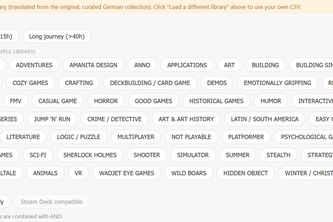
Game Library Explorer is a self-reported single-person project that builds a local, browser-based dashboard for exploring game libraries from CSV files. It allows users to filter, search, and organize their games using personal categories, playtime estimates, ratings, platforms, and Steam tags.
What changed
The author states they built this tool in response to personal frustration with existing launchers that do not support exploration of one’s own library. The project was submitted as part of a hackathon.
Single most important open question
Is there any evidence of user adoption or feedback beyond the example library and self-reported use cases?
What The Product Actually Is
The description states:
- Game Library Explorer is a single HTML application built with HTML, CSS, and JavaScript.
- It runs entirely in the browser (no backend).
- It transforms a game library CSV into a searchable dashboard.
- It supports filters for playtime estimates, ratings, platforms, Steam tags, personal categories, search, and sorting.
- It includes an example library of approximately 1,445 games to demonstrate functionality.
Inference The product is a frontend-only tool designed for personal use, not a commercial SaaS offering.
Positioning & Claim Evolution
The description states:
- The tool was inspired by the author’s need to rediscover games in their own library.
- It aims to help users answer questions like “Which adventure games under five hours have I never played?”
- Existing launchers are not designed for this kind of exploration.
Inference The positioning is personal, exploratory, and niche — focused on individual gamers who want to re-discover their own collections rather than a broader market or commercial use case.
Target Customer & ICP
The description states:
- The author is an “adventure fan” with a large game library.
- It supports users who have accumulated more games than they can finish.
- It targets people who want to explore their own libraries, not necessarily those who buy or sell games.
Inference The ICP appears to be individual gamers, especially fans of adventure or detective games, with a large and diverse library. No evidence of segmentation beyond this.
Business Model & Pricing Evidence
The description states:
- The tool is a local application with no backend.
- It includes an example library for demonstration.
- There is no mention of pricing, monetization, or commercial use.
- The author mentions future features like saved filter presets and additional personalization but does not describe any revenue model.
Inference No evidence of a business model or pricing structure. The tool is presented as a utility for personal use.
Technical & Delivery Signals
The description states:
- Built with HTML, CSS, JavaScript.
- Runs locally in the browser (no backend).
- Uses AI assistance for dashboard development but not for core logic.
- Supports flexible CSV import with manual column mapping.
- Includes a curated example library of ~1,445 games.
Inference The tool is lightweight and self-contained, with no cloud or server dependencies. The use of AI in development is noted but not quantified.
Traction & Maturity Signals
The description states:
- A complete example library with ~1,445 games is included.
- The project was submitted to a hackathon (OpenAI 2026).
- No mention of user feedback, downloads, or usage beyond the author’s own experience.
Inference No evidence of traction or adoption beyond the example and self-reported use. The tool appears to be in early development or prototype stage.
Competitive Context
The description states:
- Existing launchers manage libraries well but are not designed for exploration.
- It is not clear if there are direct competitors, as the focus is on personal library exploration rather than a commercial marketplace or platform.
Inference No evidence of a competitive landscape beyond general game launchers or library managers. The tool’s niche positioning makes it hard to compare directly.
Open Questions & Risks
The description states:
- It is a single-person project with no team.
- It runs locally in the browser and has no backend.
- No revenue, customer, or traction data is provided.
- The author notes that challenges were around import systems and category design — suggesting complexity in usability.
Inference Key risks include lack of scalability, limited user feedback, and potential difficulty in expanding beyond a single-user tool. The lack of team or commercial traction raises concerns about long-term viability.
Questions the description leaves open
- What is the actual size of your user base (if any)?
- How many people have used this tool outside of the example library?
- Are there any plans to monetize or expand beyond personal use?
- Have you received feedback from users beyond yourself?
- What are the main challenges in making it more widely usable or scalable?
Overall Assessment
The description states:
- It is a single-person project built for personal use.
- No evidence of revenue, customers, or traction.
- The tool is presented as a utility, not a commercial product.
Inference There is no evidence to support an investment or partnership opportunity at this time. The project appears to be a prototype or personal tool with no demonstrated market traction or business model.
User Stories BotA demo video on every pull request
Get a demo video on every new feature
GitHub App that watches your pull requests and records a narrated, captioned demo.
Save time on demo prep and make informed decisions faster with a video walkthrough of every new feature.
Source
Submitted to the OpenAI 2026 hackathon on Devpost. Project home on Devpost. Back to the full gallery on Devpost.
This competitive analysis was produced by top-founders.com (opens in a new tab)
Generated by a language model from this project's public Devpost page — its tagline, the author's own write-up and any built-with tags listed there — as captured in August 2026. Short quotations are the author's words. It is an opinion on the idea as a business, not on the people behind it, and it reflects the description as published then. If the project has moved on, request a correction below. The analysis is not independent research and contains no verified traction, revenue or customer data.
An independent guide by KFG International LLC — not affiliated with, endorsed by, or connected to Devpost or OpenAI.