

Archive position — measured, not model output
0 likes on Devpost
2,263 of the 7,850 archived projects have more likes, and 5,587 share exactly 0 — so this project's #4,258 place in the like-ranked listing is a tie-break inside that group, not a ranking.
Projects (log scale)
Likes on Devpost. ▲ marks this project's group.
Show the figures
| Likes | Projects | Share of archive |
|---|---|---|
| 0 | 5,587 | 71.2% |
| 1 | 1,758 | 22.4% |
| 2 | 284 | 3.6% |
| 3–4 | 132 | 1.7% |
| 5–9 | 75 | 1.0% |
| 10+ | 14 | 0.2% |
 User Stories BotA demo video on every pull request
Get a demo video on every new feature
GitHub App that watches your pull requests and records a narrated, captioned demo.
Save time on demo prep and make informed decisions faster with a video walkthrough of every new feature.
Executive Summary
What the company appears to be
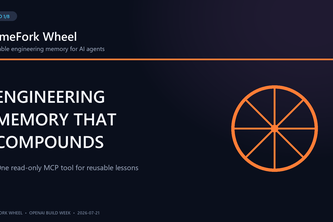
GameFork Wheel is a self-reported public knowledge layer for AI agents, built as an MCP (Model Context Protocol) endpoint that exposes a read-only search tool. It indexes and surfaces reusable design decisions, failure lessons, code patterns, and prompt templates from internal development knowledge, with a focus on safety and anonymity.
What changed
The project was originally part of a private system within GameFork. During OpenAI Build Week, the author repurposed it into a public-facing MCP service, separating it from internal tools and packaging it as a ChatGPT app. It now operates via Cloudflare Workers with a dedicated Durable Object.
Single most important open question
Is there any evidence of actual usage or adoption by AI agents, or traction beyond the author’s own development work?
What The Product Actually Is
The description states that GameFork Wheel is a public MCP knowledge wheel, designed to help AI agents retrieve verified design decisions, reusable code patterns, and failure lessons safely. It exposes one tool: search_wheel, which allows agents to browse or search across 76 indexed records.
- The system runs on Cloudflare Workers with a Durable Object.
- It uses TypeScript, Next.js, and integrates with OpenAI, Supabase, and Codex.
- It implements deterministic lexical search v2, including normalization, bigrams, identifier boosting, and abstention logic.
- The public tier is described as fail-closed, with sensitive entries returning only metadata (
body_excluded: true) and no internal paths or source locations.
Inference The product appears to be a minimal, read-only knowledge layer for AI agents, built using open-source tools and protocols. It does not appear to include any commercial or monetization features.
Positioning & Claim Evolution
The author positions GameFork Wheel as a curated, searchable knowledge layer that prevents AI agents from “reinventing the wheel” or repeating known failures.
- The tagline: “A public MCP knowledge wheel that helps AI agents retrieve verified design decisions, reusable code patterns, and hard-won failure lessons safely.”
- This is a claim of utility, not evidence of adoption.
- The write-up emphasizes:
- Avoiding reinvention of architecture decisions or security pitfalls.
- Making operational knowledge available without leaking sensitive details.
- Using a fail-closed public tier to ensure safety.
Inference The positioning reflects an intent to build a safer, more efficient AI agent knowledge base, but there is no evidence that this has been adopted beyond the author’s own development or testing.
Target Customer & ICP
The description does not clearly define target customers or personas. It implies:
- AI agents as primary users.
- A developer audience who may benefit from reusable patterns and failure lessons.
- Possibly internal teams within companies using AI coding tools, though no specific customer base is named.
Inference The ICP appears to be AI developers or agent builders, but the description does not provide evidence of a defined market segment or user group beyond the author’s own use case.
Business Model & Pricing Evidence
There is no evidence in the description of any business model, pricing structure, or monetization strategy. The system is described as a public MCP endpoint, with no indication of paid tiers, subscriptions, or commercial offerings.
- The public tier is read-only and fails closed.
- No mention of access controls, usage fees, or revenue streams.
Inference The business model remains unreported. It may be an open-source or internal tool, or a prototype for future monetization — but no evidence supports either.
Technical & Delivery Signals
The description provides several technical details:
- Built with Cloudflare Workers, Durable Objects, and Next.js.
- Uses TypeScript, Zod, Vitest, Supabase, OpenAI, and Codex.
- Implements a deterministic lexical search v2 with NFKC normalization, CJK bigrams, exact identifier boosting, and calibrated thresholds.
- Includes abstention logic to avoid weak matches.
- Sensitive entries are redacted using body_excluded: true, and no internal paths are returned.
Inference The system is technically sound for its stated purpose. It uses modern tools and protocols, but there’s no evidence of production-scale deployment or performance data.
Traction & Maturity Signals
There is no evidence of traction, adoption, or user engagement beyond the author's own development work:
- The system indexes 76 lessons, with 41 active general-purpose lessons.
- It has 338 tests and 29 search evaluation cases passing.
- It was built during a hackathon (OpenAI Build Week).
- No mention of users, customers, or real-world usage.
Inference The product is in an early stage, likely a prototype or proof-of-concept. There is no evidence of commercial traction or user adoption.
Competitive Context
The description does not reference any competitors or existing solutions in the space of AI agent knowledge bases or MCP tools. It does not state whether similar systems exist, nor how GameFork Wheel differentiates from them.
Inference No competitive context is provided. The project may be unique or niche, but there is no evidence to assess its positioning relative to others.
Open Questions & Risks
- No commercial traction: No evidence of users, customers, or revenue.
- Self-reported only: All claims are unverified and self-authored.
- Limited scope: Only one tool (
search_wheel) is exposed; no write capabilities or integration points. - No monetization strategy: No indication of how the product will generate value or revenue.
- Prototype nature: Built during a hackathon, likely not production-ready.
Inference This appears to be an early-stage prototype with no commercial viability or traction. It may evolve into something more substantial, but there is no evidence of that yet.
Questions the description leaves open
- What real-world use cases have you identified for this tool beyond your own development?
- How do you plan to scale the knowledge base beyond 76 lessons?
- Are there any internal or external users currently testing or using this system?
- What is the long-term vision for monetization or commercial adoption?
- How does this compare to other tools in the AI agent knowledge space, if any?
Overall Assessment
Not evidenced — There is no evidence of revenue, customers, traction, or a clear path to monetization. The project appears to be an early-stage prototype built during a hackathon.
Confidence Level Low This is a self-reported, unverified description with no external corroboration. It does not demonstrate commercial viability, user adoption, or business traction.
Inference At this stage, GameFork Wheel is a conceptual tool, not a product with demonstrated value or market demand. It may be a promising idea, but there is no evidence to support investment or partnership at this time.
User Stories BotA demo video on every pull request
Get a demo video on every new feature
GitHub App that watches your pull requests and records a narrated, captioned demo.
Save time on demo prep and make informed decisions faster with a video walkthrough of every new feature.
Source
Submitted to the OpenAI 2026 hackathon on Devpost. Project home on Devpost. Back to the full gallery on Devpost.
This competitive analysis was produced by top-founders.com (opens in a new tab)
Generated by a language model from this project's public Devpost page — its tagline, the author's own write-up and any built-with tags listed there — as captured in August 2026. Short quotations are the author's words. It is an opinion on the idea as a business, not on the people behind it, and it reflects the description as published then. If the project has moved on, request a correction below. The analysis is not independent research and contains no verified traction, revenue or customer data.
An independent guide by KFG International LLC — not affiliated with, endorsed by, or connected to Devpost or OpenAI.