

Archive position — measured, not model output
2 likes on Devpost
221 of the 7,850 archived projects have more likes, and 284 share exactly 2 — so this project's #334 place in the like-ranked listing is a tie-break inside that group, not a ranking.
Projects (log scale)
Likes on Devpost. ▲ marks this project's group.
Show the figures
| Likes | Projects | Share of archive |
|---|---|---|
| 0 | 5,587 | 71.2% |
| 1 | 1,758 | 22.4% |
| 2 | 284 | 3.6% |
| 3–4 | 132 | 1.7% |
| 5–9 | 75 | 1.0% |
| 10+ | 14 | 0.2% |
 User Stories BotA demo video on every pull request
Get a demo video on every new feature
GitHub App that watches your pull requests and records a narrated, captioned demo.
Save time on demo prep and make informed decisions faster with a video walkthrough of every new feature.
Executive Summary
What the company appears to be
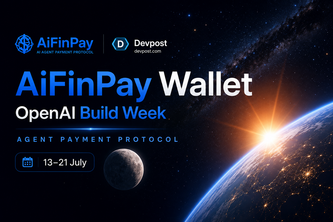
The project described by the caller is a self-reported multichain wallet built for ChatGPT, enabling both users and AI agents to manage balances, prepare payments, set spending rules, approve transactions, and operate across 12 blockchain networks. It is presented as a secure payment layer that integrates directly into ChatGPT using OpenAI’s Apps SDK and the Model Context Protocol (MCP).
What changed
The project was submitted to the OpenAI 2026 hackathon on Devpost. The author describes it as a working prototype with functional wallet features, including persistent linking, balance retrieval, payment preparation, approval flows, and audit history. It is positioned as an early-stage product in the AI-agent commerce space.
Single most important open question
Is there any evidence of real-world usage or integration beyond the hackathon submission? The description contains no data on revenue, customers, traction, or adoption — only a self-reported technical implementation and feature set.
Note
This analysis is based solely on the self-reported project description provided by the caller. No external verification or historical data are available. All claims are attributed to the author’s own account and should be treated as unverified.
What The Product Actually Is
The description states that AiFinPay Wallet for ChatGPT is a programmable multichain wallet and payment approval layer built directly into ChatGPT. It allows users and AI agents to:
- Create or connect a wallet
- View balances and transaction history
- Receive assets
- Prepare and send payments via natural-language commands
- Select from 12 supported blockchain networks
- Set spending limits and approval policies
- Review and approve transactions before execution
- Track transaction status, receipts, and audit history
The product is designed to support both human-controlled and autonomous AI-agent commerce within ChatGPT.
It uses:
- GPT-5.6 for architecture design and user flow
- Codex for code generation and testing
- OpenAI Apps SDK and Model Context Protocol (MCP)
- Node.js, TypeScript, React, Express.js
- SQLite for storage
- OAuth for wallet linking
Inference The product is described as a working prototype with 16 MCP tools, persistent wallet sessions, and an audit hash chain. However, no evidence of live deployment or user interaction beyond the hackathon submission exists.
Positioning & Claim Evolution
The author positions AiFinPay as:
- A secure payment layer inside ChatGPT
- An enabler for AI agents to perform payments without leaving the conversational interface
- A self-custodial wallet, meaning private keys are not exposed to ChatGPT or language models
Key claims include:
- Users and AI agents can prepare, approve, and execute transactions
- Private keys are never shared with ChatGPT or LLMs
- The system supports 12 blockchain networks
- It enables autonomous AI commerce through programmable spending policies
Claim vs Fact
These are self-reported claims. There is no evidence of actual customer feedback, market validation, or commercial traction.
Target Customer & ICP
The description indicates two primary user types:
- Human users who want to manage crypto assets via ChatGPT
- AI agents that need to initiate payments under defined rules and permissions
It also implies a target audience interested in:
- Multichain wallet functionality
- Conversational interfaces for financial operations
- Secure, self-custodial payment tools
- AI-agent commerce infrastructure
Not evidenced No explicit segmentation or customer personas are provided. No indication of whether the team has identified specific buyer profiles or use cases beyond general AI-agent payments.
Business Model & Pricing Evidence
There is no mention of pricing models, monetization strategies, or business model details in the description.
Not evidenced The author does not state how the product will be sold, who pays for it, or what revenue streams are planned. No pricing information, subscription tiers, transaction fees, or licensing terms are included.
Technical & Delivery Signals
The project is built using:
- OpenAI Apps SDK
- Model Context Protocol (MCP)
- GPT-5.6 and Codex for development
- Node.js, TypeScript, React, Express.js
- Blockchain networks: Avalanche, Polygon, Solana, etc.
- SQLite for transaction history
- OAuth for wallet linking
- Idempotency protection and audit hash chain
Inference The system includes:
- Wallet tools via MCP
- A secure backend with isolated payment logic
- Mobile compatibility
- Support for multiple blockchains
- Transaction approval workflows
However, the description does not confirm production-grade security or scalability.
Traction & Maturity Signals
The project is described as a working prototype submitted to the OpenAI 2026 hackathon. It includes:
- Functional ChatGPT application
- 12 supported blockchain networks
- 16 MCP wallet and payment tools
- Persistent linking, balance retrieval, approval flows
- Audit trail and transaction history
Not evidenced No evidence of real users, customer feedback, or product adoption beyond the hackathon. No data on active usage, retention, or monetization.
Competitive Context
The description does not reference competitors or existing solutions in the space.
Not evidenced There is no mention of how AiFinPay compares to other wallets, AI-agent payment platforms, or multichain interfaces. No competitive analysis or differentiation strategy is provided.
Open Questions & Risks
- Unverified claims: All features and functionality are self-reported without external validation.
- No traction or revenue: The project has no evidence of real-world usage or monetization.
- Limited team size: Only one member listed (coinsecuritiescompany Bugaenko).
- Hackathon origin: The product is a hackathon submission, not a mature product.
- Security assumptions: While private keys are said to be isolated, the description lacks details on how this is enforced in practice.
- Lack of clarity on scalability or production readiness: No mention of performance testing, security audits, or infrastructure scaling.
Inference The project may be an experimental idea with limited commercial viability unless further developed and validated.
Questions the description leaves open
- What is the current status of the product? Is it live or still in prototype form?
- Have you tested the system with real users or AI agents?
- How do you plan to onboard users and ensure secure wallet linking?
- Are there any known security vulnerabilities or limitations in the current implementation?
- What are your plans for expanding support beyond 12 blockchain networks?
- Do you have a clear path to monetization or revenue generation?
- How will you handle regulatory compliance across different blockchains and jurisdictions?
Overall Assessment
Not evidenced There is no evidence of traction, revenue, customer base, or commercial viability beyond the hackathon submission.
Confidence Level Low
Reasoning
The project is described as a prototype built for a hackathon. No data on user adoption, monetization, or product-market fit are available. The team size is small, and there is no indication of prior experience or validation in the space.
Conclusion
This is an early-stage concept with technical feasibility demonstrated through a hackathon submission. It has potential but lacks any evidence of real-world usage or commercial readiness. Further due diligence would require engagement with the founder to assess product maturity, team capability, and go-to-market strategy.
User Stories BotA demo video on every pull request
Get a demo video on every new feature
GitHub App that watches your pull requests and records a narrated, captioned demo.
Save time on demo prep and make informed decisions faster with a video walkthrough of every new feature.
Source
Submitted to the OpenAI 2026 hackathon on Devpost. Project home on Devpost. Back to the full gallery on Devpost.
This competitive analysis was produced by top-founders.com (opens in a new tab)
Generated by a language model from this project's public Devpost page — its tagline, the author's own write-up and any built-with tags listed there — as captured in August 2026. Short quotations are the author's words. It is an opinion on the idea as a business, not on the people behind it, and it reflects the description as published then. If the project has moved on, request a correction below. The analysis is not independent research and contains no verified traction, revenue or customer data.
An independent guide by KFG International LLC — not affiliated with, endorsed by, or connected to Devpost or OpenAI.