

Archive position — measured, not model output
2 likes on Devpost
221 of the 7,850 archived projects have more likes, and 284 share exactly 2 — so this project's #336 place in the like-ranked listing is a tie-break inside that group, not a ranking.
Projects (log scale)
Likes on Devpost. ▲ marks this project's group.
Show the figures
| Likes | Projects | Share of archive |
|---|---|---|
| 0 | 5,587 | 71.2% |
| 1 | 1,758 | 22.4% |
| 2 | 284 | 3.6% |
| 3–4 | 132 | 1.7% |
| 5–9 | 75 | 1.0% |
| 10+ | 14 | 0.2% |
 User Stories BotA demo video on every pull request
Get a demo video on every new feature
GitHub App that watches your pull requests and records a narrated, captioned demo.
Save time on demo prep and make informed decisions faster with a video walkthrough of every new feature.
Executive Summary
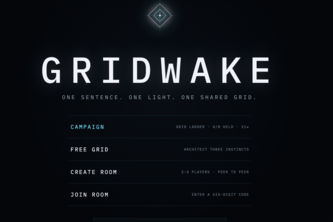
GRIDWAKE is a self-contained browser-based tactical game that interprets natural-language commands into in-game actions using a local, deterministic compiler. The author states it allows players to write one sentence describing a military doctrine and see the execution unfold in real time, with full transparency of how the system interpreted their input. The product is presented as a single-person project built over a weekend for an OpenAI hackathon.
The most important open question is whether this approach — using bounded language instead of AI models — can scale to meaningful gameplay complexity or if it remains limited to narrow, pre-defined tactical scenarios.
This analysis is based entirely on the self-reported description provided by the author. No external verification, revenue data, customer base, or traction evidence is available.
What The Product Actually Is
The description states that GRIDWAKE is a browser-based game where players write one sentence describing a tactical doctrine, which then compiles into a canonical plan and executes in real time. It includes:
- A "bounded tactical-language compiler" running locally in the browser
- Three-light squad (Guardian, Scout, Mender) controlled by player input
- A neon grid-based arena with corruption mechanics
- A scoring system based on core health, threat control, and instinct impact
- Deterministic simulation with replay capability
- Multiplayer via WebRTC
- No API calls or model inference at runtime
The game uses a 332-phrase lexicon mapping natural language to canonical vocabulary. It runs entirely client-side with no server-side processing during gameplay.
Positioning & Claim Evolution
The author claims GRIDWAKE is "not a chatbot wearing a game costume, and not a game that pretends to understand you" but rather something that reads words, shows interpretation clearly, and executes faithfully. The positioning centers on:
- Interpretation transparency as a core mechanic
- Language-based control over traditional button-based interfaces
- Bounded language approach versus AI models
- Deterministic execution with replayability
The claim evolution suggests an intent to move beyond simple "AI does what you said" experiences by making interpretation legible and arguable, rather than hidden.
Target Customer & ICP
Not evidenced. The description does not specify target customer segments, user personas, or ideal customer profiles.
Business Model & Pricing Evidence
Not evidenced. There is no mention of pricing, monetization strategy, or business model in the author's write-up.
Technical & Delivery Signals
The description states that GRIDWAKE was built with:
- TypeScript (1,760 lines for core compiler)
- Pixi.js over WebGL for rendering
- Web Audio API for sound
- Trystero over WebRTC for multiplayer
- React and Vite for development stack
- LocalStorage for persistence
- Python 3.12 reference implementation for verification
Key technical signals include:
- Fully client-side execution with no runtime API calls
- Deterministic simulation with seed-based replay capability
- Separate engine and rendering layers
- Test-driven development with 230 Vitest tests across 17 files
- Verification through corpus tests, production builds, Python reference implementation, and sensitivity sweeps
Traction & Maturity Signals
Not evidenced. No information is provided about user adoption, retention metrics, revenue, or product maturity beyond the single-person hackathon project.
Competitive Context
Not evidenced. The description does not mention competitors, market positioning, or competitive landscape.
Open Questions & Risks
- Scalability of bounded language: The approach relies on a fixed lexicon; it's unclear how complex tactical scenarios could be expressed without expanding the vocabulary significantly.
- Single-person project: With only one team member, there may be limited capacity for iteration, testing, or feature development beyond the hackathon version.
- Limited scope: The game appears to be constrained to a specific type of tactical scenario (grid-based defense with three units), which may limit its appeal or utility.
- Verification complexity: While the project includes extensive verification steps, these are likely not scalable for broader use cases or production environments.
Questions the description leaves open
- How does the bounded language approach scale to more complex tactical scenarios?
- What is the process for adding new vocabulary or expanding the lexicon?
- Are there plans to support multiplayer beyond peer-to-peer mode?
- How would you handle user feedback on interpretation errors or misreads?
- What are the technical limitations of running such a system in production at scale?
Overall Assessment
Not evidenced. No information is provided about funding, valuation, or investment interest from the author's description. The project appears to be a hackathon submission with no commercial traction or evidence of market validation.
User Stories BotA demo video on every pull request
Get a demo video on every new feature
GitHub App that watches your pull requests and records a narrated, captioned demo.
Save time on demo prep and make informed decisions faster with a video walkthrough of every new feature.
Source
Submitted to the OpenAI 2026 hackathon on Devpost. Project home on Devpost. Back to the full gallery on Devpost.
This competitive analysis was produced by top-founders.com (opens in a new tab)
Generated by a language model from this project's public Devpost page — its tagline, the author's own write-up and any built-with tags listed there — as captured in August 2026. Short quotations are the author's words. It is an opinion on the idea as a business, not on the people behind it, and it reflects the description as published then. If the project has moved on, request a correction below. The analysis is not independent research and contains no verified traction, revenue or customer data.
An independent guide by KFG International LLC — not affiliated with, endorsed by, or connected to Devpost or OpenAI.