

Archive position — measured, not model output
0 likes on Devpost
2,263 of the 7,850 archived projects have more likes, and 5,587 share exactly 0 — so this project's #2,294 place in the like-ranked listing is a tie-break inside that group, not a ranking.
Projects (log scale)
Likes on Devpost. ▲ marks this project's group.
Show the figures
| Likes | Projects | Share of archive |
|---|---|---|
| 0 | 5,587 | 71.2% |
| 1 | 1,758 | 22.4% |
| 2 | 284 | 3.6% |
| 3–4 | 132 | 1.7% |
| 5–9 | 75 | 1.0% |
| 10+ | 14 | 0.2% |
 User Stories BotA demo video on every pull request
Get a demo video on every new feature
GitHub App that watches your pull requests and records a narrated, captioned demo.
Save time on demo prep and make informed decisions faster with a video walkthrough of every new feature.
Executive Summary
What the company appears to be
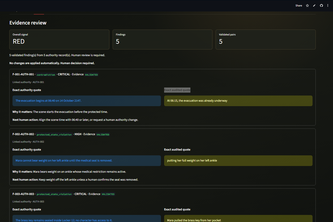
A-Eon Continuity Workspace is described as a local, deterministic tool for auditing continuity in long-form creative projects (e.g., novels, screenplays). It evaluates new scenes or chapters against structured "continuity authorities" and provides evidence-based findings without rewriting text.
What changed
The project was built during the OpenAI 2026 hackathon using Codex, GPT-5.6 Sol, Python, Pydantic, Streamlit, and other tools. It is presented as a prototype with a functional demo showing red/green signals and dual-evidence validation.
Single most important open question
Is there any evidence of real-world adoption or traction beyond the hackathon prototype? The description states no revenue, customers, or usage data exist outside of self-reported claims.
What The Product Actually Is
The description states that A-Eon Continuity Workspace is a local continuity-auditing tool for complex creative projects. It accepts:
- A structured continuity package (the "authority");
- A new scene or chapter to audit.
It outputs:
- A red, amber, or green signal;
- Detected contradictions and protected-state violations;
- Severity of each finding;
- Exact quotes from both authority and audited text;
- Short explanations;
- Recommended next actions;
- Markdown and JSON exports.
The tool does not edit text automatically, nor does it call external APIs. It is described as deterministic, local, and fully self-contained.
Inference The product is a proof-of-concept for an editorial workflow that emphasizes traceability and human control over automated decisions.
Positioning & Claim Evolution
The description states the project was inspired by the question:
“Can a continuity check produce evidence that a human editor can verify, instead of silently rewriting the text?”
This claim positions A-Eon as a human-centric tool that avoids AI rewriting and instead focuses on evidence-based auditing.
It also claims to have avoided common pitfalls in such systems — such as making decisions without showing evidence or hiding how conclusions are reached. The project explicitly separates:
- Authority;
- Detection;
- Evidence;
- Severity;
- Recommendation;
- Human decision.
This suggests a deliberate shift from generic AI assistants toward auditable, explainable tools.
Inference The positioning reflects an attempt to differentiate from AI rewriting systems by emphasizing transparency and human agency in continuity management.
Target Customer & ICP
The description states that A-Eon is designed for complex creative projects, such as:
- Long-form novels;
- Screenplays;
- Projects with timelines, character sheets, object registers, relationship maps, revisions, and working notes.
It targets users who need to maintain consistency across large, multi-layered narratives.
Inference The ICP likely includes writers, editors, or production teams working on high-complexity creative works — though no specific customer personas or use cases are mentioned beyond the general context of long-form narrative projects.
Business Model & Pricing Evidence
The description does not mention any pricing model, monetization strategy, or business model.
It states that the application is local, deterministic, and free of private data, API keys, external services, and automatic rewriting. It also says it was built during a hackathon and is presented as a prototype.
Inference No evidence exists for any commercial or pricing structure beyond the self-reported prototype.
Technical & Delivery Signals
The project was built using:
- Codex
- GPT-5.6 Sol
- Python
- Pydantic
- Streamlit
- pytest
- JSON
- git
It includes:
- A Python-based deterministic engine;
- Typed Pydantic contracts;
- Test suite with 15 automated tests;
- Markdown and JSON export functionality;
- A Streamlit UI with Workspace, Audit, and Evidence views.
The application is described as fully local, not calling external APIs, and not requiring API keys.
Inference The technical stack suggests a lightweight, developer-oriented prototype built for rapid iteration and demonstration. No evidence of scalability or production-grade infrastructure is provided.
Traction & Maturity Signals
The description states that the project was built during the OpenAI 2026 hackathon, and it includes:
- A functional demo;
- 15 automated tests;
- A complete build log, manifests, checkpoints, and delivery hashes;
- A demonstration of red and green signals.
However, there is no mention of:
- Revenue;
- Customers;
- Usage metrics;
- Product-market fit;
- Any real-world adoption or feedback beyond the hackathon.
Inference The project is a prototype, not a product in use. No traction or maturity indicators are evident from the description.
Competitive Context
The description does not reference any competitors or existing tools in the space of continuity management for creative projects.
It implies that current solutions may be:
- Rewriting assistants;
- Tools that obscure how decisions are made;
- Lacking in evidence-based auditing.
Inference The project is positioned as a novel approach to continuity auditing, but no competitive landscape or market positioning beyond its own claims is described.
Open Questions & Risks
- No traction or adoption: The tool exists only as a hackathon prototype with no evidence of real-world usage.
- Limited scope: It’s built for a narrow use case (local, deterministic, structured data) and lacks scalability or integration features.
- Unproven business model: No indication of monetization or commercial viability.
- Self-reported only: All claims are unverified; there is no independent evidence of performance, usability, or impact.
- No external validation: The tool has not been tested in real-world creative workflows.
Inference The project lacks any signal of commercial readiness or market demand beyond its own self-description.
Questions the description leaves open
- What is the actual use case for this tool? Is it being used by writers or editors in practice?
- How does the tool handle large-scale, unstructured narrative data (e.g., free-form text)?
- Are there any plans to integrate with existing creative tools or platforms?
- Has the tool been tested with real users beyond the hackathon prototype?
- What is the long-term vision for monetization or product development?
Overall Assessment
Not evidenced.
The description provides no evidence of revenue, customers, traction, or commercial viability. It describes a prototype built during a hackathon, with no indication that it has moved beyond experimental or demonstration stages.
The tool is presented as a proof-of-concept for a human-centric continuity auditing system, but there is no evidence of real-world adoption or product-market fit.
Confidence: Low.
This project is not ready for investment or partnership consideration based solely on the self-reported description.
User Stories BotA demo video on every pull request
Get a demo video on every new feature
GitHub App that watches your pull requests and records a narrated, captioned demo.
Save time on demo prep and make informed decisions faster with a video walkthrough of every new feature.
Source
Submitted to the OpenAI 2026 hackathon on Devpost. Project home on Devpost. Back to the full gallery on Devpost.
This competitive analysis was produced by top-founders.com (opens in a new tab)
Generated by a language model from this project's public Devpost page — its tagline, the author's own write-up and any built-with tags listed there — as captured in August 2026. Short quotations are the author's words. It is an opinion on the idea as a business, not on the people behind it, and it reflects the description as published then. If the project has moved on, request a correction below. The analysis is not independent research and contains no verified traction, revenue or customer data.
An independent guide by KFG International LLC — not affiliated with, endorsed by, or connected to Devpost or OpenAI.