

Archive position — measured, not model output
0 likes on Devpost
2,263 of the 7,850 archived projects have more likes, and 5,587 share exactly 0 — so this project's #7,803 place in the like-ranked listing is a tie-break inside that group, not a ranking.
Projects (log scale)
Likes on Devpost. ▲ marks this project's group.
Show the figures
| Likes | Projects | Share of archive |
|---|---|---|
| 0 | 5,587 | 71.2% |
| 1 | 1,758 | 22.4% |
| 2 | 284 | 3.6% |
| 3–4 | 132 | 1.7% |
| 5–9 | 75 | 1.0% |
| 10+ | 14 | 0.2% |
 User Stories BotA demo video on every pull request
Get a demo video on every new feature
GitHub App that watches your pull requests and records a narrated, captioned demo.
Save time on demo prep and make informed decisions faster with a video walkthrough of every new feature.
Executive Summary
What the company appears to be
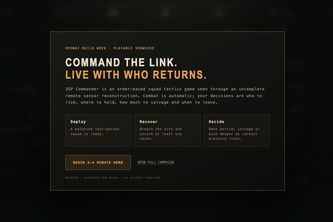
ZGP Commander is a self-reported tactical game project built as a hackathon submission for the OpenAI 2026 hackathon. It is described as a static TypeScript and Vite application using WebGL2 point-cloud rendering, with a core loop involving base management, squad missions, and uncertain sensor data. The author states it is a playable slice of a larger game concept.
What changed
The project was submitted to the OpenAI 2026 hackathon on Devpost. No prior version or evolution is described beyond this single submission.
Single most important open question
Is there any evidence of traction, revenue, or customer adoption beyond the author’s own write-up?
What The Product Actually Is
The description states that ZGP Commander is a static TypeScript and Vite application. It uses WebGL2 point-cloud rendering with a Canvas fallback, and is built using technologies such as canvas, codex, css, gpt-5.6, html5, javascript, typescript, vite, vitest, webgl.
The game features:
- A base management system where players manage a 12-person survivor roster.
- Missions dispatched via “Ghostlink”, an incomplete remote sensor reconstruction.
- Tactical gameplay involving point-cloud data, team positioning, and loot scavenging.
- A deterministic 3–4 minute route in the hackathon showcase.
- No runtime image assets.
Inference The product is a prototype or playable slice, not a full commercial game. It is self-reported as a tactical simulation with procedural elements.
Positioning & Claim Evolution
The author states:
- The project was inspired by “the old Last Stand: Dead Zone game”.
- It aims to capture the essence of tactical gameplay where players must balance risk and reward in a zombie-themed setting.
- The goal is to create something that allows players to build teams, send them on missions, and manage consequences.
Inference The positioning is tactical, survival-based, with an emphasis on risk-reward mechanics and uncertain sensor data. It is not described as a commercial product or platform but rather a game prototype.
Target Customer & ICP
The description does not state the target customer or ideal customer profile (ICP). It only describes gameplay elements such as:
- Base management.
- Squad missions.
- Survivor roster.
- Tactical decision-making under uncertainty.
Inference The likely audience is tactical game enthusiasts, possibly indie gamers or players of survival or auto-battler genres. However, no explicit customer segment is defined.
Business Model & Pricing Evidence
There is no evidence in the description of a business model or pricing strategy. The project is described as a hackathon submission, and no mention is made of monetization, subscriptions, or sales.
Inference No commercial business model is evident from the provided information.
Technical & Delivery Signals
The author states:
- Built with TypeScript, Vite, WebGL2, Canvas fallback.
- Uses a point-cloud renderer for tactical presentation.
- No runtime image assets.
- The game structure was defined by the author; Codex and Sol were used for coding and suggestions.
Inference The technical stack is modern and web-based, with an emphasis on programmatic rendering. The use of point-clouds suggests a novel visual approach to tactical gameplay, but it is not clear if this is a scalable or production-ready system.
Traction & Maturity Signals
The project is described as a hackathon submission, and no evidence of traction, revenue, customers, or adoption is provided. The author states:
- It is a playable slice.
- It includes a deterministic 3–4 minute route.
- It has roughly 33,000 environment points rendered.
Inference The project is at an early stage of development, likely a prototype or proof-of-concept, with no evidence of user engagement or commercial traction.
Competitive Context
The author references:
- “Last Stand: Dead Zone” as inspiration.
- Auto-battler and tactics games as genres.
Inference The game is positioned within the tactical survival genre, potentially competing with similar indie or niche titles. However, no specific competitors are named or analyzed.
Open Questions & Risks
- The project is a single-person hackathon submission.
- No evidence of commercial traction, revenue, or user adoption.
- The author states that the point-cloud rendering was a key innovation, but it is unclear if this has been validated in a larger context.
- No mention of funding, team expansion, or product roadmap beyond the hackathon.
Inference The project is highly speculative, with no evidence of market validation or commercial viability. It is likely a personal or experimental effort, not a scalable business.
Questions the description leaves open
- Is this project intended to evolve into a full commercial product, and if so, what is the roadmap?
- Has there been any user testing or feedback beyond the hackathon?
- What are the plans for monetization or revenue generation?
- Are there any existing partnerships or early adopters?
- How does the point-cloud rendering system scale to larger game worlds or more complex gameplay?
Overall Assessment
Not evidenced.
The project is described as a single-person hackathon submission, with no evidence of traction, revenue, customers, or commercial viability. It is not clear whether this represents a viable business opportunity or a personal experiment.
Confidence: Low.
This analysis is based entirely on self-reported information and lacks any independent validation or historical data.
User Stories BotA demo video on every pull request
Get a demo video on every new feature
GitHub App that watches your pull requests and records a narrated, captioned demo.
Save time on demo prep and make informed decisions faster with a video walkthrough of every new feature.
Source
Submitted to the OpenAI 2026 hackathon on Devpost. Project home on Devpost. Back to the full gallery on Devpost.
This competitive analysis was produced by top-founders.com (opens in a new tab)
Generated by a language model from this project's public Devpost page — its tagline, the author's own write-up and any built-with tags listed there — as captured in August 2026. Short quotations are the author's words. It is an opinion on the idea as a business, not on the people behind it, and it reflects the description as published then. If the project has moved on, request a correction below. The analysis is not independent research and contains no verified traction, revenue or customer data.
An independent guide by KFG International LLC — not affiliated with, endorsed by, or connected to Devpost or OpenAI.