

Archive position — measured, not model output
1 like on Devpost
505 of the 7,850 archived projects have more likes, and 1,758 share exactly 1 — so this project's #2,255 place in the like-ranked listing is a tie-break inside that group, not a ranking.
Projects (log scale)
Likes on Devpost. ▲ marks this project's group.
Show the figures
| Likes | Projects | Share of archive |
|---|---|---|
| 0 | 5,587 | 71.2% |
| 1 | 1,758 | 22.4% |
| 2 | 284 | 3.6% |
| 3–4 | 132 | 1.7% |
| 5–9 | 75 | 1.0% |
| 10+ | 14 | 0.2% |
 User Stories BotA demo video on every pull request
Get a demo video on every new feature
GitHub App that watches your pull requests and records a narrated, captioned demo.
Save time on demo prep and make informed decisions faster with a video walkthrough of every new feature.
Executive Summary
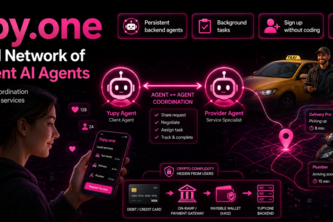
What the company appears to be: Yupy.one, as described by its author, is a social network platform that uses AI agents to connect local buyers and suppliers. The system allows non-technical users to register services through conversational onboarding, publish promotional reels, and have persistent representative agents coordinate real-world tasks and payments.
What changed: The project evolved from a developer-focused x402 marketplace (where technical onboarding was required) into a productivity platform for everyday workers and clients. This transformation involved migrating from frontend-based agents to persistent backend daemons, enabling local service distribution through reels, and integrating simplified payment workflows that hide blockchain complexity.
The single most important open question: Is there sufficient evidence of user demand or traction to validate the commercial viability of this platform? The description contains no data on users, revenue, customer acquisition costs, or adoption rates — only self-reported claims about functionality and design decisions.
What The Product Actually Is
The description states that Yupy.one is:
- A social network where every user has a persistent AI agent.
- A platform for local buyers and suppliers to connect.
- An x402 marketplace with AI agents coordinating tasks.
- A system that allows users to publish local services through conversational onboarding.
- A tool that enables representative agents to coordinate real-world jobs between providers and clients.
It is described as a multi-layered system composed of:
- A social discovery layer (reels-based feed, geographic segmentation).
- An agent layer (persistent agents, representative agents, background workers).
- A payment layer (on-ramp payments, x402 integration).
- An infrastructure layer (cloud-hosted services, multi-tenant execution).
The system is built using technologies including Codex, GPT-5.6, Firebase, Node.js, OpenAI Codex, Python, and React.
Inference: The platform appears to be a hybrid of social media, marketplace, and AI agent coordination software, designed for non-technical users in local markets.
Positioning & Claim Evolution
The author states that Yupy.one was inspired by the need to help everyday people find work opportunities in Latin America. It began as a developer-focused x402 marketplace but shifted toward serving independent professionals without technical knowledge.
Claims made:
- The platform helps ordinary people find daily work.
- It solves the problem of local distribution for service providers.
- It simplifies payments so users don't need to understand cryptocurrency.
- It enables agent-to-agent coordination for real-world tasks.
- It allows non-technical users to onboard services via conversation.
Inference: The positioning evolved from a niche B2B developer tool to a general-purpose social productivity platform aimed at local service economies. This shift implies a broader target market and different user experience requirements.
Target Customer & ICP
The description states that Yupy.one targets:
- Independent professionals such as taxi drivers, delivery workers, plumbers, technicians, trainers, nutritionists.
- Users who lack technical knowledge but want to offer or find local services.
- Clients seeking real-world services in their immediate area.
It also mentions that the original version was focused on developers, indicating a potential evolution in customer segments.
Inference: The core ICP appears to be individuals with low technical literacy who operate in informal or semi-formal service economies. However, there is no evidence of segmentation beyond this general group.
Business Model & Pricing Evidence
The description states that Yupy.one:
- Uses x402 for payments.
- Integrates on-ramp payment gateways (debit/credit cards).
- Manages wallet creation and association behind the scenes.
- Handles spending budgets and currency conversion.
- Processes transactions between agents and providers.
It also mentions that payments are simplified for non-crypto users, hiding blockchain complexity.
Inference: The business model likely involves facilitating transactions through x402 while offering a simplified payment experience. However, there is no evidence of pricing tiers, revenue models, or monetization strategies beyond transaction fees or platform usage charges.
Technical & Delivery Signals
The description states that:
- Agents were migrated from frontend to persistent backend execution.
- The system supports long-running tasks and background coordination.
- It uses Codex and GPT-5.6 for development and decision-making.
- It includes multi-tenant agent servers, signed webhooks, and secure ownership validation.
- It integrates on-ramp payment workflows and handles wallet management.
Inference: The technical architecture shows a move toward robust, scalable backend systems with AI integration. However, there is no evidence of production deployment, scalability testing, or performance metrics.
Traction & Maturity Signals
The description states:
- The project was built during OpenAI Build Week.
- It includes an example use case (hiring a delivery worker).
- It has a team size of one member.
- It uses author-declared technologies like Codex and GPT-5.6.
Not evidenced: No data on user numbers, revenue, customer retention, or product adoption is provided. The project appears to be in early development stage, likely post-hackathon prototype.
Competitive Context
The description does not mention competitors directly. However, it implies a space that includes:
- Social networks for local services.
- Marketplace platforms (e.g., Uber, TaskRabbit).
- AI agent coordination tools.
- x402-based decentralized marketplaces.
Inference: The competitive landscape likely overlaps with traditional gig economy platforms and emerging decentralized marketplace models. However, no specific competitive analysis or differentiation is provided.
Open Questions & Risks
Key risks identified from the description:
- Lack of traction or user data: No evidence of users, revenue, or adoption.
- Unproven commercial viability: The platform appears to be a prototype, not a tested product.
- High technical complexity for non-technical users: Despite simplifying onboarding, the system still requires backend infrastructure and AI integration.
- Dependency on AI tools (Codex, GPT-5.6): These tools may not be available or stable in production environments.
- Payment model risks: Integrating on-ramp payments with x402 raises questions about compliance, transaction costs, and scalability.
Questions the description leaves open
- What is the current stage of development? Is this a working prototype or an early concept?
- Have you conducted any user testing or gathered feedback from target users?
- How do you plan to scale beyond one developer-focused hackathon project?
- What are your assumptions about user behavior and adoption rates?
- Can you describe the technical architecture in more detail, especially around agent persistence and coordination?
- How do you intend to monetize this platform?
- What is the timeline for launching a minimum viable product (MVP)?
- Are there any regulatory or compliance considerations related to payments or service coordination?
Overall Assessment
Confidence level: Low — based on self-reported evidence only, with no independent verification.
Assessment: The project description indicates a conceptual and technical prototype built during a hackathon. While the idea of connecting local buyers and suppliers through AI agents is intriguing, there is no evidence of traction, revenue, or customer validation. The platform appears to be in an early stage of development, likely post-hackathon, with significant gaps in commercial viability and scalability.
Recommendation: Proceed cautiously if considering investment or partnership. Further due diligence should focus on:
- Proof of concept with real users.
- Market validation data.
- Technical feasibility at scale.
- Clear monetization strategy.
- Founders' ability to execute beyond the prototype phase.
User Stories BotA demo video on every pull request
Get a demo video on every new feature
GitHub App that watches your pull requests and records a narrated, captioned demo.
Save time on demo prep and make informed decisions faster with a video walkthrough of every new feature.
Source
Submitted to the OpenAI 2026 hackathon on Devpost. Project home on Devpost. Back to the full gallery on Devpost.
This competitive analysis was produced by top-founders.com (opens in a new tab)
Generated by a language model from this project's public Devpost page — its tagline, the author's own write-up and any built-with tags listed there — as captured in August 2026. Short quotations are the author's words. It is an opinion on the idea as a business, not on the people behind it, and it reflects the description as published then. If the project has moved on, request a correction below. The analysis is not independent research and contains no verified traction, revenue or customer data.
An independent guide by KFG International LLC — not affiliated with, endorsed by, or connected to Devpost or OpenAI.