

Archive position — measured, not model output
0 likes on Devpost
2,263 of the 7,850 archived projects have more likes, and 5,587 share exactly 0 — so this project's #7,782 place in the like-ranked listing is a tie-break inside that group, not a ranking.
Projects (log scale)
Likes on Devpost. ▲ marks this project's group.
Show the figures
| Likes | Projects | Share of archive |
|---|---|---|
| 0 | 5,587 | 71.2% |
| 1 | 1,758 | 22.4% |
| 2 | 284 | 3.6% |
| 3–4 | 132 | 1.7% |
| 5–9 | 75 | 1.0% |
| 10+ | 14 | 0.2% |
 User Stories BotA demo video on every pull request
Get a demo video on every new feature
GitHub App that watches your pull requests and records a narrated, captioned demo.
Save time on demo prep and make informed decisions faster with a video walkthrough of every new feature.
Executive Summary
What the company appears to be
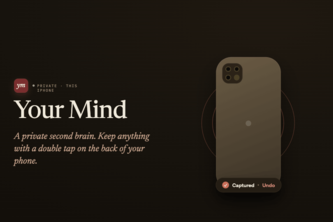
A single-person project named Your Mind, self-described as an iPhone-native second brain that captures information with one gesture and allows querying it later using AI. It is built around a capture-first workflow, where raw evidence (text, images, URLs) is stored locally before being processed into knowledge.
What changed
The author states they have tried building a second brain multiple times previously but found existing tools like Notion or Obsidian too cumbersome due to decision fatigue — the need to decide where to store information. This project aims to eliminate that friction by enabling capture with one gesture, without requiring folder structures or tagging.
The single most important open question
Is there any evidence of user adoption, revenue, or traction beyond the author's own description? The project is described as a hackathon submission and has no demonstrated market validation.
Note
This analysis is based solely on the self-reported, unverified account provided by the author. No external data, customer feedback, revenue figures, or product usage metrics are available.
What The Product Actually Is
The description states that Your Mind is an iPhone-native second brain application designed to capture information with a single gesture — via Shortcut, Share Sheet, or quick thought input. It uses SwiftUI for the UI and integrates with Cloudflare Workers (TypeScript, D1, R2) for backend storage.
- The app stores raw evidence locally for 5 seconds before uploading it.
- If not undone within that time, the raw data is quietly converted into knowledge.
- No folders or tags are used; all processing happens on top of original content.
- AI-powered answers cite sources with exact byte ranges to prevent drift.
- Extraction and grounded responses use OpenAI’s Responses API.
Inference The product appears to be a personal productivity tool focused on capturing and retrieving information in an unstructured way, leveraging AI for summarization and answering questions while preserving source integrity.
Positioning & Claim Evolution
The author claims that Your Mind solves the problem of decision fatigue in traditional note-taking apps like Notion or Obsidian. They state they've "started a second brain like five times" and that previous attempts failed because users don’t save things when faced with decisions about where to file them.
- The core positioning is: “See something worth keeping, one gesture saves it now.”
- It emphasizes minimalism in capture (no folders, tags, or naming).
- The system preserves the original source material as sacred.
- AI answers are grounded and cite their sources precisely.
Claim
This is a new approach to personal knowledge management that removes friction from capturing and querying information.
Not evidenced There is no evidence of prior market testing, user feedback, or competitive positioning beyond the author’s own narrative.
Target Customer & ICP
The description states that Your Mind targets individuals who want to build a second brain but struggle with traditional tools due to complexity and decision fatigue. It is iPhone-first, suggesting it's aimed at iOS users.
- The primary user is likely someone looking for a simpler way to collect and retrieve information.
- It assumes familiarity with mobile workflows (Shortcuts, Share Sheet).
- No explicit segmentation beyond general personal knowledge management needs.
Inference The ICP is an individual user who values ease-of-use and wants to avoid the overhead of traditional note-taking systems.
Not evidenced No specific demographic data, usage patterns, or target personas are provided.
Business Model & Pricing Evidence
The description does not mention any pricing model, monetization strategy, or business model. It is presented as a personal project built for a hackathon.
Claim
The product may eventually be monetized through subscription or freemium models (inferred from typical SaaS patterns).
Not evidenced No indication of how the product would generate revenue or whether it's intended to scale beyond a prototype.
Technical & Delivery Signals
The project is built using:
- Swift for iOS app development
- Cloudflare Workers with TypeScript, D1 (SQLite), and R2 (object storage)
- OpenAI’s Responses API for extraction and grounded answers
- Codex used throughout the development process — including generating specs, backend logic, UI components, and even visual direction
Inference The tech stack suggests a modern, serverless architecture with strong AI integration.
Not evidenced No details on scalability, performance metrics, or production readiness.
Traction & Maturity Signals
The project is described as a hackathon submission to the OpenAI 2026 hackathon and was submitted to Devpost. It has no evidence of revenue, users, or adoption beyond the author's own account.
Claim
The product exists in prototype form and was built quickly using AI assistance.
Not evidenced No data on user engagement, retention, or market traction.
Competitive Context
The description references Notion and Obsidian as prior attempts at second-brain tools that failed due to complexity and decision fatigue. However, no competitive analysis or differentiation from other similar products is provided.
Inference Your Mind positions itself as a more frictionless alternative to existing tools in the personal knowledge management space.
Not evidenced No comparison with competitors, pricing, or feature sets are mentioned.
Open Questions & Risks
- The entire project is built by one person (Pritam Neog).
- It is described as a hackathon submission — not a commercial product.
- There is no evidence of revenue, customers, or traction.
- The reliance on AI APIs (OpenAI) introduces dependency risks.
- No clear path to monetization or long-term sustainability.
Open Question
Lack of any measurable impact or user feedback makes it difficult to assess viability or scalability.
Questions the description leaves open
- What specific problems do you observe in current second-brain tools that Your Mind solves?
- How do you plan to scale beyond a single-person prototype?
- Are there any users currently testing the product? If so, what is their feedback?
- What are your plans for monetization or business model?
- How do you intend to handle data privacy and storage compliance (e.g., GDPR)?
- What are the technical limitations of relying on AI APIs like OpenAI’s Responses API?
Overall Assessment
This is a self-reported, unverified prototype built by one individual as part of a hackathon. There is no evidence of revenue, customers, or traction.
Assessment Not suitable for investment or partnership at this stage.
Confidence Level Low — based entirely on author’s own description with no external validation or data points.
User Stories BotA demo video on every pull request
Get a demo video on every new feature
GitHub App that watches your pull requests and records a narrated, captioned demo.
Save time on demo prep and make informed decisions faster with a video walkthrough of every new feature.
Source
Submitted to the OpenAI 2026 hackathon on Devpost. Project home on Devpost. Back to the full gallery on Devpost.
This competitive analysis was produced by top-founders.com (opens in a new tab)
Generated by a language model from this project's public Devpost page — its tagline, the author's own write-up and any built-with tags listed there — as captured in August 2026. Short quotations are the author's words. It is an opinion on the idea as a business, not on the people behind it, and it reflects the description as published then. If the project has moved on, request a correction below. The analysis is not independent research and contains no verified traction, revenue or customer data.
An independent guide by KFG International LLC — not affiliated with, endorsed by, or connected to Devpost or OpenAI.