

Archive position — measured, not model output
0 likes on Devpost
2,263 of the 7,850 archived projects have more likes, and 5,587 share exactly 0 — so this project's #7,777 place in the like-ranked listing is a tie-break inside that group, not a ranking.
Projects (log scale)
Likes on Devpost. ▲ marks this project's group.
Show the figures
| Likes | Projects | Share of archive |
|---|---|---|
| 0 | 5,587 | 71.2% |
| 1 | 1,758 | 22.4% |
| 2 | 284 | 3.6% |
| 3–4 | 132 | 1.7% |
| 5–9 | 75 | 1.0% |
| 10+ | 14 | 0.2% |
 User Stories BotA demo video on every pull request
Get a demo video on every new feature
GitHub App that watches your pull requests and records a narrated, captioned demo.
Save time on demo prep and make informed decisions faster with a video walkthrough of every new feature.
Executive Summary
What the company appears to be
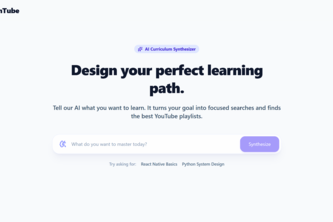
YouLearnTube is an AI-powered platform that transforms scattered YouTube tutorials into structured, guided learning paths. The author states it aims to provide a premium educational experience similar to Udemy or Coursera by merging playlists, removing duplicates, and generating adaptive content (tutoring, quizzes, flashcards) based only on material already consumed.
What changed
The project description presents YouLearnTube as an end-to-end AI learning platform built in a hackathon timeframe using AI tools like Codex. It claims to have implemented features such as spoiler-safe retrieval, course formation via embeddings, lazy transcript ingestion, and adaptive learning engines — all within a full-stack architecture.
Single most important open question
Is there any evidence of actual user adoption or revenue generation from this platform? The description is entirely self-reported without any traction data, customer feedback, or monetization proof.
What The Product Actually Is
The description states that YouLearnTube:
- Turns scattered YouTube tutorials into one guided course
- Allows learners to write a goal in plain language and select playlists
- Merges these into a structured video path
- Provides AI assistance based only on previously watched material
- Generates learning resources (tutoring, quizzes, flashcards, mind maps)
- Offers adaptive recommendations for next steps
It is described as an AI-powered learning workspace that understands what a learner has already watched and guides them through a personalized journey.
Evidence Self-reported by the author. No independent verification or demonstration of actual functionality beyond the hackathon build.
Positioning & Claim Evolution
The author positions YouLearnTube as:
- A transformation of YouTube from fragmented videos into an adaptive learning platform
- An alternative to Udemy, Coursera with a "premium experience"
- Not simply adding AI chatbots on top of videos but building an experience around the learning process
Claims include:
- Making free video learning feel like a focused course
- Providing structured progression, watched-time awareness, and source-linked explanations
- Offering progressive concepts, note-taking, checks for understanding, and next-step recommendations
Evidence Self-reported claims about intent and positioning. No evidence of market validation or user feedback.
Target Customer & ICP
The description states that YouLearnTube targets:
- Learners who use YouTube to gain technical skills
- People suffering from "tutorial hell" — spending hours searching for quality playlists
- Users struggling with progress tracking, repeated content, and lack of structured review
It is implied the platform serves individuals seeking to learn technical skills through YouTube.
Evidence Self-reported user persona. No evidence of actual customers or market research.
Business Model & Pricing Evidence
There is no mention in the description of:
- Revenue model
- Pricing strategy
- Monetization approach
- Customer acquisition costs
- Unit economics
The author only describes the product's functionality and technical implementation.
Evidence Not evidenced. No business model or pricing information provided.
Technical & Delivery Signals
Key technical elements mentioned:
- Built with FastAPI, React, ChromaDB, Docker, Cloud Run
- Uses embeddings and similarity for playlist merging
- Implements lazy transcript ingestion using chunks
- Employs a shared instructional-content filtering pipeline
- Features a spoiler-safe retrieval system enforcing learning boundaries
- Uses deterministic mock providers for language models and APIs
- Delivered as a deployable full-stack application
The author also mentions:
- Use of Codex for development, including roadmap planning, code generation, debugging, documentation
- Hour-to-hour sprinting during implementation
- Deployment on Vercel and Cloud Run
Evidence Self-reported technical details. No evidence of production performance or scalability.
Traction & Maturity Signals
The description states:
- The project was built in a hackathon timeframe (7 days)
- It includes a full-stack application with documentation and demo workflow
- Features were implemented using AI tools like Codex
- The team used mock providers to demonstrate the app without external API credits
However, there is no evidence of:
- User adoption or engagement metrics
- Revenue or monetization
- Customer feedback or testimonials
- Product usage data
- Any live deployment or active user base
Evidence Not evidenced. No traction or maturity indicators beyond a hackathon prototype.
Competitive Context
The author references platforms like:
- Udemy
- Coursera
They state YouLearnTube aims to provide a similar "premium experience" but built on YouTube content rather than original course creation.
No mention of:
- Direct competitors
- Market size or share
- Competitive advantages beyond AI integration
- Differentiation from existing YouTube-based learning tools
Evidence Self-reported competitive positioning. No market analysis or competitive intelligence provided.
Open Questions & Risks
Inferences based on the description:
- Unproven commercial viability: The platform is described as a hackathon prototype with no evidence of traction, revenue, or customer validation.
- Dependency on AI tooling: Heavy reliance on Codex and GPT models may not scale or be sustainable without continued access to these tools.
- Technical limitations in real-world use: The description notes issues like repeated generation, incorrect third-party API information, and prompt steering problems — suggesting potential instability in real-world deployment.
- Lack of monetization strategy: No evidence of how the platform will generate revenue or sustain operations beyond its initial build.
- Single-person team: With only one member (Akshat Midha), scalability and long-term maintenance are concerns.
Evidence Inferred from self-reported limitations and lack of traction data.
Questions the description leaves open
- What specific user feedback or testing has been conducted with real learners?
- How does the platform plan to monetize its service, if at all?
- Are there any plans for scaling beyond the current hackathon prototype?
- Has the team considered how to handle YouTube content changes or removals that might affect course integrity?
- What are the long-term sustainability concerns around AI tooling dependencies like Codex?
- How will user data be protected and managed, especially with regard to authentication and per-user authorization?
- What is the roadmap for expanding beyond the current set of features?
Overall Assessment
Confidence Level Low — based entirely on self-reported evidence.
Assessment Summary
YouLearnTube appears to be a hackathon-built prototype that claims to transform YouTube learning into structured, AI-enhanced experiences. It lacks any evidence of traction, revenue, or customer adoption. The platform is described as an end-to-end solution with technical depth but no indication of commercial viability or market validation.
Recommendation
This project should not be considered for investment or partnership unless further evidence emerges showing real-world usage, monetization capability, or significant traction beyond the initial build.
User Stories BotA demo video on every pull request
Get a demo video on every new feature
GitHub App that watches your pull requests and records a narrated, captioned demo.
Save time on demo prep and make informed decisions faster with a video walkthrough of every new feature.
Source
Submitted to the OpenAI 2026 hackathon on Devpost. Project home on Devpost. Back to the full gallery on Devpost.
This competitive analysis was produced by top-founders.com (opens in a new tab)
Generated by a language model from this project's public Devpost page — its tagline, the author's own write-up and any built-with tags listed there — as captured in August 2026. Short quotations are the author's words. It is an opinion on the idea as a business, not on the people behind it, and it reflects the description as published then. If the project has moved on, request a correction below. The analysis is not independent research and contains no verified traction, revenue or customer data.
An independent guide by KFG International LLC — not affiliated with, endorsed by, or connected to Devpost or OpenAI.