

Archive position — measured, not model output
1 like on Devpost
505 of the 7,850 archived projects have more likes, and 1,758 share exactly 1 — so this project's #2,252 place in the like-ranked listing is a tie-break inside that group, not a ranking.
Projects (log scale)
Likes on Devpost. ▲ marks this project's group.
Show the figures
| Likes | Projects | Share of archive |
|---|---|---|
| 0 | 5,587 | 71.2% |
| 1 | 1,758 | 22.4% |
| 2 | 284 | 3.6% |
| 3–4 | 132 | 1.7% |
| 5–9 | 75 | 1.0% |
| 10+ | 14 | 0.2% |
 User Stories BotA demo video on every pull request
Get a demo video on every new feature
GitHub App that watches your pull requests and records a narrated, captioned demo.
Save time on demo prep and make informed decisions faster with a video walkthrough of every new feature.
Executive Summary
What the company appears to be
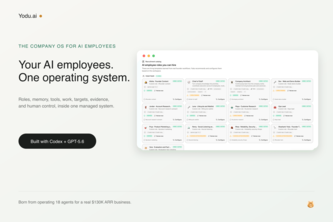
Yodu.ai is a self-reported managed operating environment for AI employees. The author describes it as a product that turns a manually assembled setup of AI agents into an operational system usable by founders. It includes a control plane and execution plane, with features around employee identity, memory, tools, scheduling, task management, and company context.
What changed
The project evolved from a personal experiment (running 18 AI agents in a VM) into a productized platform during Build Week. The author states that the system now supports multi-tenant operation, secure runtime provisioning, and structured workflows for managing AI employees.
Single most important open question — the commercial due-diligence read
Is there evidence of real traction or usage beyond the author’s own business? There is no indication of revenue, customers, or adoption outside of the author's internal use case. The product is described as a prototype built during a hackathon and not yet fully deployed in production for external users.
What The Product Actually Is
The description states that Yodu.ai is a managed operating environment for AI employees. It is not a chatbot but rather an infrastructure and management system around AI agents.
Key components include:
- A control plane built with Next.js, React, Expo, PostgreSQL, Prisma, Stripe
- An execution plane running isolated OpenClaw environments per company
- Employee roles, identities, memory (both shared and private), tools, tasks, schedules, deliverables
- Company OS layer that connects objectives to key results, initiatives, cycles, scorecards, reviews, outcomes, metrics, experiments, retrospectives, and learning history
The system uses:
- Codex for development assistance
- GPT-5.6 via device authentication
- Composio, native integrations, or custom MCP servers for tools
- Docker, GitHub, OpenAI APIs, model-context protocol, React Native, Tailwind, TypeScript
Not evidenced: actual product functionality beyond the author’s own use case; whether it has been tested or used by others.
Positioning & Claim Evolution
The author positions Yodu.ai as:
- A way to manage AI employees that remember work and keep it moving
- A structured operating system for companies run by AI agents
- A productized version of a personal setup, turning manual VM management into a repeatable product flow
Evolution from the original idea:
- Started with 18 manually configured AI agents inside a VM at API.market
- Moved to a multi-tenant platform with secure runtime provisioning and tool access controls
- Introduced features like Company Architect, Chief of Staff, Ops Lead, and Company OS
Claims are self-reported and unverified. The author describes the system as “not another chatbot” but does not provide evidence of how it differs from existing AI agent platforms or what makes it unique in practice.
Target Customer & ICP
The description states that Yodu.ai is intended for:
- Founders who want to run a company with AI employees
- People who need a way to manage support, sales, research, finance, content, operations, and engineering roles using AI agents
- Individuals or small teams looking to scale their business without losing memory, control, or evidence
The target customer is described as:
- A one-person founder or small team
- Someone who has already built a business (e.g., API.market at $130K ARR)
- Someone who wants to delegate work to AI employees while maintaining oversight and structure
Not evidenced: actual customer base, user personas, or market validation beyond the author’s own experience.
Business Model & Pricing Evidence
The description states that Yodu.ai:
- Uses Stripe for billing truth
- Has a multi-tenant architecture with organization boundaries
- Supports company-level access control and permissions
- Includes an optional Ops Lead role for review of execution evidence
- Provides a web command center and mobile app (Expo)
No pricing information, subscription tiers, or monetization strategy is provided.
Not evidenced: revenue model, pricing structure, or any indication of how the product will be sold to customers.
Technical & Delivery Signals
The system includes:
- Control plane built with Next.js, React, Expo, Better Auth, PostgreSQL, Prisma
- Execution plane using OpenClaw, isolated runtime environments
- Tool integration via Composio, native integrations, or MCP servers
- Encrypted secrets and private ports
- Risk controls for external actions (e.g., spending, deletion)
- Model access through device-authenticated ChatGPT subscription
- Support for bounded workspace snapshots and redacted updates
Not evidenced: actual deployment, performance metrics, scalability, or security audits.
Traction & Maturity Signals
The author states:
- The system was tested internally at API.market with 18 AI agents
- It was built during a Build Week hackathon
- The repository documents the boundary between pre- and post-event commits (6861cee1 to 2844ba5e)
- There is no mention of external users, customers, or revenue
Not evidenced: user adoption, ARR, customer retention, or product-market fit beyond the author’s own use.
Competitive Context
The description does not reference competitors directly. However, based on what the author says:
- Yodu.ai aims to be a structured operating system for AI employees
- It is positioned as not just another chatbot, but a management and infrastructure layer
It appears to compete with:
- AI agent platforms (e.g., AutoGen, LangChain, CrewAI)
- No-code automation tools
- Foundational AI workplace tools
Not evidenced: competitive landscape analysis, market share, or differentiation from existing solutions.
Open Questions & Risks
Key risks and open questions include:
- No external validation: The system is described only in self-reporting terms; no third-party verification or user feedback
- High complexity: Requires deep technical integration (OpenClaw, Docker, MCP, etc.) with strict runtime boundaries
- Limited product maturity: Built during a hackathon; not yet fully developed or validated for production use
- Unclear monetization path: No pricing, revenue model, or customer acquisition strategy described
- Single founder team: Only one member listed (Shashank Agarwal), which may limit scalability and execution
Not evidenced: any risk mitigation strategies, product testing, or market traction.
Questions the description leaves open
- What specific business outcomes have you seen from using AI employees in your own company?
- How do you plan to scale the system beyond a single founder’s use case?
- Are there any early adopters or customers currently testing Yodu.ai?
- What are the key assumptions about how AI employees will behave at scale?
- Can you walk us through how the approval and risk control mechanisms work in practice?
- How do you intend to monetize this platform, and what is your go-to-market strategy?
- What are the biggest technical challenges still unresolved or under development?
Overall Assessment
The project is described as a self-reported prototype built during a hackathon, with no evidence of traction, revenue, or external adoption.
It shows:
- Strong technical execution
- Clear vision for an AI-powered company OS
- Potential for solving real problems around AI agent management and structure
However, it lacks:
- Any indication of market validation or customer feedback
- Revenue, ARR, or user data
- A clear path to monetization or product-market fit
Assessment: Early-stage idea with strong engineering foundation but no demonstrated commercial viability or traction. Not ready for investment or partnership unless further validated in a real-world setting.
User Stories BotA demo video on every pull request
Get a demo video on every new feature
GitHub App that watches your pull requests and records a narrated, captioned demo.
Save time on demo prep and make informed decisions faster with a video walkthrough of every new feature.
Source
Submitted to the OpenAI 2026 hackathon on Devpost. Project home on Devpost. Back to the full gallery on Devpost.
This competitive analysis was produced by top-founders.com (opens in a new tab)
Generated by a language model from this project's public Devpost page — its tagline, the author's own write-up and any built-with tags listed there — as captured in August 2026. Short quotations are the author's words. It is an opinion on the idea as a business, not on the people behind it, and it reflects the description as published then. If the project has moved on, request a correction below. The analysis is not independent research and contains no verified traction, revenue or customer data.
An independent guide by KFG International LLC — not affiliated with, endorsed by, or connected to Devpost or OpenAI.