

Archive position — measured, not model output
0 likes on Devpost
2,263 of the 7,850 archived projects have more likes, and 5,587 share exactly 0 — so this project's #6,178 place in the like-ranked listing is a tie-break inside that group, not a ranking.
Projects (log scale)
Likes on Devpost. ▲ marks this project's group.
Show the figures
| Likes | Projects | Share of archive |
|---|---|---|
| 0 | 5,587 | 71.2% |
| 1 | 1,758 | 22.4% |
| 2 | 284 | 3.6% |
| 3–4 | 132 | 1.7% |
| 5–9 | 75 | 1.0% |
| 10+ | 14 | 0.2% |
 User Stories BotA demo video on every pull request
Get a demo video on every new feature
GitHub App that watches your pull requests and records a narrated, captioned demo.
Save time on demo prep and make informed decisions faster with a video walkthrough of every new feature.
Executive Summary
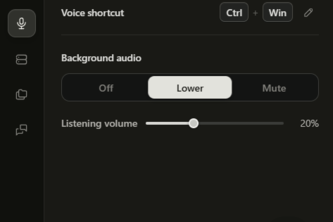
QLayer is a Windows desktop application described by its author as a local-first, open-source tool that enables voice dictation with Codex (or ChatGPT) without interrupting background audio playback. The app allows users to trigger dictation globally via a shortcut, mute or lower background audio, focus the correct chat window, and resume audio upon release. It also includes features for managing local development servers and organizing project contexts.
The author states that QLayer was built during OpenAI's Build Week hackathon using Codex and GPT-5.6, with no revenue, customers, or traction data provided. The app is self-reported as supporting Windows 10 and 11 on x64 only, and the author emphasizes its local-first design and open-source nature.
The single most important open question is: What is the actual commercial potential of this tool, and how does it differentiate from existing solutions or integrate into developer workflows beyond a personal productivity hack?
This analysis is based entirely on self-reported information. No evidence exists for revenue, customer adoption, market traction, or competitive positioning.
What The Product Actually Is
The description states that QLayer is a Windows app designed to allow users to use voice dictation with Codex (or ChatGPT) without stopping background audio such as music, podcasts, or YouTube videos. It offers:
- Voice Flow: A global shortcut to start dictation, mute audio, focus the correct chat window, and resume audio after speaking.
- Chat Shortcuts: Ability to save and organize frequently used chats by project.
- Localhost Manager: Detects local development servers, identifies projects, groups ports, and displays server metrics like URL, CPU usage, memory usage, uptime.
- Projects: Links a local folder with its associated chats and preferred development ports.
The author reports that the app was built using technologies including Rust, React, TypeScript, Tauri 2, Tailwind CSS, Vite, Windows API, and Codex/GPT-5.6 for implementation and refinement.
Not evidenced: No information about actual user base, usage frequency, or adoption metrics.
Positioning & Claim Evolution
The author positions QLayer as a tool to reduce friction in using AI-powered coding assistants like Codex by enabling seamless voice interaction without audio interruption. It is framed as an enhancement to developer workflow rather than a standalone product.
Key claims:
- The app removes small but frequent interruptions during development.
- It aims to become a collection of practical quality-of-life tools for developers.
- It is local-first, open-source, and respects user privacy by not syncing telemetry or reading credentials.
The project evolved from an initial idea developed before Build Week into a focused two-day iteration during the OpenAI hackathon. The author notes that prior attempts were abandoned due to technical limitations in implementing core Windows functionality.
Inference: The positioning suggests QLayer is intended for individual developers seeking improved productivity, not enterprise or marketplace adoption.
Target Customer & ICP
The description implies that QLayer targets individual developers, particularly those who use Codex or ChatGPT regularly and work with background audio during coding sessions. It also caters to users managing multiple local development projects.
Features like Localhost Manager and Project grouping suggest a focus on developers working across several simultaneous projects, needing context-aware tools.
Not evidenced: No explicit segmentation of target personas, no data on typical user behavior or demographics.
Business Model & Pricing Evidence
The description states that QLayer is local-first and open-source, with no telemetry, cloud sync, or data collection. It does not mention any pricing model or monetization strategy.
Not evidenced: No evidence of revenue streams, subscriptions, licensing fees, or paid features.
Technical & Delivery Signals
The app is built using:
- Rust
- React
- TypeScript
- Tauri 2
- Tailwind CSS
- Vite
- Windows API
It supports Windows 10 and 11 on x64 only. The author notes that the project was completed over two days during a hackathon, using Codex and GPT-5.6 for development.
Not evidenced: No evidence of scalability, performance benchmarks, or long-term architecture plans.
Traction & Maturity Signals
The description indicates that QLayer is a personal productivity tool built during a single hackathon event (OpenAI Build Week). There is no mention of:
- User adoption
- Customer feedback
- Market traction
- Product roadmap
- Iteration beyond the initial version
Not evidenced: No evidence of any user base, usage metrics, or product maturity beyond its initial release.
Competitive Context
The author does not reference existing tools or competitors. However, based on the described functionality:
- Voice dictation with AI chat assistants is a niche area.
- Localhost management and project grouping are features found in various developer tooling ecosystems.
- The specific combination of voice control, audio muting, and local server tracking may be unique.
Not evidenced: No competitive landscape analysis, no comparison to existing tools or platforms.
Open Questions & Risks
- Single-person team: Only one founder is mentioned (Alonso Torres), which raises concerns about scalability and long-term maintenance.
- Limited platform support: Currently supports only Windows 10/11 x64.
- No commercial traction: No evidence of revenue, users, or adoption beyond the author’s own use case.
- Unproven market demand: The described problem may be a minor inconvenience rather than a widespread issue.
- Self-reported features: All functionality is claimed by the author without independent verification.
Inference: The tool appears to address a very specific personal workflow and has not demonstrated broader commercial viability or scalability.
Questions the description leaves open
- What percentage of your time do you spend using Codex/ChatGPT with background audio?
- How many developers have expressed interest in QLayer beyond yourself?
- Are there any plans to expand support beyond Windows 10 and 11?
- What are the key assumptions about developer workflows that underpin this tool?
- Do you see a path toward monetization or integration into larger platforms?
- How do you plan to maintain and evolve QLayer post-hackathon?
Overall Assessment
The description presents QLayer as a personal productivity hack built during a short hackathon period, with no evidence of commercial traction, user adoption, or scalability.
It is not evident whether this tool has sufficient market demand to justify investment or partnership interest. The author’s stated goal is to share tools with other developers through open-source, but there is no indication that this will lead to a sustainable business model or product ecosystem.
Confidence level: Low — based on minimal self-reported evidence and lack of external validation or traction indicators.
User Stories BotA demo video on every pull request
Get a demo video on every new feature
GitHub App that watches your pull requests and records a narrated, captioned demo.
Save time on demo prep and make informed decisions faster with a video walkthrough of every new feature.
Source
Submitted to the OpenAI 2026 hackathon on Devpost. Project home on Devpost. Back to the full gallery on Devpost.
This competitive analysis was produced by top-founders.com (opens in a new tab)
Generated by a language model from this project's public Devpost page — its tagline, the author's own write-up and any built-with tags listed there — as captured in August 2026. Short quotations are the author's words. It is an opinion on the idea as a business, not on the people behind it, and it reflects the description as published then. If the project has moved on, request a correction below. The analysis is not independent research and contains no verified traction, revenue or customer data.
An independent guide by KFG International LLC — not affiliated with, endorsed by, or connected to Devpost or OpenAI.