

Archive position — measured, not model output
0 likes on Devpost
2,263 of the 7,850 archived projects have more likes, and 5,587 share exactly 0 — so this project's #7,769 place in the like-ranked listing is a tie-break inside that group, not a ranking.
Projects (log scale)
Likes on Devpost. ▲ marks this project's group.
Show the figures
| Likes | Projects | Share of archive |
|---|---|---|
| 0 | 5,587 | 71.2% |
| 1 | 1,758 | 22.4% |
| 2 | 284 | 3.6% |
| 3–4 | 132 | 1.7% |
| 5–9 | 75 | 1.0% |
| 10+ | 14 | 0.2% |
 User Stories BotA demo video on every pull request
Get a demo video on every new feature
GitHub App that watches your pull requests and records a narrated, captioned demo.
Save time on demo prep and make informed decisions faster with a video walkthrough of every new feature.
Executive Summary
What the company appears to be
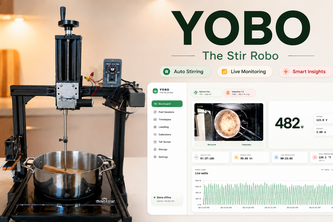
Yobo – The Stir Robo is a self-reported hardware product that automates the stirring of slow-cooked foods using a motorized stirrer, live monitoring dashboard, and AI learning system. It is described as a prototype built by one person (Prince Malik) for an OpenAI 2026 hackathon.
What changed
The project description indicates development from an initial idea to a working prototype with multiple functional components including hardware, software, and AI integration. However, no evidence of commercial traction or customer adoption is provided.
Single most important open question
Is there any evidence that Yobo has moved beyond the prototype stage into actual use by consumers or businesses? The author states it has completed real cooking sessions but does not provide data on usage frequency, user feedback, or product iteration beyond the hackathon submission.
What The Product Actually Is
The description states:
- Yobo is a motorized stirrer designed for slow-cooked foods.
- It includes live monitoring via a dashboard accessible from a phone.
- It tracks cooking time and energy use.
- It automatically controls an exhaust fan.
- It generates timelapses and summaries after each cooking session.
- It uses AI to recognize pot, ingredients, paddle movement, and stages of cooking.
Inference The product is described as a hybrid hardware-software system combining robotics, IoT sensors, computer vision, and AI for home cooking automation.
Evidence strength Self-reported. No independent verification or demonstration beyond the author’s account.
Positioning & Claim Evolution
The description states:
- Yobo aims to replace manual stirring for slow-cooked foods.
- It combines motorized stirrer, live monitoring, and AI learning system.
- The goal is to make slow cooking smarter and less labor-intensive.
Inference Positioning appears to be a DIY or home automation solution targeting home cooks who want convenience and smart features in their kitchen appliances.
Evidence strength Self-reported claims about intent and positioning, not proof of traction or adoption.
Target Customer & ICP
The description states:
- Millions of home cooks spend hours stirring food so it doesn't burn.
- Yobo is intended for users who cook slow-cooked foods manually.
Inference Target customer appears to be home cooks interested in reducing manual effort during slow cooking, possibly with some interest in smart kitchen gadgets.
Evidence strength Claims about target market are self-reported and lack data on actual user segmentation or feedback.
Business Model & Pricing Evidence
The description states:
- No explicit mention of pricing.
- No indication of a monetization strategy beyond the prototype.
- No evidence of sales, subscriptions, or revenue streams.
Evidence strength Not evidenced.
Technical & Delivery Signals
The description states:
- Built with: codex, computer-vision, css, esp32, ffmpeg, gpt-5.6, hls, html, iot, javascript, macos, mediamtx, opencv, python, rest-api, robotics, shelly-api, tailscale, vl53l7cx, webrtc
- Hardware includes: aluminum frame, geared motor, adjustable wooden paddle, camera, smart energy plug, sensors
- Software dashboard built with help from ChatGPT, Image generation, Codex and GPT-5.6
Inference The project uses a mix of AI tools, embedded systems (IoT), and open-source or low-cost components for development.
Evidence strength Self-reported technical stack; no evidence of scalability, reliability, or production readiness.
Traction & Maturity Signals
The description states:
- Yobo has completed real, multi-hour cooking sessions multiple times.
- The system now works together as one integrated unit (hardware + software).
- It does not require constant manual stirring anymore.
- The team is working on AI recognition of ingredients and cooking stages.
Inference The product is at a prototype stage with some functionality demonstrated, but no evidence of commercial deployment or user base.
Evidence strength Self-reported; no data on customer adoption, usage metrics, or product iteration beyond the hackathon submission.
Competitive Context
The description states:
- No mention of competitors.
- No indication of market analysis or differentiation strategy.
Evidence strength Not evidenced.
Open Questions & Risks
- The project is described as a single-person effort (team size: 1), raising questions about scalability and long-term maintenance.
- No evidence of product testing, user feedback, or commercial viability beyond the hackathon.
- The use of AI tools like GPT-5.6 in development suggests a reliance on generative AI rather than robust engineering practices.
- Hardware challenges such as heat resistance, camera reliability, and motor load were noted — these may indicate technical limitations.
- No mention of intellectual property, manufacturing plans, or go-to-market strategy.
Evidence strength Inferences based on self-reported project details; no external validation or data to confirm risks.
Questions the description leaves open
- What is the current status of Yobo beyond the hackathon prototype? Is it being used by anyone outside of development?
- How many real-world cooking sessions have been completed, and what were the outcomes?
- Are there any plans for manufacturing or distribution?
- What is the intended pricing model, if any?
- Has the team considered how to scale beyond a single-person operation?
- What are the key technical challenges that remain unresolved?
- How does Yobo compare to existing slow cookers or kitchen automation tools in the market?
Overall Assessment
The description states:
- This is a hackathon project submitted by one individual (Prince Malik).
- It includes a functional prototype with hardware and software components.
- No evidence of revenue, customers, or commercial traction.
Inference At this stage, Yobo appears to be an experimental idea with potential but no demonstrated market readiness or business model. It may be a candidate for early-stage investment if the founder can demonstrate further development, user feedback, and scalability.
Evidence strength Very low. The project is described as a prototype with no verified commercial activity or data on performance or adoption.
User Stories BotA demo video on every pull request
Get a demo video on every new feature
GitHub App that watches your pull requests and records a narrated, captioned demo.
Save time on demo prep and make informed decisions faster with a video walkthrough of every new feature.
Source
Submitted to the OpenAI 2026 hackathon on Devpost. Project home on Devpost. Back to the full gallery on Devpost.
This competitive analysis was produced by top-founders.com (opens in a new tab)
Generated by a language model from this project's public Devpost page — its tagline, the author's own write-up and any built-with tags listed there — as captured in August 2026. Short quotations are the author's words. It is an opinion on the idea as a business, not on the people behind it, and it reflects the description as published then. If the project has moved on, request a correction below. The analysis is not independent research and contains no verified traction, revenue or customer data.
An independent guide by KFG International LLC — not affiliated with, endorsed by, or connected to Devpost or OpenAI.