

Archive position — measured, not model output
1 like on Devpost
505 of the 7,850 archived projects have more likes, and 1,758 share exactly 1 — so this project's #1,882 place in the like-ranked listing is a tie-break inside that group, not a ranking.
Projects (log scale)
Likes on Devpost. ▲ marks this project's group.
Show the figures
| Likes | Projects | Share of archive |
|---|---|---|
| 0 | 5,587 | 71.2% |
| 1 | 1,758 | 22.4% |
| 2 | 284 | 3.6% |
| 3–4 | 132 | 1.7% |
| 5–9 | 75 | 1.0% |
| 10+ | 14 | 0.2% |
 User Stories BotA demo video on every pull request
Get a demo video on every new feature
GitHub App that watches your pull requests and records a narrated, captioned demo.
Save time on demo prep and make informed decisions faster with a video walkthrough of every new feature.
Executive Summary
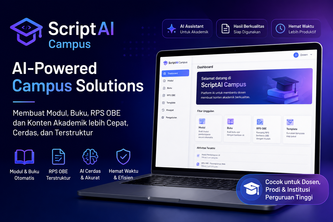
What the company appears to be: ScriptAI Campus is an AI-powered platform for generating academic documents such as RPS OBE, teaching modules, textbooks, research proposals, and others. It is described as a tool that allows educators and researchers to create structured, editable content quickly using LLMs and prompt engineering.
What changed: The project was submitted to the OpenAI 2026 hackathon by one developer (Tanwir Tanwir), indicating an early-stage prototype or proof-of-concept. No evidence of revenue, customers, or product-market fit is provided.
Single most important open question: Is there any evidence that ScriptAI Campus has been used beyond the hackathon context, and if so, how does it perform in real-world academic settings?
This analysis is based entirely on self-reported information from the project description. No independent verification, traction data, or financials are available.
What The Product Actually Is
The description states that ScriptAI Campus is an AI-powered platform for creating academic documents such as:
- RPS OBE (Outcome-Based Education)
- Teaching Modules
- Textbooks
- Research Proposals
- Community Service Proposals
- Learning Materials
- Course Syllabi
- Academic Reports
It uses LLMs, prompt engineering, and academic templates to generate structured, editable content from user prompts.
The product is described as an academic document generator that supports multiple formats but no evidence of actual deployment or usage beyond the hackathon submission exists.
Positioning & Claim Evolution
The author positions ScriptAI Campus as a time-saving tool for educators and researchers who spend significant time preparing repetitive academic documents. It claims to reduce preparation time from days to minutes, and emphasizes:
- AI-powered content generation
- Structured academic templates
- Customizable workflows
- Editable outputs
- Support for multiple document types
The platform is positioned as a way to reduce administrative workload and allow focus on teaching and innovation.
The positioning is self-reported and focuses on intent rather than demonstrated impact or adoption. No evidence of market validation or user feedback beyond the developer's own account.
Target Customer & ICP
The description identifies educators, researchers, and academic professionals as primary users. These individuals are said to be preparing documents such as RPS OBE, teaching modules, textbooks, research proposals, etc.
The target customer segment is inferred from the types of documents mentioned but not explicitly defined or validated in the description.
Business Model & Pricing Evidence
No information about pricing, monetization strategy, or business model is provided. The description does not mention any revenue streams, subscriptions, licensing, or sales processes.
Not evidenced.
Technical & Delivery Signals
The platform is built using:
- AI technologies (LLMs, prompt engineering)
- Frameworks: Laravel, Next.js, Node.js
- Languages: TypeScript, JavaScript, CSS, Tailwind
- Databases: MySQL
- Tools: OpenAI API, REST APIs, React
It supports export-ready document generation and has a responsive web interface.
The technical stack suggests a modern, web-based application built for ease of use and integration with AI services. However, no evidence of scalability, performance metrics, or production deployment is provided.
Traction & Maturity Signals
The project was submitted to the OpenAI 2026 hackathon by one developer (Tanwir Tanwir). There is no mention of:
- Users or customers
- Revenue or monetization
- Product usage statistics
- Market traction
- Institutional partnerships
- Beta testing or feedback loops
Not evidenced.
Competitive Context
No competitive landscape or comparison to existing tools is described. The author does not reference competitors, market size, or differentiation strategies.
Not evidenced.
Open Questions & Risks
- Lack of traction: No evidence of real-world usage or adoption.
- Single-founder model: Only one team member listed, raising questions about scalability and execution capacity.
- Unproven commercial viability: No pricing, revenue, or customer data.
- Unclear quality control: While the platform claims to produce structured content, there is no mention of how it ensures academic standards or avoids plagiarism.
- Highly specialized niche: Academic document generation may have limited market reach without broader appeal or institutional integration.
These are inferences based on lack of evidence rather than direct claims.
Questions the description leaves open
- Has ScriptAI Campus been used beyond the hackathon? If yes, by whom and how?
- What specific academic institutions or educators have tested the platform?
- How does the platform ensure quality and adherence to academic writing standards?
- Are there any plans for monetization or pricing models?
- What are the key challenges in scaling this tool across different educational contexts?
- How is user feedback incorporated into product development?
- What is the current state of the platform — prototype, MVP, or early-stage release?
Overall Assessment
ScriptAI Campus appears to be an early-stage hackathon project with no demonstrated traction, revenue, or customer base. The author describes a compelling vision for AI-assisted academic writing but provides no evidence of real-world impact or commercial viability.
This is a speculative opportunity with high uncertainty and low confidence due to lack of verified data. Any investment or partnership decision should be contingent upon further validation of product-market fit, user adoption, and business model clarity.
User Stories BotA demo video on every pull request
Get a demo video on every new feature
GitHub App that watches your pull requests and records a narrated, captioned demo.
Save time on demo prep and make informed decisions faster with a video walkthrough of every new feature.
Source
Submitted to the OpenAI 2026 hackathon on Devpost. Project home on Devpost. Back to the full gallery on Devpost.
This competitive analysis was produced by top-founders.com (opens in a new tab)
Generated by a language model from this project's public Devpost page — its tagline, the author's own write-up and any built-with tags listed there — as captured in August 2026. Short quotations are the author's words. It is an opinion on the idea as a business, not on the people behind it, and it reflects the description as published then. If the project has moved on, request a correction below. The analysis is not independent research and contains no verified traction, revenue or customer data.
An independent guide by KFG International LLC — not affiliated with, endorsed by, or connected to Devpost or OpenAI.