

Archive position — measured, not model output
0 likes on Devpost
2,263 of the 7,850 archived projects have more likes, and 5,587 share exactly 0 — so this project's #5,808 place in the like-ranked listing is a tie-break inside that group, not a ranking.
Projects (log scale)
Likes on Devpost. ▲ marks this project's group.
Show the figures
| Likes | Projects | Share of archive |
|---|---|---|
| 0 | 5,587 | 71.2% |
| 1 | 1,758 | 22.4% |
| 2 | 284 | 3.6% |
| 3–4 | 132 | 1.7% |
| 5–9 | 75 | 1.0% |
| 10+ | 14 | 0.2% |
 User Stories BotA demo video on every pull request
Get a demo video on every new feature
GitHub App that watches your pull requests and records a narrated, captioned demo.
Save time on demo prep and make informed decisions faster with a video walkthrough of every new feature.
Executive Summary
What the company appears to be
Paper-to-Prototype is a self-reported educational tool that turns research papers into interactive learning labs using AI-assisted structured extraction and pre-built algorithmic engines. It allows users to run, manipulate, and visualize core methods from supported arXiv papers without needing to write code or understand complex notation.
What changed
The project was built as a hackathon submission for the OpenAI 2026 hackathon. The author describes it as a proof-of-concept prototype with three initial labs covering attention mechanisms, clustering, and search algorithms. It uses GPT-5.6 for understanding papers and a trusted registry of algorithmic implementations to avoid uncontrolled code generation.
The single most important open question
Is there any evidence that this concept has traction or adoption beyond the hackathon prototype? The description does not include any data on user engagement, customer feedback, revenue, or usage metrics—only claims about functionality and design decisions.
What The Product Actually Is
The description states that Paper-to-Prototype is a system designed to convert research papers into interactive learning labs. It allows users to enter an arXiv paper ID and access pre-built algorithmic implementations (labs) that visualize how core methods behave under different inputs.
It uses:
- GPT-5.6 for extracting structured data from papers (not generating code)
- A trusted registry of algorithmic engines (e.g., Scaled Dot-Product Attention, k-Means Clustering, A* Search)
- Next.js, React, TypeScript, Tailwind CSS for frontend
- Playwright and OpenAI APIs for backend support
The system is described as failing safely when a paper doesn’t match any supported lab.
Inference This appears to be an educational prototype focused on making complex algorithms more accessible through interactive visualization. It is not a commercial product but rather a proof-of-concept tool built for demonstration purposes.
Positioning & Claim Evolution
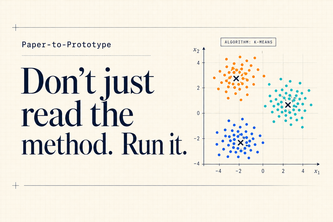
The description positions Paper-to-Prototype as a way to “turn research papers into interactive learning labs” and emphasizes that it doesn’t just summarize the paper—it lets users run the method. The tagline reads: “Don’t just read the method—run it.”
It claims:
- It surfaces core methods, learning goals, step-by-step procedures, and evidence from papers.
- It avoids unsafe AI-generated code by relying on a trusted registry of algorithmic implementations.
- It supports three specific labs (Attention, k-Means, A*), with one explicitly marked as hand-reviewed and verified.
Inference The positioning evolved from a hackathon idea into an educational tool focused on algorithmic transparency and hands-on learning. However, there is no indication that this has moved beyond the prototype stage or gained traction in real-world use cases.
Target Customer & ICP
The description does not clearly define target customers or personas. It implies that users are likely students, educators, or researchers who want to understand complex algorithms through interactive exploration.
It mentions:
- Educators may benefit from guided experiments and classroom activities.
- Learners can manipulate algorithmic behavior to gain deeper insight.
Inference The ICP seems to be individuals interested in machine learning, AI, or computational methods—particularly those seeking a hands-on approach to understanding academic content. However, no explicit segmentation or customer data is provided.
Business Model & Pricing Evidence
There is no evidence of any business model or pricing structure in the description. The project is described as a hackathon prototype with no mention of monetization strategies, subscriptions, or paid features.
Inference The tool appears to be free to use and publicly accessible without login or setup, suggesting either an open-source or non-commercial intent. No indication exists that it has moved toward a revenue-generating model.
Technical & Delivery Signals
The system is built using:
- Frontend: Next.js, React, TypeScript, Tailwind CSS
- Backend: OpenAI APIs (Codex, GPT-5.6), Playwright
- Algorithmic engines: Deterministic, seeded implementations in SVG format
- Trusted registry: Ensures only verified labs are used
Key technical features include:
- Structured data extraction via GPT-5.6
- Visualizations using SVG
- Reproducible experiments with no arbitrary code execution
- Safe fallback for unsupported papers
Inference The architecture shows a deliberate effort to balance AI assistance with controlled execution, which suggests a thoughtful approach to safety and accuracy. However, this is still a prototype, not a scalable or production-ready system.
Traction & Maturity Signals
There is no evidence of traction, adoption, or user engagement beyond the hackathon submission. The project is described as a public prototype with no login required, but there are no metrics on:
- Number of users
- Time spent interacting
- Feedback from educators or learners
- Retention rates or usage frequency
Inference This remains a proof-of-concept tool with no demonstrated market traction or user base. It lacks any evidence of maturity beyond the initial development phase.
Competitive Context
The description does not provide information on competitors or similar tools in the market. It does not reference existing platforms for algorithm visualization, educational AI tools, or research paper analysis systems.
Inference Without competitive data, it's unclear whether Paper-to-Prototype fills a gap or duplicates an existing solution. The novelty lies in combining structured extraction with trusted algorithmic execution, but no comparison to other tools is made.
Open Questions & Risks
Key risks and open questions based on the self-reported description:
- No traction or adoption: No evidence of real-world usage or impact.
- Prototype-only status: The tool is described as a hackathon prototype with no indication of further development or scaling.
- Limited scope: Only three labs are supported, and only one is hand-reviewed.
- Unverified claims: All assertions about functionality, safety, and design choices are self-reported without external validation.
- No commercial viability: No mention of monetization, pricing, or business model.
Inference The project lacks any signs of commercial readiness or market validation. It may be a promising idea but has not yet demonstrated its ability to attract users or generate value beyond the hackathon context.
Questions the description leaves open
- What is the actual user feedback from educators or students who have used this tool?
- Are there plans to expand beyond the three current labs, and how will new labs be vetted?
- How does the team plan to scale this beyond a hackathon prototype?
- Is there any intention to monetize or commercialize the platform?
- What are the long-term goals for algorithmic coverage and educational integration?
Overall Assessment
Not evidenced.
There is no evidence of revenue, customers, traction, or financial performance beyond the hackathon prototype. The project is described as a self-contained tool with no indication of commercial viability or strategic value.
The description states that it was built for the OpenAI 2026 hackathon and remains a proof-of-concept. No data supports claims about market demand, scalability, or competitive positioning.
Confidence level Low — this is a self-reported prototype with no external validation or evidence of adoption or impact.
User Stories BotA demo video on every pull request
Get a demo video on every new feature
GitHub App that watches your pull requests and records a narrated, captioned demo.
Save time on demo prep and make informed decisions faster with a video walkthrough of every new feature.
Source
Submitted to the OpenAI 2026 hackathon on Devpost. Project home on Devpost. Back to the full gallery on Devpost.
This competitive analysis was produced by top-founders.com (opens in a new tab)
Generated by a language model from this project's public Devpost page — its tagline, the author's own write-up and any built-with tags listed there — as captured in August 2026. Short quotations are the author's words. It is an opinion on the idea as a business, not on the people behind it, and it reflects the description as published then. If the project has moved on, request a correction below. The analysis is not independent research and contains no verified traction, revenue or customer data.
An independent guide by KFG International LLC — not affiliated with, endorsed by, or connected to Devpost or OpenAI.