

Archive position — measured, not model output
0 likes on Devpost
2,263 of the 7,850 archived projects have more likes, and 5,587 share exactly 0 — so this project's #7,749 place in the like-ranked listing is a tie-break inside that group, not a ranking.
Projects (log scale)
Likes on Devpost. ▲ marks this project's group.
Show the figures
| Likes | Projects | Share of archive |
|---|---|---|
| 0 | 5,587 | 71.2% |
| 1 | 1,758 | 22.4% |
| 2 | 284 | 3.6% |
| 3–4 | 132 | 1.7% |
| 5–9 | 75 | 1.0% |
| 10+ | 14 | 0.2% |
 User Stories BotA demo video on every pull request
Get a demo video on every new feature
GitHub App that watches your pull requests and records a narrated, captioned demo.
Save time on demo prep and make informed decisions faster with a video walkthrough of every new feature.
Executive Summary
What the company appears to be
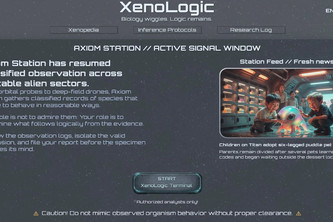
XenoLogic is a browser-based logic-training game built as a hackathon project. The author describes it as an educational tool where players act as xeno-analysts examining alien field reports and selecting logical conclusions from three options. It includes a deterministic logic engine, AI-assisted development (using Codex and GPT-5.6), and a focus on player reasoning without reliance on unpredictable models.
What changed
The project evolved from a static shell into a deployed, playable product with full session functionality across three difficulty levels. The author notes that the core logic engine, question generation, feedback system, and deployment were all implemented during Build Week using AI tools for assistance but under explicit human authority and verification.
Single most important open question
Is there any evidence of traction, revenue, or user adoption beyond the single developer's account? The description contains no data about users, monetization, or market interest — only claims about educational intent and product functionality.
What The Product Actually Is
The description states that XenoLogic is a browser-based logic-training game with three clearance levels: Observer, Analyst, and Containment. Each session presents ten alien field cases, each containing visible evidence, one focused question, and exactly three possible conclusions — one valid, two invalid for distinct logical reasons.
It includes:
- A deterministic Python logic engine
- Browser-local Research Log storing performance data without registration or server-side profiles
- Procedural persistent starfield and ambient soundtrack
- Xenopedia (research-terminal interface)
- AI-assisted development using Codex and GPT-5.6, but not in the runtime
The game is described as having:
- Immediate explanatory feedback for correct/incorrect answers
- Automated checks including blind-solving tools, counterfactual mutation checks, and cue audits
- Deployment via GitHub-to-Railway pipeline
Inference: The product appears to be an experimental educational tool focused on logic reasoning through narrative immersion. It is not a commercial SaaS offering or marketplace.
Positioning & Claim Evolution
The author positions XenoLogic as:
- A logic-training game that feels like an investigation rather than homework.
- An educational experience where players become xeno-analysts aboard Axiom Station.
- A tool that uses AI to help build a deterministic logic system, not to make decisions within the player-facing experience.
The tagline: “Decode alien field reports, test what follows from the evidence, and train your reasoning” reflects this positioning — emphasizing logic over entertainment or narrative depth.
Inference: The project is self-described as an educational prototype, not a scalable commercial product. There is no indication of branding, marketing, or positioning for mass adoption.
Target Customer & ICP
The description states that the game targets players who want to:
- Practice logic reasoning
- Engage in investigative thinking
- Experience a narrative-driven educational environment
It does not name specific customer segments beyond "players" or "learners". The author describes the experience as immersive but does not define target demographics, use cases, or verticals.
Inference: The ICP is likely students, logic enthusiasts, or educators interested in gamified learning tools. No evidence of targeting enterprise users or B2B customers.
Business Model & Pricing Evidence
There is no mention of pricing, monetization, or business model in the description. The game runs freely on Railway without requiring an account. It stores progress locally and does not collect personal data.
Inference: There is no evidenced business model. The project appears to be a prototype with no commercial intent stated.
Technical & Delivery Signals
The author reports:
- Built using FastAPI, Python, JavaScript, HTML5/CSS3
- AI tools used for architecture, implementation, testing, debugging, and semantic review (Codex, GPT-5.6)
- Deterministic logic engine with proof-checked answer generation
- Session APIs, scoring, restart, and browser-local progress tracking
- Deployment via GitHub-to-Railway pipeline
- Hundreds of automated checks for logic, session state, privacy boundaries, rendering, and deployment
Inference: The technical stack is functional and well-documented in the author’s own account. However, there is no evidence of production-scale infrastructure or performance metrics.
Traction & Maturity Signals
The description states:
- The project was built during a 2026 OpenAI hackathon (Build Week)
- It evolved from a static shell into a working product
- Players can complete and restart full sessions at all three clearance levels
- The game is deployed and functional without requiring an account
- Hundreds of automated checks protect the system
Absence of evidence: No data on user engagement, retention, or adoption. No mention of downloads, active users, or feedback from players.
Competitive Context
The description does not reference competitors or market positioning beyond its own educational goals. It is described as a logic-training game with an alien-themed narrative and AI-assisted development.
Inference: The project likely competes in the educational gamification space, possibly overlapping with logic puzzles, reasoning games, or AI-enhanced learning platforms. However, no known competitors are named.
Open Questions & Risks
- No commercial traction or revenue evidence: The product is described only as a prototype.
- Single developer team: No indication of scaling beyond one person.
- Unproven market demand: No evidence of interest from users, educators, or investors.
- AI dependency without clear value-add: While AI was used in development, it does not appear to be part of the core user experience.
- No monetization strategy: The product is free and deployed without account requirements.
Inference: The project lacks commercial viability indicators. It is a personal or experimental endeavor with no signs of market traction or business sustainability.
Questions the description leaves open
- What is the intended user base for XenoLogic, and how do you plan to reach them?
- Are there any plans to monetize the product or expand its functionality beyond the current prototype?
- Has the logic engine been tested with real users, and what feedback has been received?
- How would you scale this product if it were to gain traction?
- What are your long-term goals for XenoLogic — is it intended as a standalone tool or part of a larger platform?
Overall Assessment
Not evidenced: There is no evidence of revenue, customers, or commercial traction. The project is described as a hackathon prototype with no indication of market readiness or scalability.
Confidence level: Low — based entirely on self-reported claims and author’s own account.
Assessment: XenoLogic is an experimental educational tool built by one developer using AI for assistance. It shows technical competence but lacks any evidence of commercial viability, user adoption, or business model. It is not ready for investment or partnership consideration at this stage.
User Stories BotA demo video on every pull request
Get a demo video on every new feature
GitHub App that watches your pull requests and records a narrated, captioned demo.
Save time on demo prep and make informed decisions faster with a video walkthrough of every new feature.
Source
Submitted to the OpenAI 2026 hackathon on Devpost. Project home on Devpost. Back to the full gallery on Devpost.
This competitive analysis was produced by top-founders.com (opens in a new tab)
Generated by a language model from this project's public Devpost page — its tagline, the author's own write-up and any built-with tags listed there — as captured in August 2026. Short quotations are the author's words. It is an opinion on the idea as a business, not on the people behind it, and it reflects the description as published then. If the project has moved on, request a correction below. The analysis is not independent research and contains no verified traction, revenue or customer data.
An independent guide by KFG International LLC — not affiliated with, endorsed by, or connected to Devpost or OpenAI.