

Archive position — measured, not model output
0 likes on Devpost
2,263 of the 7,850 archived projects have more likes, and 5,587 share exactly 0 — so this project's #7,747 place in the like-ranked listing is a tie-break inside that group, not a ranking.
Projects (log scale)
Likes on Devpost. ▲ marks this project's group.
Show the figures
| Likes | Projects | Share of archive |
|---|---|---|
| 0 | 5,587 | 71.2% |
| 1 | 1,758 | 22.4% |
| 2 | 284 | 3.6% |
| 3–4 | 132 | 1.7% |
| 5–9 | 75 | 1.0% |
| 10+ | 14 | 0.2% |
 User Stories BotA demo video on every pull request
Get a demo video on every new feature
GitHub App that watches your pull requests and records a narrated, captioned demo.
Save time on demo prep and make informed decisions faster with a video walkthrough of every new feature.
Executive Summary
Company: Xeer AI
Self-reported basis: The description is entirely self-reported and unverified, based on a Devpost submission for the OpenAI 2026 hackathon. No third-party evidence, revenue, customer data or traction is available.
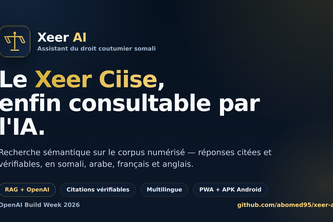
What it appears to be: A proof-of-concept SaaS platform using RAG (retrieval-augmented generation) to make the Xeer Ciise — a customary Somali legal code — accessible via an AI assistant with citation and multilingual support.
What changed: The project was submitted as a hackathon entry, suggesting it is in early development or prototype stage.
Single most important open question: Is there any evidence of user adoption, revenue, or traction beyond the author's own account?
What The Product Actually Is
The description states that Xeer AI is a SaaS platform built around an AI assistant, designed to make the Xeer Ciise (customary Somali legal code) searchable and accessible. It includes:
- Semantic search (RAG) on a digitized corpus of the Xeer Ciise
- Structured responses with verifiable citations
- Multilingual support in Somali, Arabic, French, English
- PWA installable on web and Android
- User accounts, subscriptions, payments, and admin dashboard
The system uses OCR (Tesseract + PyMuPDF), embeddings (Sentence Transformers), ChromaDB for indexing, FastAPI backend, and OpenAI API for response generation.
Inference: The platform appears to be a proof-of-concept prototype, not yet a production-grade SaaS offering. It is built as a full-stack solution with frontend, backend, and data pipeline components.
Positioning & Claim Evolution
The description states that Xeer AI aims to:
- Preserve the Xeer Ciise — a customary legal code of the Issa clan — which is orally transmitted and rarely digitized.
- Make it accessible in multiple languages.
- Provide verifiable answers, avoiding hallucinations.
Claim: The platform is positioned as a tool for preserving and democratizing access to a traditional legal system, with an emphasis on citable AI responses and multilingual support.
Inference: This is a niche, culturally specific use case, likely targeting scholars, legal practitioners, or diaspora communities. The positioning is not commercial in nature but rather preservation-oriented.
Target Customer & ICP
The description states:
- The target audience includes old men, students, lawyers, and diaspora members who want to consult the Xeer Ciise.
- It is designed for users who need simple access to a legal code that is otherwise hard to find or understand.
Inference: The ICP (Ideal Customer Profile) appears to be:
- Scholars or researchers of Somali customary law
- Legal practitioners in the Horn of Africa
- Members of the Somali diaspora with interest in cultural preservation
There is no evidence of a defined customer segment beyond these general groups.
Business Model & Pricing Evidence
The description states that Xeer AI includes:
- A free tier and a premium tier at $10/month
- Organizational subscriptions
- Payment methods including mobile money (Waafi), CAC Bank, Visa/MasterCard
It also mentions:
- Admin dashboard with KPIs, MRR, revenue tracking
- User management features
Inference: The business model is SaaS with freemium and subscription tiers, with a focus on monetizing access to the legal corpus. However, there is no evidence of actual monetization or customer base.
Technical & Delivery Signals
The description states that the platform was built using:
- OCR pipeline: PyMuPDF + Tesseract
- RAG engine: Sentence Transformers, ChromaDB, OpenAI API
- Backend: FastAPI with SQLite
- Frontend: Vanilla JavaScript PWA with service worker and APK packaging
- Security features: PBKDF2 for auth, signed tokens, quotas
Inference: The technical stack is modest but functional, suggesting a hackathon-level prototype. It includes:
- End-to-end pipeline from PDF to AI assistant
- Multi-language support (including Somali)
- PWA and mobile app capabilities
Traction & Maturity Signals
The description states:
- A demo mode that runs the full platform without keys or index
- The project was submitted to a hackathon
- No mention of user adoption, revenue, or customer data
Inference: There is no evidence of traction, customers, or revenue. The product appears to be in an early prototype stage.
Competitive Context
The description does not mention any direct competitors. It is a unique niche solution for a specific legal tradition and language. However, there are no references to:
- Similar RAG-based tools
- Legal AI platforms or custom law repositories
- Existing solutions for customary law digitization
Inference: The competitive landscape is unexplored, and the project appears to be first-of-its-kind in this domain.
Open Questions & Risks
- No traction or revenue evidence: The product is described as a hackathon submission with no commercial adoption.
- Cultural specificity: The focus on Xeer Ciise limits scalability and generalizability.
- Technical limitations: OCR on old documents may be unreliable; the system is not production-ready.
- Monetization risk: No evidence of paid users or revenue streams.
- Sustainability: Only one team member, suggesting limited capacity for scaling.
Questions the description leaves open
- What is the current status of the Xeer Ciise corpus? Is it complete and accurate?
- Have you conducted any user testing with legal practitioners or scholars?
- How do you plan to scale beyond the Xeer Ciise into other customary traditions?
- Are there any partnerships with institutions or universities in Djibouti/Somalia?
- What is your roadmap for monetization and customer acquisition?
- How do you plan to maintain the OCR quality of old documents?
- What are the legal and ethical considerations around digitizing and making accessible traditional customary law?
Overall Assessment
Not evidenced: There is no evidence of revenue, customers, or traction beyond the author’s own description.
Inference: This project appears to be a proof-of-concept prototype, likely built in a hackathon setting. It has potential for cultural preservation and niche legal AI use, but lacks commercial viability or scalability indicators.
Confidence level: Low — based on self-reported, unverified evidence only.
User Stories BotA demo video on every pull request
Get a demo video on every new feature
GitHub App that watches your pull requests and records a narrated, captioned demo.
Save time on demo prep and make informed decisions faster with a video walkthrough of every new feature.
Source
Submitted to the OpenAI 2026 hackathon on Devpost. Project home on Devpost. Back to the full gallery on Devpost.
This competitive analysis was produced by top-founders.com (opens in a new tab)
Generated by a language model from this project's public Devpost page — its tagline, the author's own write-up and any built-with tags listed there — as captured in August 2026. Short quotations are the author's words. It is an opinion on the idea as a business, not on the people behind it, and it reflects the description as published then. If the project has moved on, request a correction below. The analysis is not independent research and contains no verified traction, revenue or customer data.
An independent guide by KFG International LLC — not affiliated with, endorsed by, or connected to Devpost or OpenAI.