

Archive position — measured, not model output
1 like on Devpost
505 of the 7,850 archived projects have more likes, and 1,758 share exactly 1 — so this project's #2,240 place in the like-ranked listing is a tie-break inside that group, not a ranking.
Projects (log scale)
Likes on Devpost. ▲ marks this project's group.
Show the figures
| Likes | Projects | Share of archive |
|---|---|---|
| 0 | 5,587 | 71.2% |
| 1 | 1,758 | 22.4% |
| 2 | 284 | 3.6% |
| 3–4 | 132 | 1.7% |
| 5–9 | 75 | 1.0% |
| 10+ | 14 | 0.2% |
 User Stories BotA demo video on every pull request
Get a demo video on every new feature
GitHub App that watches your pull requests and records a narrated, captioned demo.
Save time on demo prep and make informed decisions faster with a video walkthrough of every new feature.
Executive Summary
What the company appears to be
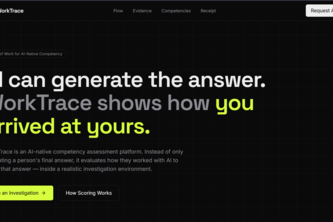
WorkTrace is a self-reported platform that evaluates learners’ investigation processes in AI-assisted coding environments, rather than just final outputs. It records learner actions as evidence for competency assessment and generates “Competency Receipts” based on those actions.
What changed
The author states that AI has changed how people create work, making it easy to generate polished code but breaking traditional testing methods. WorkTrace aims to shift evaluation from final answers to the process behind them.
Single most important open question
Is there any evidence of traction, revenue, or adoption beyond the single-person project submission? The description lacks any data on users, customers, or usage metrics.
Note
This analysis is based entirely on the self-reported, unverified account provided by the author. No third-party verification or historical data exists for this project.
What The Product Actually Is
The description states that WorkTrace evaluates the investigation process in AI-assisted coding environments, not just final answers. It provides a structured workflow where learners:
- Start an investigation mission.
- Inspect codebases.
- Ask questions to an AI teammate.
- Accept, reject, or verify AI suggestions.
- Collect evidence.
- Submit a solution.
- Explain reasoning.
- Receive a Competency Receipt.
The system records learner actions as evidence and uses these for competency assessment. AI chat and suggestions are treated as context, not evidence.
Claim
WorkTrace turns AI-assisted investigation into an evidence-backed Competency Receipt.
Evidence The description explicitly states this.
Inference The product is a tool for assessing learning or hiring in technical environments using AI-native workflows.
Label
Inferred from the stated workflow and use case.
Positioning & Claim Evolution
The author claims that AI has changed how people create work, making it easy to generate polished final code, which breaks traditional testing. WorkTrace is positioned as a solution to this problem by evaluating the investigation process instead of just outputs.
Claim
AI makes it easy to generate polished final code, which breaks traditional testing.
Evidence Stated in the inspiration section.
Claim
WorkTrace changes how we evaluate work by focusing on the investigation process.
Evidence Stated in the tagline and description.
Inference The positioning is rooted in a shift from output-based to process-based assessment, especially in AI-assisted environments.
Label
Inferred from claim evolution.
Target Customer & ICP
The description does not name specific customers or personas. However, it implies that WorkTrace targets:
- Learners in technical education.
- Hiring managers evaluating candidates.
- Teachers assessing student work.
It also mentions future features like role-specific missions and hiring workflows, suggesting a potential expansion into professional recruitment or training contexts.
Claim
The product is for learners, teachers, and hiring managers.
Evidence Not directly stated; inferred from use case and feature roadmap.
Inference The ICP likely includes educators, technical recruiters, and students in coding education.
Label
Inferred.
Business Model & Pricing Evidence
No information is provided about pricing, monetization, or business model. The description does not mention any revenue streams, subscriptions, or customer acquisition strategies.
Claim
No evidence of pricing or business model.
Evidence Not evidenced.
Technical & Delivery Signals
The project was built using:
- Frontend: React, Vite, Redux Toolkit, Tailwind CSS, Framer Motion, Monaco Editor.
- Backend: Node.js, Express, REST APIs, SQLite, better-sqlite3.
- AI tools used in development: Codex, GPT-5.6, Google Gemini API.
The author reports using these technologies during the OpenAI Build Week hackathon and notes that they were used to build a full-stack flow, connect Redux state to backend APIs, debug persistence, and write tests.
Claim
The system uses React, Node.js, SQLite, and AI APIs for development.
Evidence Stated in the “How I built it” section.
Inference The tech stack suggests a full-stack, lightweight, developer-focused solution with AI integration.
Label
Inferred.
Traction & Maturity Signals
There is no evidence of traction, adoption, or user data. The project was submitted as a hackathon entry by one person (Yusra Tariq) and has no mention of users, customers, or revenue.
Claim
No traction or maturity signals are evident.
Evidence Not evidenced.
Competitive Context
The description does not reference any competitors or existing solutions in the space of AI-assisted learning or competency evaluation. It also does not describe how WorkTrace differs from other tools in the market.
Claim
No competitive context provided.
Evidence Not evidenced.
Open Questions & Risks
- The project is a single-person hackathon submission with no evidence of traction, customers, or revenue.
- There is no mention of scalability, security, or long-term viability.
- The system’s evaluation logic relies on backend validation of evaluator output — this could be fragile without independent verification.
- No data on user behavior, usage patterns, or feedback exists.
Inference The lack of any real-world deployment or testing makes the product unproven in practice.
Label
Inferred.
Questions the description leaves open
- Has WorkTrace been tested with actual learners or hiring managers?
- What is the current validation process for evaluator outputs?
- Are there any plans to collect user feedback or iterate on the product?
- How would you scale this beyond a single-person prototype?
- What are your thoughts on integrating with existing LMS or HR platforms?
Overall Assessment
Not evidenced.
Claim
No evidence of investment or partnership readiness.
Evidence Not evidenced.
Inference Given the project is a hackathon submission, there is no indication of commercial viability or traction to support investment or partnership interest.
Label
Inferred.
User Stories BotA demo video on every pull request
Get a demo video on every new feature
GitHub App that watches your pull requests and records a narrated, captioned demo.
Save time on demo prep and make informed decisions faster with a video walkthrough of every new feature.
Source
Submitted to the OpenAI 2026 hackathon on Devpost. Project home on Devpost. Back to the full gallery on Devpost.
This competitive analysis was produced by top-founders.com (opens in a new tab)
Generated by a language model from this project's public Devpost page — its tagline, the author's own write-up and any built-with tags listed there — as captured in August 2026. Short quotations are the author's words. It is an opinion on the idea as a business, not on the people behind it, and it reflects the description as published then. If the project has moved on, request a correction below. The analysis is not independent research and contains no verified traction, revenue or customer data.
An independent guide by KFG International LLC — not affiliated with, endorsed by, or connected to Devpost or OpenAI.