

Archive position — measured, not model output
2 likes on Devpost
221 of the 7,850 archived projects have more likes, and 284 share exactly 2 — so this project's #497 place in the like-ranked listing is a tie-break inside that group, not a ranking.
Projects (log scale)
Likes on Devpost. ▲ marks this project's group.
Show the figures
| Likes | Projects | Share of archive |
|---|---|---|
| 0 | 5,587 | 71.2% |
| 1 | 1,758 | 22.4% |
| 2 | 284 | 3.6% |
| 3–4 | 132 | 1.7% |
| 5–9 | 75 | 1.0% |
| 10+ | 14 | 0.2% |
 User Stories BotA demo video on every pull request
Get a demo video on every new feature
GitHub App that watches your pull requests and records a narrated, captioned demo.
Save time on demo prep and make informed decisions faster with a video walkthrough of every new feature.
Executive Summary
What the company appears to be
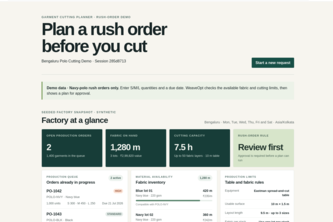
WeaveOpt-Making Solver Based Optimization Accessible to SMEs is a self-reported project that aims to make solver-based optimization accessible to small and medium enterprises (SMEs) in the garment industry. It uses natural language processing (NLP), LLMs, and constraint solvers to convert planner requests into structured problems and generate optimized cutting plans for garments.
What changed
The author reports a shift from a purely flexible LLM-based approach to one that incorporates deterministic validation layers, balancing ease-of-use with auditability. The project evolved from a hackathon MVP to a more structured system involving formulation and critic agents, with an emphasis on minimizing fabric cost under constraints.
Single most important open question
Is there evidence of real-world traction or integration with actual garment factories beyond the initial industry conversation? The description states no revenue, customers, or adoption data — only self-reported inspiration and MVP functionality.
What The Product Actually Is
The description states that WeaveOpt is a system designed to optimize garment-cutting plans for SMEs. It uses:
- Natural language input interpreted by an LLM-based formulation agent.
- A symbolic constraint language to express planning rules.
- A solver (possibly cp-sat or or-tools) to compute optimal layouts within 5 seconds.
- A critic agent that validates the constraints against existing factory data.
- An audit trail showing whether constraints were satisfied.
The system is described as being built with:
- Docker
- FastPI
- Next.js
- OpenRouter
- OR-Tools (or-tools)
- CP-SAT solver
It currently supports fixed objectives like minimizing cost and handles one order at a time, including constraints on markers, fabrics, and piles. The output includes how many lays are needed, what pieces go into each lay, and pile counts.
Inference The product is not yet a full-fledged SaaS offering but rather an MVP prototype built for a hackathon with limited scope and no production deployment or integration details.
Positioning & Claim Evolution
The author claims that the project addresses two major problems faced by garment factory owners:
- Manual resource reallocation and throughput calculation.
- Layout optimization to comply with large corporate standards, which is currently done manually.
These are positioned as NP-hard optimization problems traditionally solved using solvers and heuristics — but inaccessible to SMEs due to lack of tools or expertise.
The evolution of the idea shows a move from:
- A more open-ended LLM-based coding approach
- To a hybrid model with deterministic validation layers
This shift reflects an awareness of risk in purely generative AI systems, especially in high-stakes environments like manufacturing.
Inference The positioning is centered on democratizing access to optimization tools for SMEs. However, the claim lacks evidence of market validation or product-market fit beyond a single hackathon submission.
Target Customer & ICP
The target customer is described as:
- Garment factory owners (SMEs)
- Who contract with large corporations requiring compliance with specific layout standards
- Who currently perform manual planning and optimization tasks
The ICP appears to be defined by:
- Need for efficient resource allocation in garment production
- Requirement to reduce waste through better fabric usage
- Desire to comply with external corporate standards without losing flexibility
Inference There is no explicit segmentation beyond "garment factory owners." No indication of whether the solution targets other industries or verticals, though the author mentions a “moonshot” to generalize across domains.
Business Model & Pricing Evidence
Not evidenced. The description does not mention any pricing strategy, monetization model, or customer acquisition plans.
Inference It is unclear if this will be sold as SaaS, embedded in ERP systems, or offered via licensing or consulting. No commercial structure is described.
Technical & Delivery Signals
The system uses:
- LLMs (Codex, OpenRouter)
- Constraint solvers (cp-sat, or-tools)
- Symbolic constraint language
- Docker for containerization
- FastPI and Next.js for backend/frontend
It includes:
- A dual-agent architecture: formulation agent + critic agent
- Deterministic validation layer
- Audit trail functionality
- Bottom-left 2D strip packing algorithm (for MVP purposes)
Inference The technical stack suggests a hybrid AI + optimization approach. The use of symbolic languages and deterministic checks implies an attempt to balance flexibility with reliability — a key concern in manufacturing environments.
Traction & Maturity Signals
Not evidenced. There is no mention of:
- Revenue
- Customers
- Deployments
- Usage metrics
- Product iterations beyond MVP
The project was submitted as a hackathon entry and is described as an MVP.
Inference No traction or maturity indicators are present. The system has not moved past the prototype stage, and there is no evidence of real-world adoption or feedback loops.
Competitive Context
Not evidenced. No information is provided about:
- Competitors
- Existing solutions in the market
- Market size or competitive landscape
Inference The author does not reference any existing tools or platforms that solve similar problems, nor do they describe how their approach differs from current industry offerings.
Open Questions & Risks
- No real-world validation: The only customer interaction described is a one-time conversation with a factory owner — no actual implementation or feedback.
- MVP-only scope: The system works only on fixed inputs and constraints; it's unclear how it scales to complex, dynamic environments.
- Unproven business model: No evidence of monetization strategy or customer pipeline.
- Dependency on LLM accuracy: While a critic agent exists, the reliance on natural language interpretation introduces risk in constraint formulation.
- Limited domain applicability: The system is tailored for garment cutting and may not generalize easily without significant rework.
Inference There are no signs of product-market fit or scalable traction. The project remains largely conceptual and untested in production settings.
Questions the description leaves open
- What specific feedback did you receive from the factory owner after your initial conversation?
- How many constraints can be handled simultaneously in the current MVP? Is there a limit to complexity?
- Have you tested the system with real-world data or only simulated inputs?
- Are there any known limitations in how well the LLM translates natural language into structured constraints?
- What are your plans for integrating with ERP systems or CAD software?
- How do you intend to validate that the solver outputs are actually feasible in a real factory setting?
- Is there a roadmap for expanding beyond garment cutting into other industries?
Overall Assessment
Not evidenced.
The description contains no information about:
- Funding status
- Valuation
- Founders' backgrounds
- Strategic partners or investors
- Go-to-market strategy
Inference This is a very early-stage idea, likely at the prototype or proof-of-concept stage. It lacks commercial viability indicators such as revenue, customers, or traction. Any investment or partnership interest would require further due diligence into market validation, technical scalability, and business model development.
User Stories BotA demo video on every pull request
Get a demo video on every new feature
GitHub App that watches your pull requests and records a narrated, captioned demo.
Save time on demo prep and make informed decisions faster with a video walkthrough of every new feature.
Source
Submitted to the OpenAI 2026 hackathon on Devpost. Project home on Devpost. Back to the full gallery on Devpost.
This competitive analysis was produced by top-founders.com (opens in a new tab)
Generated by a language model from this project's public Devpost page — its tagline, the author's own write-up and any built-with tags listed there — as captured in August 2026. Short quotations are the author's words. It is an opinion on the idea as a business, not on the people behind it, and it reflects the description as published then. If the project has moved on, request a correction below. The analysis is not independent research and contains no verified traction, revenue or customer data.
An independent guide by KFG International LLC — not affiliated with, endorsed by, or connected to Devpost or OpenAI.